
Mobile Home Foreclosures for Investors
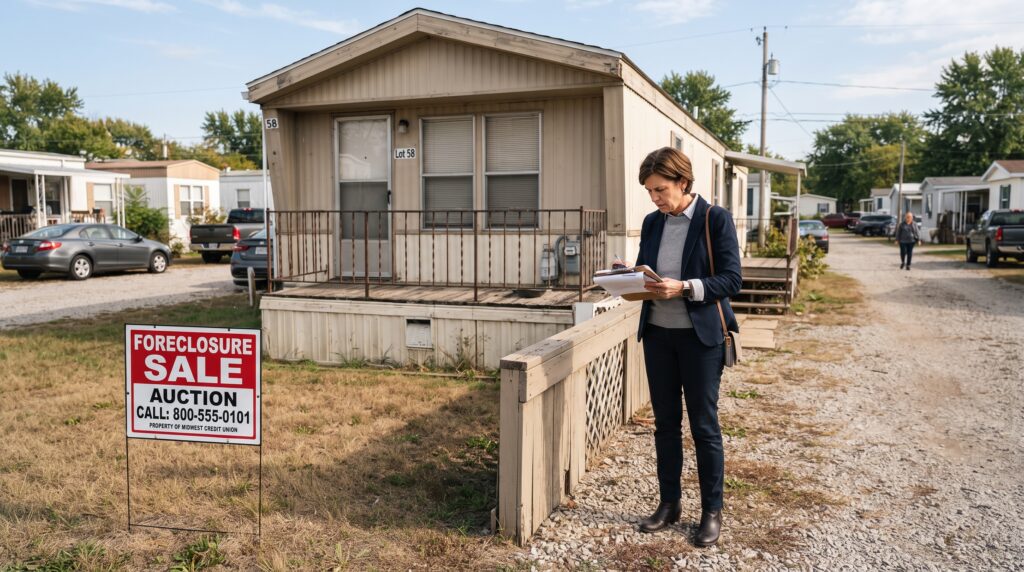
A foreclosed mobile or manufactured home may offer a lower acquisition price than a conventional house, but the discount can conceal a more complicated ownership structure.
You may be buying a manufactured home together with the land beneath it. You may be buying only the home while leasing a space in a manufactured-home community. In other cases, the lender may be repossessing a titled structure treated more like personal property than real estate.
These distinctions determine whether you receive a deed, a certificate of title, or both. They also affect financing, taxes, insurance, park approval, relocation rights, and the eventual buyer pool.
Successful mobile home foreclosure investing begins by establishing exactly what property is being sold.
Learn the Strategies Behind Smarter Foreclosure Investing
Get practical foreclosure investing content delivered twice a week, including deal analysis tips, strategy breakdowns, useful tools, and new resources from Foreclosure Flips. Sign up to keep learning and spotting better opportunities.
Mobile, Manufactured, and Modular Are Not the Same
The terms are often used casually, but they can describe different types of housing.
A mobile home generally refers to a factory-built home produced before June 15, 1976. A manufactured home built after that date must comply with federal construction and safety standards and normally carries HUD certification labels. HUD’s manufactured-home resources explain that homes built in the United States after June 15, 1976 must be certified by the manufacturer as complying with the federal standards.
A modular home is also factory-built, but it is constructed to applicable state and local building codes rather than the federal manufactured-housing code. Once assembled on its site, a modular home is usually financed and transferred more like a site-built property.
Before bidding, confirm the year, manufacturer, model, serial number, HUD label numbers, and legal classification. Do not rely on the listing agent, auction headline, or assessor’s informal description.
Determine Which of Three Assets You Are Buying
The fastest way to route the opportunity is to place it into one of three ownership structures.
| Ownership structure | What may transfer | Main investor concern |
|---|---|---|
| Home and land together | Deed to the land and title interest in the home | Whether the home has been legally converted to real property |
| Home on leased land | Title to the home plus rights under a lot lease | Park approval, lot rent, lease terms, and resale restrictions |
| Home only for removal | Title to the structure without continuing site rights | Relocation feasibility, transport expense, permits, and destination site |
A property advertised as a foreclosure may involve a judicial or nonjudicial real estate sale when land is included. A home classified as personal property may instead be subject to repossession or another process governed partly by vehicle-title and secured-transaction law.
You need to know which process applies before using a conventional foreclosure bidding model.
When the Home and Land Are Sold Together
A manufactured home attached to investor-owned land can provide the broadest range of exits. You may be able to renovate and resell it, operate it as a rental, or refinance it after stabilization.
The title still requires close attention.
States use different procedures for converting a manufactured home from personal property to real property. The certificate of title may need to be surrendered or canceled, and the home may need to be permanently affixed to an approved foundation. The deed and title records should identify the same owner and site.
Freddie Mac’s current manufactured-home eligibility standards require a qualifying home to be classified as real property under state law and permanently attached to a permanent foundation. That does not mean every investor or property qualifies for a Freddie Mac loan. It does show why title conversion, foundation status, and land ownership affect the financing available to your future buyer.
Look for a Split-Title Problem
The land may have been foreclosed while the manufactured home remains titled to a different person. The reverse can also occur: the home may be repossessed while another party owns the land.
Search both the county land records and the state agency responsible for manufactured-home titles. Match the owner names, serial numbers, legal description, and lien information.
If the home was never properly converted to real property, a title company may require additional documents before it will insure the full property. Missing titles, unreleased personal-property liens, deceased owners, incorrect serial numbers, and prior relocations can delay resale long after the physical renovation is complete.
Homes in Manufactured-Home Communities Require a Different Model
When the home sits on rented land, you are buying a depreciating or appreciating structure while another party controls the site.
The community owner may require you to apply before taking possession, satisfy financial or experience standards, sign a new lot lease, or agree to renovate the exterior within a stated period. Your future tenant or retail buyer may also need park approval.
Request the complete community rules and lease before bidding. Confirm current lot rent, utilities, annual increases, late charges, transfer fees, age restrictions, pet rules, rental limitations, and requirements for resale.
A low purchase price can be offset by high monthly site rent. If the home needs six months of renovation and marketing, you may owe lot rent throughout that period even though the unit produces no income.
Verify That Investor Ownership Is Permitted
Some communities allow owner occupancy but restrict rentals, subleasing, corporate ownership, or investor purchases. Others permit rentals only after a waiting period or approval process.
Do not assume you can place a tenant because the prior occupant rented the home. The earlier arrangement may have been grandfathered, unauthorized, or governed by a different lease.
Your resale also depends on the community. A renovated home may be difficult to sell if lot rent is high, the park has poor infrastructure, buyers face strict approval standards, or the operator has a history of large rent increases.
A Home Sold for Removal Can Become a Logistics Deal
Occasionally, an investor can purchase a repossessed or foreclosed manufactured home without acquiring the right to keep it at its current location.
This is not simply a cheap house. It is a transportation, permitting, and site-development project.
Before bidding, confirm whether the structure can be legally moved, whether the current site provides adequate access for transport equipment, and whether another jurisdiction will accept a home of its age and condition. Some localities restrict the placement of older units or require specific wind, foundation, appearance, and installation standards.
Your cost may include disconnection, structural bracing, permits, escort vehicles, transport, crane work, site preparation, foundation construction, utility installation, skirting, stairs, decks, inspections, and repairs caused by the move.
A home that costs $12,000 at auction can require several times that amount before it is installed and usable elsewhere.
Inspect the Structure Differently From a Site-Built House
Manufactured homes have systems and components that require specific inspection attention.
Start with the frame, chassis, piers, footings, anchors, tie-downs, marriage line, skirting, drainage, and signs of settlement. Floors can soften around plumbing fixtures, doors, exterior walls, and water heaters. Roof leaks may travel through ceiling assemblies before becoming visible.
Check whether additions such as porches, decks, carports, room extensions, and roof-over systems were permitted and supported independently. An improperly attached addition can place loads on the manufactured home that it was not designed to carry.
Plumbing may include older or nonstandard materials. Electrical panels, service capacity, aluminum wiring, HVAC ductwork beneath the floor, and inaccessible crawl areas also deserve close inspection.
Replacement materials can be less standardized than those used in conventional houses. Doors, windows, siding panels, bathtubs, cabinets, and fixtures may require manufactured-home-specific sizing or adaptation.
Financing Shapes the Resale Market
Financing is one of the largest differences between manufactured-home and conventional-property investing.
When the borrower owns the land and the home is permanently affixed and legally classified as real property, mortgage financing may be available subject to property, borrower, appraisal, and occupancy requirements.
When the home is titled as personal property or located on leased land, buyers may need a chattel loan or specialized manufactured-home financing. CFPB research on manufactured-housing finance notes that ownership of the underlying land plays a central role in whether a home is classified as personal or real property, which can substantially affect financing cost and security of tenure.
Your future buyer pool may therefore be smaller than the pool for a site-built home at the same price. Investor loans can be narrower still, particularly for older single-wide homes, homes that have been moved, or units on leased land.
Ask lenders active in the local manufactured-home market how they would treat the property after renovation. Do this before setting the resale value and ordering an appraisal.
Value the Land and Home Separately
Comparable sales can be misleading when they mix different ownership structures.
A double-wide sold with two acres is not comparable to a similar home in a park with $850 monthly lot rent. A home converted to real property on a permanent foundation is not directly comparable to a titled unit that must be moved.
Estimate the land value independently when land is included. Then analyze the contribution of the home based on its age, size, width, condition, foundation, title status, financing eligibility, and local demand.
For park homes, compare recent sales within the same community or communities with similar rent, amenities, approval standards, and location. The cost of site occupancy influences value as directly as the condition of the unit.
Avoid assuming that renovation spending will be recovered dollar for dollar. The surrounding land arrangement and financing options may place a ceiling on resale value.
Include Park, Title, and Utility Costs in the Bid
Your maximum price should account for expenses that do not appear in a conventional rehab estimate.
For a home-and-land acquisition, include title conversion, foundation certification, survey work, septic or well repairs, utility connections, and land-related liens.
For a community home, include unpaid lot rent, transfer fees, required exterior work, community deposits, utilities, insurance, and carrying rent during renovation and resale.
For a removal project, include the complete relocation and installation cost—not merely the purchase and transport price.
You should also verify whether taxes are assessed as real estate, personal property, or both. Delinquent tax treatment may differ depending on the classification.
Match the Deal to a Buyer Who Can Actually Close
A manufactured-home foreclosure may work as a rental when you control the land, rental demand is stable, and the home can be maintained economically. A park home may work when lot rent is reasonable, investor ownership is permitted, and the community appeals to financed or cash buyers.
The deal becomes weaker when the title is missing, the land and home have different owners, the unit must be moved, or resale depends on a financing program for which the property is not eligible.
Build your exit around a real buyer category:
- An owner-occupant using real-property mortgage financing
- A buyer using specialized manufactured-home financing
- A cash buyer purchasing a park home
- A landlord acquiring the home and land together
- An adjoining owner or community operator purchasing the unit
One concise buyer test is useful because financing and site control determine whether your projected resale market exists.
The Dirt, Title, and Home Must Tell the Same Story
Profitable mobile home foreclosure investing depends on aligning three separate assets: the structure, the legal title, and the land arrangement.
Verify whether the sale includes the land, whether the home is personal or real property, and whether every required title and lien can be cleared. Then evaluate the foundation, park lease, lot rent, utilities, condition, financing eligibility, and realistic resale buyer.
A low-priced manufactured home can be a strong rental or resale opportunity when the title is clean, the site is secure, and financing or cash demand supports the exit.
When the home, land, and title do not align, the apparent discount may only be compensation for a problem you cannot economically solve.
Wondering Where the Savviest Investors Find Their Best Deals?
Access the largest database of foreclosure properties nationwide and discover below-market deals before other investors. Start your search today!