
How to Find City-Owned Foreclosure Property Deals That Work
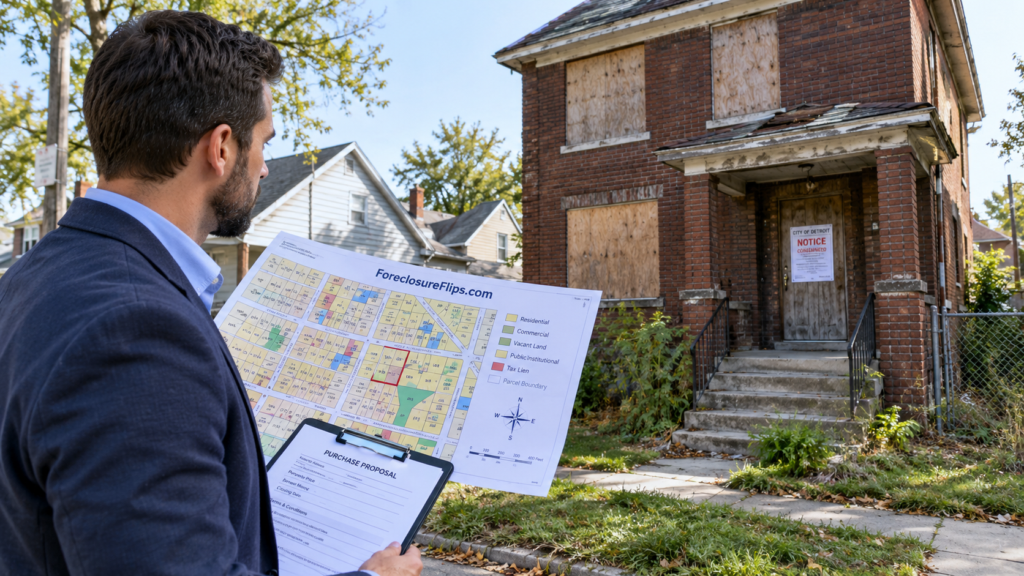
City-owned foreclosure property deals place vacant houses and lots in front of investors at prices that look hard to ignore. The price, however, sits beside a second transaction: an application process shaped by public goals, property condition, funding evidence, and a redevelopment timetable.
Some addresses are held by a city, while others sit with a redevelopment authority or land bank. Each route carries its own sale terms. This guide maps the research, application, and underwriting work behind a public-property acquisition that fits an investor’s exit plan.
Public sales can carry conditions that rarely appear in ordinary listings, so the research begins well before an application window closes.
Stay Ahead of the Next Deal
Markets move quickly, and good foreclosure opportunities often require fast analysis. Subscribe to our twice-weekly newsletter for investor-focused tips, tools, and market insights designed to help you make better decisions.
How city-owned sales differ from sheriff sales and REOs
A city-owned property is held by a municipal government, redevelopment authority, or affiliated land bank. Public ownership may follow tax foreclosure, abandonment, code enforcement, a transfer from another public body, or a direct government acquisition. The route into public ownership affects the sale process, the condition of the asset, and the commitments attached to closing.
Lender-owned REO listings and sheriff sales are driven largely by creditor recovery and auction mechanics. Public inventory often operates under a broader set of objectives: returning vacant property to use, supporting a neighborhood plan, expanding housing supply, or reducing the cost of holding blighted buildings. Price is part of the evaluation, but a lower offer with a well-supported redevelopment plan may outperform a higher offer that lacks a realistic scope or source of funds.
That distinction is reflected in land-bank practice. The Center for Community Progress describes land banks as public entities that commonly acquire tax-foreclosed properties and may select a responsible buyer based on the community outcome rather than the highest bid. Its guide to buying from a land bank also notes that many assets are older, sold as-is, and in line for substantial repair work. Price therefore represents only one part of the investment case.
Where to find city-owned properties for sale
The search usually begins with the public body that owns or manages the inventory. Cities, redevelopment authorities, and land banks may post properties on interactive maps, inventory portals, fixed-price lists, request-for-proposal pages, or notices for public bidding.
A general search can help surface potential addresses as well; city-owned property listings offer one way to build an initial watchlist in a defined market.
The listing page alone rarely tells the whole story. Baltimore’s developer opportunities page shows several possible tracks for public inventory: fixed-price sales, expressions of interest, open bids, and formal RFP or RFQ opportunities. The available route determines the materials, timing, and evaluation criteria attached to an offer.
A simple property file turns scattered information into an investable lead. Useful fields include the street address, parcel number, legal description, current public owner, program name, asking price or bid method, application deadline, contact, and stated use restrictions. County assessor, recorder, treasurer, zoning, permit, code-enforcement, and tax records add the detail that a municipal map cannot provide.
A consistent review rhythm also helps. Weekly checks of official inventory, saved copies of listing terms, and calendar reminders for public meetings and application deadlines give each address a documented history. An address that disappears from inventory may have moved into a proposal process, changed status, or returned to the market after a prior applicant failed to perform.
Program calendars may show activity before an individual address becomes available. Council agendas, redevelopment-board notices, public bid calendars, and neighborhood-planning updates often indicate where inventory or policy priorities are changing. Those signals complement official listings and help explain why one block is receiving attention while another has no near-term sale activity.
Match the property with the local exit strategy
Public ownership does not change the core investment question: what will the finished asset be worth, and who will buy or rent it? A city-owned house in a weak resale pocket can remain a weak resale house after closing. Vacant land without viable zoning, utilities, or buyer demand may carry little value regardless of its asking price.
The best prospects generally sit in a market that already matches a defined exit. A flip exit rests on recent sold comparables, buyer preferences, typical renovation scope, and the depth of demand at the expected resale price. Rental performance rests on achievable rent, property taxes, operating expenses, local licensing, and the condition level supported by tenant demand. New construction or infill brings zoning, setbacks, utility access, soil and site work, and the comparable value of completed homes into the first pass.
A one-page market scorecard can keep public listings in context. Recent sold prices, market time, rent range, permit friction, contractor availability, nearby vacancy, school boundaries, and neighborhood investment activity provide a more reliable picture than a single comparable sale. Blocks with several unfinished rehabs or extensive vacancy often call for a lower basis and longer holding period than blocks with strong owner-occupant demand.
Review ownership, sale terms, and property condition
Confirm public ownership and the sale route
Public-property research has two layers. One addresses the asset itself: ownership, physical condition, title, taxes, zoning, and market fit. Another addresses the agreement with the public seller: buyer eligibility, required use, financial evidence, redevelopment scope, completion date, and the remedy for missed obligations.
Read the disposition terms and title requirements
Columbus’s Land Bank program illustrates the level of documentation that public sellers may seek. It uses an application process rather than a conventional sale-contract offer and publishes materials for proof of funds, project narrative and experience, lead-risk acknowledgement, and rehabilitation specifications for structures. Other cities may use tax-clearance rules, adjacent-owner preferences, development agreements, performance deposits, or board and council approvals.
Sale documents deserve the same attention as a purchase price. Deed restrictions, owner-occupancy rules, affordability terms, construction deadlines, resale limits, and covenants attached to the land can materially change the deal economics. A legal and title review before an offer, bid, or development agreement is signed establishes how those terms affect financing, resale, leasing, and the path to insurable ownership.
Examine property condition and lawful access
Property condition remains a separate question. Publicly held structures often have long vacancy periods, which can lead to water intrusion, theft, damaged systems, code issues, lead exposure, or hidden structural work. Exterior observations from public areas, permit records, prior listings, aerial imagery, and lawful access through the seller provide the early facts. Full inspection becomes far more valuable once access is available.
Include public-program costs in the underwriting
A public-property model starts with a conservative after-repair value or stabilized rental value. From there, the budget expands beyond acquisition and construction to cover title work, legal review, surveys, application fees, utility reconnection, permits, insurance, financing, taxes, holding costs, and contingency.
Program requirements add another layer. A bond, escrow, performance deposit, reporting obligation, or fixed completion date affects cash flow as much as a repair line item. Insurance may begin before renovations start. A closing delay can shift contractor availability or extend the carry. Those variables are part of the acquisition basis, rather than administrative details to solve after the property is awarded.
Title review also belongs in the early underwriting. Public ownership may address some earlier recorded issues, but the deed, legal description, taxes, assessments, easements, and restrictions still shape future financing and resale. A title professional can explain how the planned transfer, deed language, and program covenants interact with a lender’s requirements and a later buyer’s expectations.
For a rehab or resale project, Rehab Valuator provides a practical place to organize acquisition, renovation, funding, and exit assumptions. A downside scenario with higher repair costs, slower permitting, or a lower resale value shows whether the margin survives ordinary setbacks. Thin deals become visible quickly when all cash demands sit in the same model.
What public sellers review in a purchase proposal
An application is a project package, not a bare price. The strongest submissions make it easy for a review team to see the proposed use, scope of work, source of funds, completion timeline, and relevant experience. Clear facts carry more weight than broad claims about neighborhood improvement.
Proof of funds, an outline of financing, contractor relationships, property-management capacity, photographs, comparable projects, and a property-specific scope help connect the applicant to the work ahead. A reusable project narrative can save time, but each submission benefits from specific detail about the address, repair plan, estimated cost, and exit. Generic promises tend to leave unanswered questions about execution.
Public review also places weight on credibility after closing. A proposal that ties the budget to a documented funding source, the scope to an experienced contractor, and the timetable to reasonable permitting assumptions gives reviewers a practical basis for assessing execution risk. That same discipline improves the investor’s view of the project before capital is committed.
Detroit’s public-property purchase guidance gives a useful view of the materials that may accompany a larger rehab or ground-up proposal: a conceptual plan, estimated costs, funding sources, and relevant prior experience. The city also evaluates the proposed use, zoning fit, offer price, and the applicant’s standing. Terms vary by jurisdiction, yet the underlying point is consistent: public sellers evaluate the project as well as the bidder.
From application approval to closing
An accepted application or award begins a period of closing, documentation, and compliance. Public disposition may involve staff review, board action, council approval, deed preparation, and closing conditions. Detroit notes that City Council makes final decisions about City-owned property and that even simpler transactions may take months from application through closing. Financing and contractor schedules benefit from that time allowance.
After title transfers, the first several months often set the tone for the whole project. Insurance, site security, utilities, permits, contractor mobilization, construction records, and communication with the program manager all shape whether the work stays on schedule. Invoices, inspections, photographs, draw records, and written correspondence create a useful file for both project control and covenant compliance.
Changes in scope occasionally arise from weather, hidden conditions, financing shifts, or permit delays. Most public programs have a process for extensions or amendments. Early communication and written approval provide a cleaner path than allowing a milestone to pass without a record.
Red flags in city-owned listings
Some properties are better researched than acquired. Unclear ownership, an unknown sale route, a thin margin after rehabilitation and carrying costs, or a required use that conflicts with the exit plan can keep a listing in observation mode. The same applies to unresolved environmental questions, uncertain utility service, limited lawful inspection access, or a budget built on assumptions rather than verified scope.
City-owned foreclosure property deals reward careful pricing of uncertainty. A nominal sales price may sit alongside major repair costs and a binding redevelopment obligation. The more complete the property file and underwriting, the easier it becomes to separate a promising public acquisition from an expensive commitment.
A ready-to-use acquisition file
Public inventory favors investors who already have a working market file, current proof of funds, realistic contractor input, and a clear picture of the project they can deliver. That preparation shortens the response time when a suitable address appears and keeps the analysis focused on the price, conditions, and agreement that determine the outcome.
The strongest city-owned deals are rarely defined by price alone. They are defined by a property that matches the local market, a proposal that fits the program, and a financial model with room for the actual work. When those elements line up, a public listing becomes a project with a credible path from acquisition to exit.
You might also like:
 Can You Redevelop That Foreclosure Profitably?
 Finding Contractors for House Flips: The Investor’s Playbook
 House Flipping: How to Find, Analyze, Renovate, and Sell a Profitable Flip
 Cleanout Costs Investors Forget on Foreclosure Flips
 How to Calculate After Repair Value Before You Buy
 Title 24 Requirements for Home Renovation Before You Flip