
Private Money Loans for Foreclosure Investments
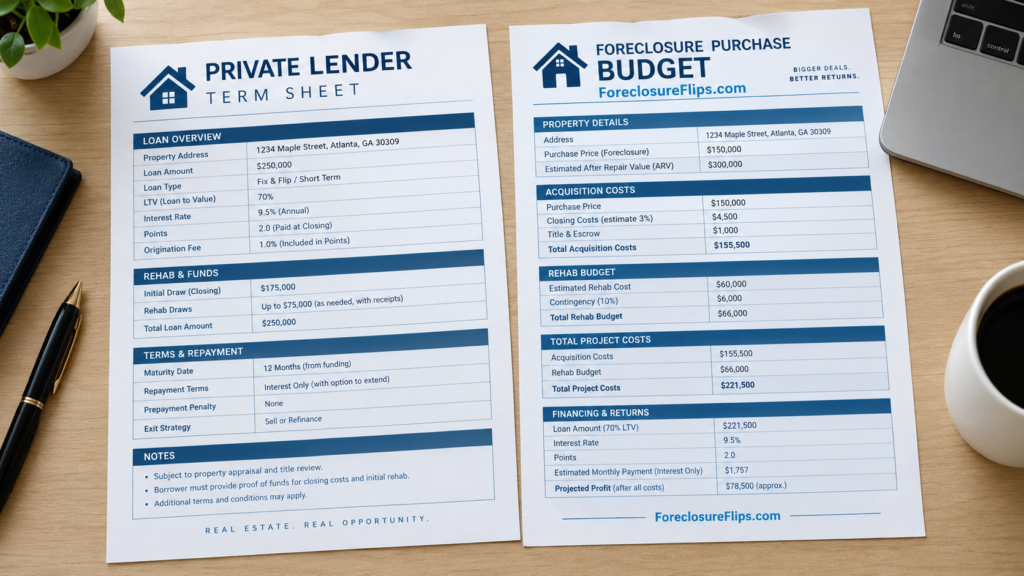
A foreclosure deal can require funds faster than a conventional lender can approve, document, and close. That makes private money attractive, but the speed comes with a different cost structure and a shorter margin for error.
When you evaluate private money loans real estate investors use, you are usually trading bank-style pricing for faster decisions, flexible underwriting, and terms built around a specific property.
The loan still has to fit the purchase, rehab schedule, exit, and downside. Before you accept the money, understand exactly what the lender is funding, how the debt is secured, and what happens if the project runs late.
Get Foreclosure Investing Insights Twice a Week
Subscribe to the Foreclosure Flips newsletter for practical ideas on finding deals, analyzing opportunities, and understanding foreclosure-related investing strategies. We send concise updates twice a week so you can stay informed without adding more noise to your inbox.
What a Private Money Loan Is and When It Fits a Foreclosure Deal
A private money loan is financing provided by an individual, small private lending company, investment group, or other non-bank capital source. The lender typically evaluates the property, your experience, your cash contribution, and the planned exit rather than relying primarily on the standardized underwriting used for conventional owner-occupied mortgages.
For foreclosure investing, private money is often used when the purchase requires a short closing, the property is too distressed for ordinary financing, or the project needs acquisition and rehab capital under one short-term structure.
These loans commonly use interest-only payments, points, a short maturity, and a mortgage or deed of trust securing the property. Rehab funds may arrive through draws rather than at closing.
The appeal of private money loans real estate investors arrange for foreclosures is speed and flexibility. They fit best when the project has a clear exit and enough margin to absorb the higher financing cost.
Put the Loan Term Sheet Next to the Project Budget
Assume you are buying a foreclosure for $145,000 and expect to spend $55,000 on renovation. Your estimated after-repair value is $285,000.
A private lender offers these terms:
| Loan term | Example |
|---|---|
| Maximum principal | $170,000 |
| Interest rate | 12% |
| Origination fee | 2 points |
| Initial term | 9 months |
| Payment | Monthly interest only |
| Collateral | First-position lien |
| Rehab funding | Draws after completed work |
| Extension | 6 months for 1 additional point |
| Guarantee | Personal guarantee |
| Planned repayment | Sale or refinance |
The 12% rate is only one cost. Points, cash required at closing, draw timing, maturity, extension rights, guarantees, and lender fees can change the economics just as much.
Convert Points and Fees Into Dollars
Two points on a $170,000 loan equal $3,400.
Find out whether the lender deducts that amount from closing proceeds, requires separate payment, or adds it to the balance. Then identify document, valuation, inspection, servicing, wire, and extension fees.
A $170,000 note may provide much less than $170,000 of usable project cash.
Check Whether Interest Starts on Undrawn Rehab Funds
Suppose $45,000 of the commitment sits in a rehab reserve.
One lender may charge interest only after each draw funds. Another structure may calculate interest against a larger committed balance. Ask which method applies and model the actual draw dates.
That distinction can change carrying cost by thousands of dollars over a nine-month project.
Calculate the Cost Through the Expected Payoff Date
Assume $125,000 funds at closing and the remaining rehab money is released over the next four months.
If the entire $170,000 balance were outstanding for nine months at 12%, interest would total about $15,300. Add $3,400 in points and financing cost reaches $18,700 before extension fees and other charges.
Actual interest may be lower when the lender charges only on disbursed funds.
When comparing private money loans real estate investors use, calculate the cost through the month you realistically expect to repay the debt. A six-month flip and an eleven-month flip do not carry the same financing burden even when the term sheet is identical.
If you use Rehab Valuator for project analysis, keep points, interest, draws, extension fees, and payoff timing as visible assumptions rather than hiding them inside one financing number.
Confirm the Cash You Need Before the First Rehab Draw
A loan can cover most of the project and still leave you short of cash.
If the lender reimburses completed work, you may have to fund demolition, deposits, materials, and labor before the first draw. A $12,000 contractor deposit can create an immediate cash gap.
Before closing, identify:
- Cash required for the down payment
- Points and lender fees due at closing
- Buyer closing costs
- Initial insurance and tax requirements
- Rehab expenses you must front
- Minimum liquidity the lender requires you to retain
This calculation tells you whether the financing actually supports the construction schedule.
Verify the Lien Position and Loan Documents
Private money should not move on a handshake and an emailed spreadsheet.
A typical file can include a promissory note, mortgage or deed of trust, guarantee, draw agreement, insurance requirements, default provisions, and extension terms.
Use a closing professional familiar with private lending in the property state so the security instrument matches local law and the intended lien position.
Compare the New Loan With Existing Liens
A lender expecting first position will usually require title work before funding.
Existing mortgages, tax liens, judgments, association claims, or other recorded interests can interfere with that position. Resolve required releases and payoffs through closing rather than assuming the private mortgage will automatically become senior.
Foreclosure acquisitions deserve extra care because default-related title issues may surface only after the initial offer.
Test the Repayment Source Before You Accept the Loan
Private lenders often focus heavily on collateral, but your plan should repay the loan without depending on foreclosure or a distressed sale.
For a flip, reduce the projected sale price, lengthen the marketing period, and increase selling costs. A rental exit should survive a lower completed value, higher permanent rate, and more conservative loan-to-value ratio.
The OCC’s refinance-risk guidance is directed to regulated banks, but the risk principle applies directly to short-term investment debt: refinance risk rises when principal remains due at maturity and the borrower depends on future market conditions to replace it.
If the project repays the private lender only when ARV, rates, rehab timing, and lender appetite all land exactly as projected, the exit has too little room.
Read the Maturity and Extension Terms Before Closing
Return to the nine-month loan.
The original plan calls for rehab completion in month four and sale in month seven. Permit delays push construction to month six, the first buyer cancels, and the sale closes in month ten.
Your nine-month loan has matured.
If the lender offers a six-month extension for one point, the extension adds $1,700 on a $170,000 balance before additional interest. The loan documents may also require updated title work, a new inspection, an extension agreement, or lender approval.
Determine whether the extension is a contractual option or simply something the lender may consider. Those are very different forms of protection.
Confirm the Loan Is Structured for Business Use
Foreclosure investment financing is often business-purpose credit, but the legal treatment depends on the actual transaction.
The CFPB’s Regulation Z commentary explains that credit used to acquire, improve, or maintain non-owner-occupied rental property is deemed business-purpose credit. It also lists factors used to determine whether other transactions are primarily business or consumer in nature.
That federal exemption does not eliminate state licensing, interest-rate, disclosure, servicing, or other lending rules. If the borrower may occupy the property or the lender makes loans repeatedly, have local counsel review the structure.
Check Securities Rules Before Soliciting Multiple Lenders
There is a difference between borrowing from one private lender for one property and broadly soliciting investors to fund a series of notes or a pooled investment program.
Investor.gov’s promissory-note guidance notes that promissory notes sold as investments are typically securities and generally must be registered or qualify for an exemption.
Real estate collateral does not make a note guaranteed or risk-free. If your capital plan expands into repeated solicitation, passive investors, or pooled money, securities counsel can determine what rules apply.
Report Problems Before the Loan Reaches Maturity
Private lending often depends on repeat relationships.
Send the updates you agreed to provide: rehab progress, draw requests, major budget changes, listing status, expected payoff, and delays.
If the roof costs $8,000 more than expected and adds three weeks, tell the lender while the project still has time and liquidity. Surprise overruns and last-minute extension requests can damage a repeat lending relationship even when the project eventually makes money.
Reprice the Loan for a 60-Day Delay
Before signing, take the original model and add two months.
Increase interest expense. Add any extension fee that would apply. Delay the sale or refinance. Carry taxes, insurance, utilities, and other holding costs for the additional period. Then reduce the exit value enough to test whether the loan can still be repaid without consuming the expected profit.
For private money loans real estate projects rely on, this delayed-case model is more useful than choosing the lowest advertised rate.
Private money is best used when its speed and flexibility solve a specific acquisition problem and the project has enough margin to carry the higher cost. The lender should know what secures the debt and how repayment will occur; you should know how much cash the loan really provides and what happens if the original schedule slips.
You might also like:
 Speed vs Speculation in House Flipping
 House Flipping: How to Find, Analyze, Renovate, and Sell a Profitable Flip
 How Higher Interest Rates Affect Foreclosure Deals
 How to Calculate After Repair Value Before You Buy
 How to Analyze an Investment Property Before You Buy
 Real Estate Syndication Waterfall for Foreclosure Deals