
BRRRR Investing: How to Buy, Rehab, Rent, Refinance, and Repeat
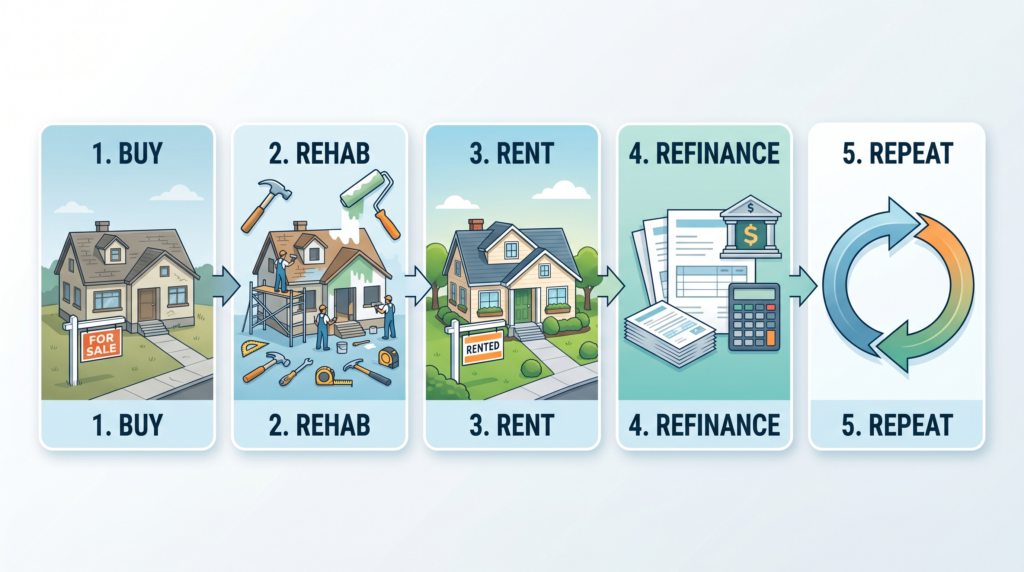
BRRRR investing is a real estate strategy designed to help investors build a rental portfolio while recycling capital from one deal into the next.
BRRRR stands for Buy, Rehab, Rent, Refinance, Repeat.
The basic idea is straightforward. An investor buys an undervalued or distressed property, renovates it, rents it to a qualified tenant, refinances based on the improved value and rental income, then uses the recovered capital to buy another property.
When the strategy works, the investor may end up owning a cash-flowing rental property while recovering much of the original cash invested. That capital can then be redeployed into the next deal.
This is why BRRRR is popular with investors who want to scale rental portfolios without leaving all of their cash trapped in each property.
But BRRRR is not automatic.
The strategy depends on several assumptions working together. The purchase price must be low enough. The rehab budget must be accurate. The renovated property must appraise high enough. The market rent must support the loan. The lender must approve the refinance. Interest rates, loan-to-value limits, seasoning rules, debt-service coverage, insurance, taxes, vacancy, repairs, and property management all matter.
A BRRRR deal can look strong at purchase and still fail at refinance. It can appraise well and still produce weak cash flow. It can cash flow initially and still underperform if repairs were underestimated or reserves were too thin.
BRRRR is best understood as a linked sequence. Each step must support the next one.
This guide explains how BRRRR investing works from start to finish, including how to find properties, analyze deals, finance the project, control the rehab, rent the property, refinance correctly, manage risks, and decide whether this strategy fits your investment goals.
Get Foreclosure Investing Insights Twice a Week
Subscribe to the Foreclosure Flips newsletter for practical ideas on finding deals, analyzing opportunities, and understanding foreclosure-related investing strategies. We send concise updates twice a week so you can stay informed without adding more noise to your inbox.
What Is BRRRR Investing?
BRRRR is an acronym for:
Buy.
Rehab.
Rent.
Refinance.
Repeat.
Each step has a specific purpose.
The investor first buys a property, usually one that is undervalued, distressed, poorly managed, outdated, or in need of repairs.
Then the investor rehabs the property to improve its condition, value, rentability, safety, and appeal to tenants.
After rehab, the investor rents the property to a qualified tenant at a market-supported rent.
Once the property is stabilized, the investor refinances into longer-term debt, ideally based on the improved value and income of the property.
Finally, the investor repeats the process by using recovered capital, experience, and cash flow to pursue another deal.
BRRRR is not simply buying a rental property. Traditional rental investing often involves buying a property, placing a tenant, and holding it while slowly building equity over time. BRRRR adds a renovation and refinance component designed to accelerate capital recovery.
BRRRR is also not flipping. A flipper buys, renovates, and sells. A BRRRR investor buys, renovates, and keeps the property as a rental.
The strategy combines parts of both approaches. Like flipping, BRRRR relies on forced appreciation through renovation. Like rental investing, it relies on long-term income, tenant management, debt service, maintenance, and property operations.
The refinance is the key difference. BRRRR investors are trying to convert a distressed or underperforming property into a stabilized asset that a lender will finance based on its improved value and income.
That is where the opportunity exists. It is also where the risk concentrates.
BRRRR vs. Traditional Rental Investing vs. Flipping
BRRRR sits between traditional rental investing and flipping.
A traditional rental investor may buy a property that is already rent-ready, finance it conventionally, lease it, and hold it for income and appreciation. This can be simpler than BRRRR, but capital recovery is usually slower.
A flipper buys a property, renovates it, and sells it for a profit. This can return capital quickly, but the investor does not keep the property as a long-term asset.
A BRRRR investor renovates like a flipper but holds like a rental investor. The investor’s goal is to create enough value through the rehab to refinance and recover capital while keeping the property.
| Strategy | Main Goal | How Profit Is Created | Capital Recovery | Main Risk |
|---|---|---|---|---|
| Traditional Rental | Long-term income and appreciation | Cash flow, principal paydown, appreciation | Usually slower | Overpaying or weak cash flow |
| Flipping | Short-term resale profit | Buy, renovate, sell | At sale | Rehab overruns and resale risk |
| BRRRR | Build rental portfolio while recycling capital | Forced appreciation, rental income, refinance | Through refinance | Refinance shortfall and cash flow pressure |
The comparison matters because BRRRR has more moving parts.
A traditional rental can work even if there is no major rehab or refinance.
A flip can work if the property sells profitably.
A BRRRR deal must usually satisfy three tests:
It must work as a purchase.
It must work as a renovation.
It must work as a long-term rental after refinance.
If any one of those tests fails, the strategy can underperform.
Who BRRRR Investing Is Best For
BRRRR investing is best for investors who want to build a rental portfolio and are comfortable managing renovation, financing, and rental operations.
It may be a good fit for investors who:
Want to own long-term rental properties.
Can identify undervalued or distressed properties.
Have access to acquisition and rehab capital.
Are comfortable working with contractors.
Understand rental property analysis.
Can evaluate rents, expenses, vacancy, maintenance, and management costs.
Are willing to work with lenders before and after renovation.
Can handle appraisal uncertainty.
Have enough reserves to manage delays or refinance shortfalls.
Are patient enough to complete the full cycle before scaling.
BRRRR is less suitable for investors who need immediate liquidity, cannot tolerate renovation delays, lack cash reserves, or do not want to own and manage rentals.
It is also not ideal for investors who rely on perfect refinance assumptions. A deal that only works if the appraisal comes in high, the lender offers maximum leverage, interest rates stay low, repairs stay exactly on budget, and rent hits the top of the market is not a strong BRRRR candidate.
The best BRRRR investors are conservative underwriters. They assume some costs will be higher than expected, the refinance may not return every dollar, and the property must still cash flow after the dust settles.
How BRRRR Investing Works Step by Step
BRRRR follows a simple acronym, but the actual process requires careful execution.
1. Choose a target market
Before searching for properties, define the market.
A strong BRRRR market should have rental demand, reasonable purchase prices, contractor availability, lender interest, stable employment, and enough comparable sales to support valuation.
The best market is not always the cheapest market. Cheap properties can have weak tenant demand, high maintenance, high vacancy, difficult management, or limited refinance options.
Look for markets where the finished property can attract qualified tenants and support the refinance.
2. Define rental and refinance criteria
A BRRRR investor should define the rules before looking at deals.
Examples include:
Minimum monthly cash flow after refinance.
Maximum cash left in the deal.
Minimum debt-service coverage.
Target loan-to-value.
Minimum rent-to-price relationship.
Maximum rehab budget.
Minimum reserve requirement.
Acceptable property types.
Acceptable neighborhoods.
Lender seasoning requirements.
Without criteria, investors are more likely to force weak deals into the BRRRR model.
3. Find an undervalued or distressed property
BRRRR usually requires buying below stabilized value. That often means looking for properties that are outdated, distressed, poorly marketed, vacant, inherited, mismanaged, or in need of repairs.
The acquisition price is critical. If the investor pays full retail value, there may not be enough room to create equity through rehab.
4. Estimate ARV and stabilized rent
ARV, or after-repair value, is the estimated value of the property after renovations are complete.
Stabilized rent is the rent the property should command after repairs and tenant placement.
Both estimates need to be realistic. An inflated ARV may lead to a refinance disappointment. An inflated rent estimate may lead to negative cash flow.
5. Estimate rehab costs
The rehab budget should be based on a defined scope of work, contractor bids, material costs, permits, utility activation, inspections, and contingency reserves.
For BRRRR, the rehab should improve both value and rentability. The goal is not to create the nicest house in the neighborhood. The goal is to create a durable, rent-ready property that supports appraisal and tenant demand.
6. Secure acquisition and rehab financing
Many BRRRR investors use short-term financing for the purchase and renovation, such as cash, hard money, private money, bridge loans, lines of credit, or partnership capital.
Before buying, the investor should also confirm likely refinance options. The acquisition loan is only the first step. The long-term refinance must be part of the plan from the beginning.
7. Buy below stabilized value
The purchase price must leave enough room for repairs, costs, refinance limits, and cash flow.
A property is not a BRRRR deal just because it needs work. It must be bought at a price that supports the full cycle.
8. Complete renovations
Renovation execution determines whether the business plan stays on track.
The investor must manage contractors, permits, inspections, materials, change orders, budget, and timeline. Delays increase holding costs. Overruns reduce cash recovery. Poor workmanship can hurt appraisal, rentability, and long-term maintenance.
9. Place a qualified tenant
After rehab, the property should be leased to a qualified tenant at a market-supported rent.
Tenant screening matters. A high rent number is not useful if the tenant does not pay or damages the property.
The lease also helps support the refinance because the lender may review rental income, occupancy, and lease documentation.
10. Track actual income and expenses
Before refinancing, the investor should know the property’s actual operating profile.
This includes rent, taxes, insurance, utilities, maintenance, management, vacancy expectations, repairs, and any HOA or local fees.
The refinance decision should be based on real numbers, not assumptions from the purchase date.
11. Apply for refinance
Once the property is renovated and leased, the investor applies for long-term financing.
The lender may order an appraisal, review the lease, evaluate borrower qualifications, verify insurance, review title, calculate debt-service coverage, and apply seasoning rules.
12. Use refinance proceeds to repay acquisition and rehab capital
The refinance proceeds may repay the original purchase loan, rehab loan, private lender, hard money loan, or investor cash.
In an ideal BRRRR deal, the investor recovers most or all of the capital invested while keeping a cash-flowing rental.
In many real-world BRRRR deals, some cash remains in the property. That is not automatically a failure if the property cash flows and the return on remaining capital is attractive.
13. Hold the property as a rental
After the refinance, the investor owns a stabilized rental property with long-term debt.
The focus shifts from project execution to asset management: rent collection, maintenance, reserves, tenant retention, insurance, taxes, and long-term performance.
14. Repeat only after the first deal performs
The final R is “repeat,” but repeating too quickly can be dangerous.
Investors should confirm that the property performs as expected before using the model again. A weak BRRRR deal repeated five times becomes a portfolio problem.
Build Your Investing Knowledge One Email at a Time
Foreclosure investing rewards preparation. Join our 2X week newsletter for straightforward guidance on pre-foreclosures, short sales, BRRRR, flipping, and other strategies investors use to evaluate distressed property opportunities.
How to Find BRRRR Properties
BRRRR properties are usually found where there is some form of distress, mispricing, deferred maintenance, or operational inefficiency.
Distressed properties
Distressed properties may need repairs, have vacancy issues, suffer from poor management, or be owned by sellers who want a faster sale.
These properties can create value-add opportunities if the acquisition price reflects the work required.
Pre-foreclosures
Pre-foreclosure properties can be potential BRRRR candidates if the owner still controls the property, there is enough equity, and the investor can buy before auction.
The property may need repairs, and the seller may be motivated by the need to resolve a default situation. However, timing and legal compliance matter.
Foreclosures
Foreclosure auctions and bank-owned properties may create BRRRR opportunities, especially when the property needs renovation but is located in a strong rental market.
Auction purchases can be riskier because inspection access may be limited and payment deadlines can be strict.
Short sales
Short sales may fit BRRRR when the lender approves a purchase price low enough to support repairs, rental income, and refinance value.
The main downside is time. Short sales can take months and may not be approved.
Off-market sellers
Off-market opportunities may come from tired landlords, inherited properties, vacant homes, code violation lists, absentee owners, or owners who do not want to list publicly.
These deals often require more outreach but may have less competition.
Wholesalers
Wholesalers can be a source of BRRRR leads, especially in investor-heavy markets.
Investors should still verify the numbers independently. Do not rely only on the wholesaler’s ARV, rent estimate, or repair budget.
Investor-friendly agents
Agents who understand investor criteria can help identify MLS fixer-uppers, estate sales, stale listings, price reductions, and distressed sellers.
The best agents for BRRRR understand both resale comps and rental fundamentals.
MLS fixer-uppers
Some BRRRR deals are listed publicly. These may include outdated homes, failed listings, estate sales, vacant properties, or homes that do not qualify for traditional owner-occupant financing.
Competition may be higher, but listed properties can still work if the numbers are sound.
Tired landlord properties
A tired landlord may own a property with deferred maintenance, problem tenants, below-market rent, or management fatigue.
These properties can be strong BRRRR candidates if the investor can solve the operational issues and stabilize the asset.
Small multifamily properties
Duplexes, triplexes, and fourplexes may work well for BRRRR if rents support the refinance and the property can be improved efficiently.
Small multifamily properties can offer more income diversity than single-family rentals, but expenses and management may also be more complex.
Foreclosure listing platforms
Because BRRRR often depends on buying below stabilized value, foreclosure and distressed-property listings can be useful research sources.
You can start by reviewing distressed-property opportunities through Foreclosure.com, then screen potential deals for rental demand, repair scope, ARV support, refinance feasibility, and post-refinance cash flow.
How to Analyze a BRRRR Deal
A BRRRR deal must be analyzed as both a project and a rental asset.
The property needs to work during acquisition and rehab, then still work after refinance.
Purchase price
The purchase price must be low enough to support the full strategy.
A common mistake is buying a property because it appears discounted, without confirming that the stabilized value and refinance will support the total project cost.
Repair budget
The repair budget should be based on a clear scope of work. Include labor, materials, permits, utilities, inspections, cleanup, landscaping, appliances, contingency, and holding time.
Rehab costs are one of the most common reasons BRRRR deals underperform.
After-repair value
ARV is critical because the refinance is usually based on the property’s appraised value after renovation.
Use recent comparable sales. Match property type, square footage, bedroom count, condition, location, and finish level.
Do not assume the appraiser will give full credit for every dollar spent.
Stabilized rent
Rent must be supported by actual market data. Review comparable rentals, days on market, tenant demand, property condition, seasonality, and neighborhood quality.
The rent should be realistic, not best-case.
Operating expenses
A BRRRR property must be underwritten with full operating expenses, including:
Property taxes.
Insurance.
Repairs and maintenance.
Vacancy.
Property management.
Capital expenditures.
Utilities paid by owner.
HOA dues.
Lawn care or snow removal.
Licensing or inspection fees.
Pest control.
Accounting and administrative costs.
Many weak BRRRR deals appear profitable only because the investor ignores real expenses.
Property taxes
Taxes may increase after purchase or reassessment. Investors should not rely blindly on the seller’s prior tax bill.
Insurance
Insurance costs can vary based on property condition, location, vacancy, renovation status, tenant occupancy, and coverage type.
Confirm insurance early, especially for distressed or vacant properties.
Vacancy
Even strong rentals have vacancy risk. Include a vacancy allowance, especially during lease-up and turnover periods.
Maintenance and capital expenditures
Maintenance covers routine repairs. Capital expenditures cover larger items such as roofs, HVAC systems, plumbing, electrical, appliances, and exterior improvements.
A newly renovated property may have lower near-term maintenance, but reserves are still necessary.
Property management
Even if the investor self-manages, management has value. For underwriting, include a management expense or at least understand the tradeoff.
A deal that only cash flows when labor is free may not be as strong as it appears.
Loan terms
Loan terms after refinance drive cash flow. Interest rate, amortization period, loan amount, points, fees, escrow requirements, and prepayment penalties all matter.
Refinance loan-to-value
Many lenders cap cash-out refinance proceeds based on a percentage of appraised value. For example, a lender may allow 70% or 75% loan-to-value.
A lower LTV means more cash may remain in the property.
Seasoning requirements
Some lenders require the investor to own the property for a certain period before using the new appraised value for a cash-out refinance.
This can delay capital recovery.
Debt-service coverage
Rental lenders may require the property’s income to support the debt payment. If rent is too low or interest rates are too high, the property may not qualify for the desired refinance.
Cash left in the deal
The investor should calculate how much cash remains in the property after refinance.
Leaving some cash in the deal is not always bad. What matters is whether the remaining equity produces an acceptable return and whether the property cash flows safely.
Post-refinance cash flow
A BRRRR deal is not successful just because it recovers capital. It must also operate as a rental.
Cash flow should be calculated after debt service, taxes, insurance, vacancy, maintenance, management, and reserves.
Break-even occupancy
Know how much vacancy the property can tolerate before it loses money.
This is especially important for small multifamily properties and properties with higher debt payments.
Reserves
Reserves protect the investor from repairs, vacancies, insurance increases, tax increases, and refinance shortfalls.
BRRRR without reserves is fragile.
Example BRRRR Deal Math
Here is a simplified BRRRR example.
Assume an investor finds a distressed single-family rental candidate with the following numbers:
Purchase price: $150,000
Rehab budget: $45,000
Closing and holding costs: $10,000
Total project cost: $205,000
Estimated after-repair value: $275,000
Refinance loan-to-value: 75%
The projected refinance amount is:
$275,000 ARV × 75% LTV = $206,250 refinance loan
On paper, this refinance could recover most or all of the $205,000 total project cost before considering refinance closing costs.
That looks strong.
But the investor still needs to analyze rental performance.
Assume the renovated property rents for $2,100 per month.
Estimated monthly operating numbers:
Gross rent: $2,100
Vacancy reserve: $105
Maintenance reserve: $150
Property management: $180
Taxes: $250
Insurance: $150
Capital expenditure reserve: $150
Estimated monthly operating expenses before mortgage: $985
Estimated net operating income before debt service:
$2,100 rent
minus $985 operating expenses
= $1,115 monthly NOI before mortgage
Now assume the refinance loan creates a monthly principal and interest payment of $1,250.
Monthly cash flow estimate:
$1,115 NOI before mortgage
minus $1,250 debt payment
= negative $135 per month
In this version, the deal may recover most of the investor’s capital, but it does not cash flow after refinance.
That is a problem.
The investor may need to reduce the refinance loan amount, negotiate a lower purchase price, reduce rehab costs, increase rent only if market-supported, find better loan terms, or walk away.
Now consider a more conservative refinance.
If the investor refinances at $185,000 instead of $206,250, the mortgage payment may be lower. The investor leaves roughly $20,000 in the deal, but the property may cash flow.
This may be a better outcome.
The lesson is important: maximum cash-out is not always the best BRRRR result.
A successful BRRRR deal should balance capital recovery with safe long-term cash flow. Consider trying out Rehab Valuator software to help analyze your next opportunity.
Financing a BRRRR Deal
BRRRR financing usually has two phases: acquisition and rehab financing, followed by long-term refinance.
Acquisition and rehab financing
The first loan or capital source is used to buy and renovate the property.
Common options include:
Cash.
Hard money.
Private money.
Bridge loans.
HELOC or line of credit.
Renovation loans.
Partnership capital.
Seller financing, where appropriate.
Cash gives the investor flexibility and may help close quickly, but it ties up capital.
Hard money can fund both purchase and repairs, but it is usually expensive and short-term.
Private money can be flexible but must be documented properly.
A HELOC or business line of credit can provide flexible capital, but the investor must manage repayment risk.
Bridge loans can work when the investor has a clear refinance or sale plan.
Partnership capital can help fund larger projects, but it requires clear agreements.
Long-term refinance financing
After rehab and rent-up, the investor refinances into longer-term debt.
Options may include:
Conventional rental property loan.
DSCR loan.
Portfolio loan.
Local bank loan.
Commercial loan for small multifamily.
Credit union financing.
Blanket loan for multiple properties.
The refinance lender may review:
Appraised value.
Lease agreement.
Rental income.
Debt-service coverage.
Borrower credit.
Borrower liquidity.
Property condition.
Title.
Insurance.
Seasoning period.
Number of financed properties.
Entity structure.
Reserve requirements.
Prepayment penalties.
Investors should speak with refinance lenders before buying the property. The worst time to learn about seasoning rules or DSCR limits is after the rehab is complete.
Stay Ahead of the Next Deal
Markets move quickly, and good foreclosure opportunities often require fast analysis. Subscribe to our twice-weekly newsletter for investor-focused tips, tools, and market insights designed to help you make better decisions.
The Rehab Phase: What Investors Need to Control
The rehab phase is where value is created, but it is also where many BRRRR deals break down.
Scope of work
A clear scope of work should identify exactly what will be repaired, replaced, upgraded, or left alone.
The scope should support rentability, durability, safety, and appraisal value. It should not be based on personal preferences.
Contractor selection
The contractor must be capable, licensed where required, insured, reliable, and familiar with investor projects.
The cheapest bid is not always the best bid. A low bid that leads to delays, rework, or poor quality can cost more in the long run.
Permits
Permit requirements should be reviewed early. Unpermitted work can create problems with inspections, insurance, appraisals, refinancing, and resale.
Budget contingency
Every rehab budget should include contingency. Older and distressed properties often reveal problems after work begins.
A reasonable contingency may be 10% to 20%, depending on property condition and scope.
Timeline
Holding costs continue during rehab. Delays increase interest, utilities, insurance, taxes, and opportunity cost.
The schedule should be realistic and monitored closely.
Rent-ready standards
A BRRRR rehab should produce a property that is clean, safe, durable, functional, and attractive to the target renter.
This may include reliable systems, durable flooring, neutral paint, working appliances, secure doors and windows, proper lighting, code-compliant repairs, and clean curb appeal.
Appraisal-supporting improvements
Some improvements support value better than others. Kitchens, bathrooms, flooring, major systems, roof condition, exterior appeal, and functional layout often matter.
However, over-improving beyond neighborhood standards may not produce a corresponding appraisal increase.
Utility activation
Utilities may need to be turned on for inspections, contractor work, appraisals, and tenant move-in. Delays in utility activation can slow the project.
Change orders
Change orders should be documented and approved before work proceeds. Uncontrolled change orders are a common source of budget overruns.
Quality control
Inspect work regularly. Poor workmanship can hurt tenant satisfaction, increase maintenance calls, reduce appraisal confidence, and create long-term costs.
The rehab goal is not simply to finish. It is to create a stable rental asset.
The Rent Phase: Turning the Property Into a Performing Asset
The rent phase converts the renovated property into an income-producing asset.
Setting market rent
Rent should be based on comparable rentals, not guesswork. Review similar properties by location, size, condition, bedroom count, amenities, and lease terms.
Overpricing can create vacancy. Underpricing reduces income and may weaken refinance performance.
Tenant screening
Tenant quality is critical. A BRRRR property with a poor tenant can damage cash flow, delay refinance, and create legal costs.
Screening should include income verification, rental history, credit review, background checks where legally permitted, eviction history where legally permitted, and reference checks.
Lease terms
The lease should be clear, enforceable, and compliant with local law. It should define rent, due dates, late fees, deposits, maintenance responsibilities, utilities, pets, occupancy limits, and property rules.
Security deposit
A proper security deposit helps protect against damage and unpaid rent. Deposit handling must comply with state and local law.
Property management
Investors should decide whether to self-manage or hire a property manager.
Professional management adds cost but can improve leasing, rent collection, maintenance coordination, compliance, and tenant communication.
Rent collection
Consistent rent collection is essential. The refinance lender may review rental income, and long-term performance depends on reliable collections.
Maintenance process
Set up a maintenance process before the tenant moves in. Fast, professional maintenance helps preserve the property and reduce turnover.
Documentation for lender
Keep organized records, including the signed lease, rent ledger, insurance policy, tax information, rehab invoices, contractor receipts, and before-and-after photos.
This documentation may help during refinance and future portfolio financing.
Stabilization period
Some lenders require the property to be leased or stabilized for a period before refinance. Understand those requirements in advance.
The Refinance Phase: Where BRRRR Deals Succeed or Fail
The refinance is often the most important stage of BRRRR.
This is where the investor finds out whether the value creation, rent, lender terms, and debt structure support the original plan.
Appraisal risk
The appraisal may come in lower than expected.
This can happen because comparable sales are weak, the appraiser is conservative, the property is over-improved, market conditions changed, or the investor’s original ARV was too aggressive.
A lower appraisal usually means lower refinance proceeds.
Interest rate risk
Interest rates can change between acquisition and refinance. A deal that cash flowed at one rate may be weak at a higher rate.
Investors should model higher-rate scenarios before buying.
Loan-to-value limits
Lenders usually limit the refinance amount to a percentage of appraised value. If the LTV is lower than expected, more cash remains in the deal.
Cash-out refinance rules
Some lenders restrict cash-out refinancing, especially if the property was recently purchased. Rules vary by lender, loan type, and seasoning period.
Seasoning requirements
Seasoning refers to how long the investor must own the property before refinancing based on new appraised value.
Some lenders may allow refinancing quickly. Others may require six months, twelve months, or more. Some may use the lower of purchase price or appraised value if seasoning is not met.
Debt-service coverage ratio
DSCR measures whether the property’s income supports the debt payment.
If rent is too low or the loan payment is too high, the refinance may be reduced or denied.
Property condition requirements
The property must usually be habitable and in acceptable condition. Incomplete rehab can delay or prevent refinance.
Tenant occupancy requirements
Some lenders require a signed lease or tenant occupancy. Others may use market rent. Know the rule before choosing the lender.
Reserve requirements
Lenders may require cash reserves after closing. This can affect how much capital is truly available for the next deal.
Closing costs
Refinance closing costs reduce net cash recovery. Include lender fees, appraisal, title, recording, escrow setup, and other settlement costs.
Prepayment penalties on original debt
If the acquisition loan has a prepayment penalty or minimum interest period, refinancing early may cost more than expected.
Cash left in the deal
A perfect BRRRR is sometimes described as recovering all invested capital. In practice, many good deals leave some cash in the property.
The better question is whether the remaining cash produces an attractive return and whether the property is financially stable after refinance.
A refinance that extracts too much cash and leaves the property with weak or negative cash flow can turn a good project into a fragile asset.
Due Diligence Checklist Before Buying a BRRRR Property
Use this checklist before buying a BRRRR candidate.
Confirm target rent with comparable rentals.
Confirm ARV with recent comparable sales.
Confirm the purchase price supports the refinance plan.
Estimate repairs with contractor input.
Add a rehab contingency.
Confirm contractor availability.
Check property taxes and likely reassessment.
Check insurance cost and availability.
Check zoning and legal rental use.
Check HOA rules, if applicable.
Check short-term or long-term rental restrictions.
Check permit requirements.
Confirm utility status.
Confirm neighborhood rental demand.
Confirm tenant profile.
Confirm acquisition financing.
Confirm refinance lender options.
Confirm seasoning rules.
Model refinance at conservative LTV.
Model a lower appraisal scenario.
Model a higher interest rate scenario.
Model a lower rent scenario.
Model higher insurance and taxes.
Confirm post-refinance cash flow.
Confirm reserves.
Confirm property management plan.
Confirm backup exit strategy.
If the deal only works under perfect assumptions, it is not a strong BRRRR deal.
Risks and Common Mistakes
BRRRR investing has several common failure points.
Overpaying for the property
The purchase price determines how much room exists for rehab, refinance, and cash flow. Overpaying at acquisition is difficult to fix later.
Underestimating rehab costs
Repair overruns reduce capital recovery and can force the investor to leave more cash in the deal.
Overestimating ARV
If the ARV is too high, refinance proceeds may disappoint.
Overestimating rent
A rent estimate that is too aggressive can create vacancy, weak DSCR, and poor cash flow.
Ignoring operating expenses
Taxes, insurance, maintenance, management, vacancy, and capital expenditures must be included.
Assuming 100% capital recovery
Not every BRRRR deal returns all invested capital. Some can still be good deals, but the investor must model cash left in the property.
Not understanding lender seasoning rules
Seasoning rules can delay refinance or reduce loan proceeds.
Refinancing into negative cash flow
Pulling out too much cash can leave the property unable to support its debt. This is one of the most dangerous BRRRR mistakes.
Using short-term debt without backup capital
Hard money and bridge loans can be useful, but they create pressure. If the refinance is delayed, the investor needs reserves or backup financing.
Over-improving the property
Luxury finishes in a moderate rental market may not increase value or rent enough to justify the cost.
Hiring the wrong contractor
Contractor problems can create delays, budget overruns, poor quality, and refinance issues.
Scaling too quickly
Repeating the strategy before the first property is stabilized can multiply mistakes.
Failing to maintain reserves
BRRRR investors need reserves for repairs, vacancy, loan payments, insurance, taxes, and unexpected refinance shortfalls.
Learn the Strategies Behind Smarter Foreclosure Investing
Get practical foreclosure investing content delivered twice a week, including deal analysis tips, strategy breakdowns, useful tools, and new resources from Foreclosure Flips. Sign up to keep learning and spotting better opportunities.
Expected Timeline
A BRRRR deal often takes longer than investors expect.
A typical timeline may look like this:
Deal sourcing: ongoing.
Acquisition: 15 to 45 days, depending on seller and financing.
Rehab planning: one to three weeks.
Rehab work: one to six months, depending on scope.
Rent-up: two weeks to two months.
Stabilization or seasoning: immediate to several months, depending on lender.
Refinance process: 30 to 60 days.
Full cycle: often six to twelve months.
Some light-rehab BRRRR deals can move faster. Heavy rehabs, permit issues, contractor delays, appraisal problems, tenant delays, or lender seasoning rules can extend the timeline.
The repeat step should not begin simply because the rehab is finished. It should begin after the investor understands the actual performance of the property.
Exit Strategies and Backup Plans
BRRRR is designed as a hold strategy, but every deal needs a backup plan.
Keep the property with more cash left in the deal
If the refinance proceeds are lower than expected, the investor may keep the property with more equity and less recovered capital.
This can still be acceptable if the property cash flows and the return on remaining cash is strong.
Convert to a traditional rental
If the refinance is delayed or limited, the investor may hold the property as a traditional rental until refinancing conditions improve.
Sell as a flip
If resale demand is strong and rental numbers are weaker than expected, selling may be the better exit.
Sell as-is to another investor
If the project is partially completed or no longer fits the plan, an investor sale may preserve capital.
Refinance with a different lender
Different lenders have different rules. A local bank, DSCR lender, portfolio lender, or credit union may provide a better fit.
Bring in a partner
A partner may contribute capital to complete the project, reduce debt, or support the refinance.
This should be structured carefully with written agreements.
Pay down debt
If cash flow is tight, paying down debt may improve DSCR and reduce monthly payments.
Delay refinance
Sometimes waiting is better than forcing a weak refinance. If rents improve, the property stabilizes, or better comps appear, refinancing later may produce a better result.
A backup plan should be part of the original analysis, not something created after the deal goes sideways.
Tools, Resources, and Next Steps
BRRRR investing works best when the investor uses a repeatable process.
Useful tools and resources include:
Rental comp tools.
Sales comp tools.
Repair estimate checklist.
Contractor bid template.
Deal calculator.
Refinance calculator.
DSCR calculator.
Property management checklist.
Lease documentation.
Tenant screening process.
Before-and-after photo documentation.
Title company.
Insurance broker.
Hard money or private lender.
Long-term refinance lender.
Foreclosure or distressed-property listing source.
A practical next step is to build a BRRRR analysis template before buying. The template should calculate purchase price, repairs, total project cost, ARV, refinance proceeds, cash left in the deal, monthly rent, expenses, debt service, and post-refinance cash flow.
Then use that template to screen potential properties.
You can start by researching distressed-property opportunities through Foreclosure.com, then evaluate whether each property can support the full BRRRR sequence: purchase, rehab, rent, refinance, and long-term hold.
Frequently Asked Questions About BRRRR Investing
What does BRRRR stand for?
BRRRR stands for Buy, Rehab, Rent, Refinance, Repeat.
How does the BRRRR strategy work?
An investor buys an undervalued or distressed property, renovates it, rents it to a qualified tenant, refinances based on the improved value and income, then uses recovered capital to pursue another deal.
Is BRRRR investing good for beginners?
BRRRR can work for beginners who are well-capitalized, conservative, and supported by experienced contractors, lenders, and property managers. However, it is more complex than buying a rent-ready property because it includes renovation and refinance risk.
How much money do you need for BRRRR?
The amount depends on purchase price, rehab budget, financing structure, lender requirements, reserves, and closing costs. Even if the refinance recovers capital later, investors usually need money upfront for acquisition, repairs, holding costs, and contingencies.
Can you BRRRR with no money down?
Claims about no-money-down BRRRR deals should be treated carefully. Some investors use private money, hard money, partnerships, or seller financing to reduce personal cash required, but the deal still needs capital, reserves, and risk coverage.
What is a good BRRRR deal?
A good BRRRR deal is one where the investor buys below stabilized value, controls rehab costs, rents the property at a market-supported rate, refinances on reasonable terms, recovers an acceptable amount of capital, and still has positive cash flow after refinance.
How do you calculate a BRRRR deal?
Calculate total project cost, after-repair value, expected refinance proceeds, cash left in the deal, monthly rent, operating expenses, debt service, and post-refinance cash flow. Then test lower appraisal, higher cost, higher rate, and lower rent scenarios.
What is the biggest risk in BRRRR investing?
The biggest risk is refinance failure or shortfall. If the appraisal is low, the lender limits proceeds, rates rise, or the property does not support the debt, the investor may be forced to leave more cash in the deal or accept weak cash flow.
What happens if the refinance comes in low?
The investor may need to leave more cash in the property, refinance with a different lender, pay down debt, delay the refinance, sell the property, or hold it as a traditional rental.
Do BRRRR properties need to cash flow?
Yes. A BRRRR property should generally cash flow after refinance. Recovering capital is not enough if the property becomes a negative-cash-flow rental.
Can you use hard money for BRRRR?
Yes. Many investors use hard money for acquisition and rehab, then refinance into long-term debt after the property is repaired and rented. The hard money costs must be included in the analysis.
Is BRRRR better than flipping?
Neither strategy is automatically better. Flipping focuses on short-term resale profit. BRRRR focuses on long-term rental ownership and capital recycling. BRRRR may be better for portfolio building, while flipping may be better for investors who want to avoid long-term property management.
Can BRRRR work with high interest rates?
Yes, but the numbers become more difficult. Higher rates reduce refinance proceeds, weaken cash flow, and may lower debt-service coverage. Investors need more conservative purchase prices and stronger rent coverage in higher-rate environments.
How long does a BRRRR deal take?
A full BRRRR cycle often takes six to twelve months, depending on acquisition, rehab scope, rent-up, lender seasoning, and refinance timing.
Test Your BRRRR Investing Knowledge
You already understand foreclosure investing basics. Now test your knowledge of buying, rehabbing, renting, refinancing, cash flow, lender risk, and capital recycling.
Your Quiz Results
Want to Keep Building Your BRRRR Investing Knowledge?
Subscribe to the Foreclosure Flips 2X newsletter for practical investing tips, checklists, worksheets, and new foreclosure investing resources.
Subscribe to the 2X NewsletterAnswer Review
Related Real Estate Investment Strategies
BRRRR often depends on finding below-market or distressed acquisitions.
Pre-foreclosures may create opportunities to buy before auction.
Foreclosures may produce distressed properties that can be renovated and rented.
Short sales may allow investors to buy properties below the mortgage debt owed if the lender approves.
Flipping is closely related because both strategies involve renovation and forced appreciation. The difference is that flipping exits through resale, while BRRRR keeps the property as a rental.
Recommended related guides:
Understanding these related strategies can help investors decide whether a distressed property should be flipped, rented, refinanced, or avoided.
Final Takeaway
BRRRR investing can be one of the most effective ways to build a rental portfolio while recycling capital. The strategy allows investors to buy distressed or undervalued properties, improve them, rent them, refinance them, and use recovered capital to pursue additional deals.
But BRRRR only works when the full sequence works.
A good purchase price is not enough. The rehab must stay controlled. The property must rent at a realistic market rate. The appraisal must support the refinance. The lender’s terms must make sense. The property must produce safe cash flow after debt service and operating expenses.
The strongest BRRRR deals are not built on perfect assumptions. They can tolerate some pressure. Repairs can run slightly high. The appraisal can come in slightly lower. Interest rates can be less favorable. Rent can be a little softer than expected. The deal may still work.
If a BRRRR deal only succeeds when every assumption is perfect, it is not a strong deal.
The right approach is to buy conservatively, rehab for durability and value, rent professionally, refinance carefully, maintain reserves, and repeat only after the property proves that the model works.
You might also like:
 BRRRR Method Explained: Building Wealth Through Real Estate
 Rental Property Cash Flow Analysis: Calculating True Returns + Free Template
 Property Refinancing Strategies in BRRRR to Recycle Capital
 Calculating Cash Flow for Rental Properties: Step-by-Step Template
 How to Build a Better Duplex Budget
 Why Missing Middle Housing Is Missing