
Foreclosure Investing Strategies
Distressed real estate investing is not one single strategy. Investors can find opportunities before foreclosure, at auction, through short sales, by renovating properties for resale, or by turning discounted properties into long-term rentals.
The key is knowing which strategy fits your capital, experience, timeline, risk tolerance, and investment goals.
This guide compares five core foreclosure investing strategies: Pre-Foreclosures, Foreclosures, Short Sales, BRRRR, and House Flipping. Use it as a starting point to understand how each approach works, where the opportunity comes from, and which detailed guide to read next.
Choose the Right Strategy Before You Start Looking for Deals
Many new investors make the mistake of treating every distressed property the same way. A pre-foreclosure lead, a foreclosure auction, a short sale, a bank-owned property, and a fixer-upper rental candidate can all look similar from the outside, but they require different processes.
The right strategy depends on several factors:
- How much capital you have available.
- How quickly you can act.
- Whether you are comfortable contacting homeowners directly.
- Whether you can manage renovation risk.
- Whether you want short-term profit or long-term rental income.
- Whether you can tolerate lender approval, auction rules, title issues, or refinance uncertainty.
Before looking for deals, it helps to understand the strategy first. That way, you are not just chasing distressed properties. You are matching each opportunity to a clear investment plan.
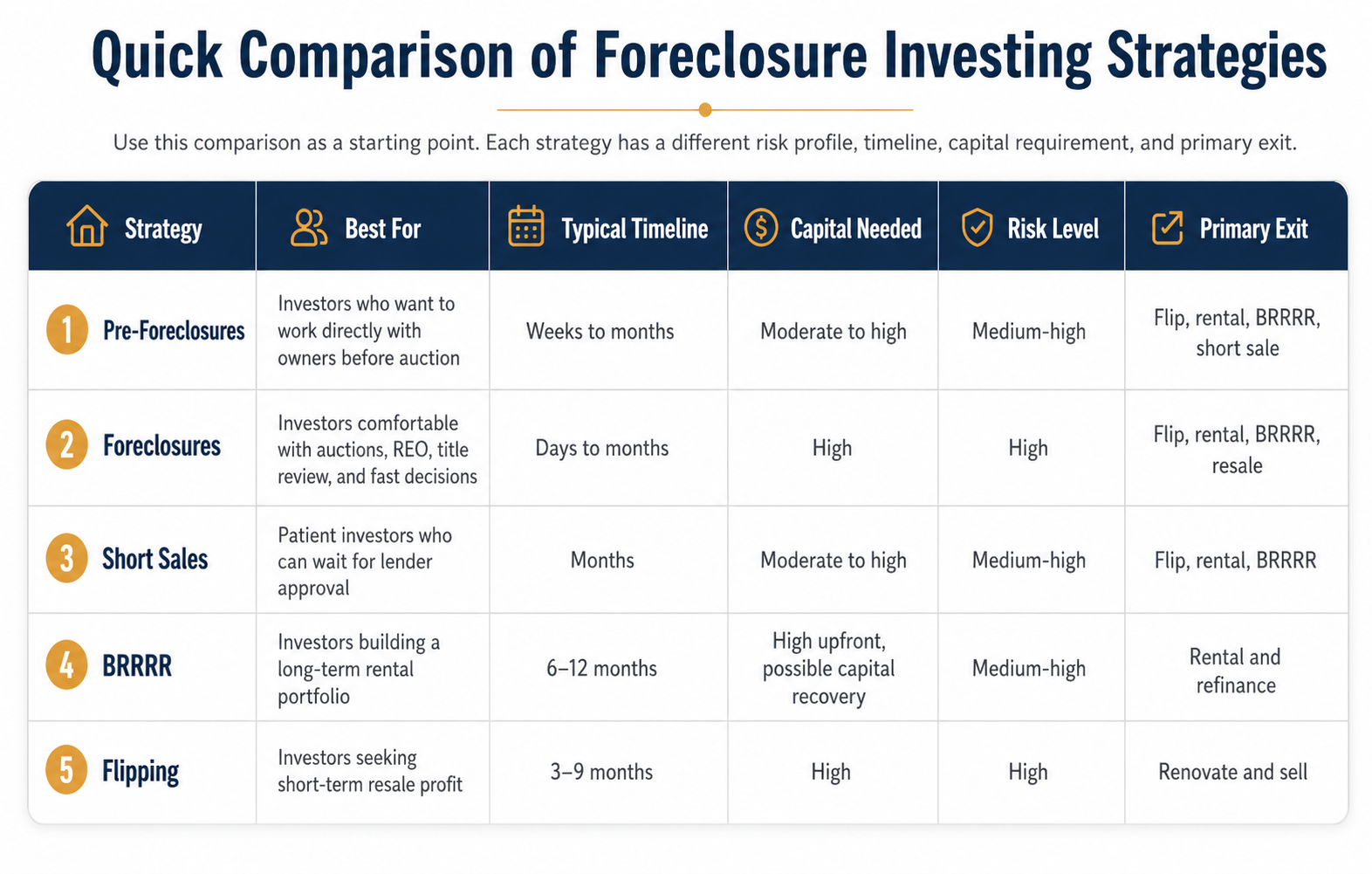
The 5 Core Foreclosure Investing Strategies
The strategies below are connected, but they are not interchangeable. A property may begin as a pre-foreclosure, become a short sale candidate, move to foreclosure auction, become bank-owned, and later be purchased by an investor for a flip or BRRRR rental.
Understanding the full cycle helps you decide where you want to enter the market and what type of opportunity you are best prepared to handle.
1. Pre-Foreclosures
Pre-foreclosure investing focuses on properties where the homeowner is behind on payments or moving through the early stages of default, but the property has not yet been sold through foreclosure.
The homeowner still owns the property. That means an investor may be able to negotiate directly with the owner before the home reaches auction. In some cases, the owner may want to sell quickly to avoid foreclosure, preserve equity, relocate, or resolve a difficult financial situation.
The opportunity comes from timing. Investors who identify pre-foreclosure properties early may find deals before they become broadly visible to auction buyers, REO agents, or other investors.
But pre-foreclosure investing requires care. The investor must verify the foreclosure timeline, review liens and taxes, estimate property value, understand repair costs, and communicate professionally with homeowners who may be under financial stress.
This strategy is best for investors who are comfortable with direct outreach, negotiation, due diligence, and time-sensitive decision-making.
Best fit: Investors who want to find opportunities before auction and are comfortable working directly with owners.
Key risks: Legal compliance, title issues, liens, seller distress, short timelines, and uncertain seller motivation.
2. Foreclosures
Foreclosure investing usually refers to buying properties deeper in the foreclosure process. This can include public foreclosure auctions, sheriff sales, trustee sales, REO properties, bank-owned homes, and government-owned foreclosure inventory.
The appeal is straightforward: foreclosure can create access to distressed properties that may sell below full retail value. Some investors buy these properties to renovate and resell. Others use them as rentals or BRRRR candidates.
The risk is that foreclosure investing often moves quickly and allows less room for error. Auction purchases may require cash or certified funds. Some properties cannot be inspected before purchase. Some may be occupied. Some may have unpaid taxes, title issues, municipal liens, or redemption rights.
REO and bank-owned properties may be easier to inspect and finance than auction properties, but they can also attract more competition and may still be sold as-is.
This strategy is best for investors who can move quickly, understand local foreclosure rules, analyze title and repair risk, and avoid overbidding.
Best fit: Investors with access to cash or fast financing who can evaluate distressed properties quickly and conservatively.
Key risks: Title issues, limited inspection access, auction rules, occupancy problems, repair uncertainty, and overbidding.
3. Short Sales
A short sale happens when a homeowner sells the property for less than the total mortgage debt owed, and the lender agrees to accept less than full payoff.
The homeowner still owns the property, but the lender must approve the sale because the proceeds will not fully satisfy the mortgage. That makes short sale investing different from both pre-foreclosure investing and foreclosure auction buying.
Short sales can create opportunities when a property is worth less than the loan balance, the owner needs to sell, and the lender believes a discounted sale is better than completing foreclosure. For investors, the potential benefit is buying a distressed property before it becomes bank-owned or goes to auction.
The challenge is timing and uncertainty. Short sales can take weeks or months. The lender may reject the offer, counter at a higher price, require additional documents, or delay approval. Junior lienholders can also complicate the transaction.
This strategy is best for patient investors who can analyze deals conservatively, work through lender approval, and avoid tying up all of their time in one uncertain transaction.
Best fit: Investors who are patient, organized, and comfortable with lender approval processes.
Key risks: Lender rejection, long timelines, junior liens, foreclosure deadlines, valuation disputes, and approval conditions.
4. BRRRR
BRRRR stands for Buy, Rehab, Rent, Refinance, Repeat.
This strategy is designed for investors who want to build a rental portfolio while recycling capital. The investor buys a distressed or undervalued property, renovates it, rents it to a qualified tenant, refinances based on the improved value and rental income, then uses recovered capital to pursue another deal.
BRRRR is often connected to foreclosure investing because distressed properties can provide the below-market acquisition price needed to make the strategy work. Pre-foreclosures, foreclosures, short sales, REO properties, and fixer-upper listings can all become BRRRR candidates if the numbers support the full cycle.
The most important point is that a BRRRR deal must work twice. It must work as a renovation project, and it must work as a long-term rental after refinance.
The biggest risks are overpaying, underestimating repairs, overestimating rent, getting a low appraisal, failing to meet lender requirements, or refinancing into weak cash flow.
Best fit: Investors who want to build a long-term rental portfolio and are comfortable managing renovation, tenants, and refinance risk.
Key risks: Rehab overruns, low appraisal, higher interest rates, weak rent, refinance shortfall, and negative cash flow.
5. House Flipping
House flipping involves buying a property, renovating or improving it, and reselling it for a profit.
Foreclosure-related properties are common flip candidates because they may be distressed, outdated, vacant, bank-owned, or in need of repairs. Investors may source flip opportunities through pre-foreclosures, foreclosure auctions, short sales, REO listings, wholesalers, estate sales, or distressed MLS listings.
The potential upside is short-term profit. A successful flip can return capital faster than a long-term rental strategy and does not require ongoing tenant management.
The risk is that flipping compresses many variables into a short period. The investor must buy at the right price, estimate after-repair value correctly, control renovation costs, manage contractors, carry financing and holding costs, and sell at a price that supports the projected profit.
A flip is often won or lost before the purchase. If the acquisition price is too high, even a good renovation may not save the deal.
Best fit: Investors seeking short-term resale profit who can manage contractors, budgets, timelines, and resale execution.
Key risks: Overpaying, repair overruns, contractor problems, financing costs, appraisal risk, slow resale, and market shifts.
Which Foreclosure Investing Strategy Is Right for You?
There is no single best foreclosure investing strategy. The right choice depends on what you are trying to accomplish and what risks you are prepared to manage.
- Choose Pre-Foreclosures if you want to find opportunities before auction and are comfortable contacting homeowners directly.
- Choose Foreclosures if you can move quickly, understand auction or REO rules, and have access to cash or fast financing.
- Choose Short Sales if you are patient and willing to wait for lender approval.
- Choose BRRRR if your goal is to build a long-term rental portfolio and recycle capital through refinancing.
- Choose Flipping if your goal is short-term resale profit and you can manage renovation and market risk.
The better question is not “Which strategy is easiest?” The better question is: “Which strategy fits my capital, skills, timeline, and risk tolerance?”
How These Strategies Fit Together
Foreclosure investing strategies are connected by the distressed-property lifecycle.
A homeowner may first fall behind on mortgage payments. At that point, the property may become a pre-foreclosure opportunity. If the homeowner owes more than the home is worth, the situation may become a short sale candidate. If no sale or resolution occurs, the property may move to foreclosure auction, sheriff sale, trustee sale, or eventually become bank-owned.
Once an investor acquires the property, the exit strategy may become flipping or BRRRR.
A simplified pathway looks like this:
Pre-Foreclosure → Short Sale or Foreclosure → Auction / REO → Flip or BRRRR
This is why it helps to understand all five strategies, even if you plan to focus on only one. The same property can move through multiple stages, and the best opportunity may depend on when you find it.
Start Researching Distressed Property Opportunities
Understanding the strategy is the first step. The next step is learning how to evaluate actual properties.
Start by reviewing distressed-property listings, then compare each opportunity against local sales data, repair estimates, title information, financing options, and your intended exit strategy.
Do not chase every distressed property. Look for deals where the strategy, numbers, timeline, and risk profile all fit together.
Frequently Asked Questions
What is the best foreclosure investing strategy for beginners?
For many beginners, REO properties, bank-owned homes, or MLS-listed distressed properties may be easier to understand than foreclosure auctions. Pre-foreclosures and short sales can also work, but they require more seller communication and process management. Auction investing is usually more advanced because of cash requirements, title risk, and limited inspection access.
Is pre-foreclosure investing the same as foreclosure investing?
No. Pre-foreclosure happens before the property is sold through foreclosure. The homeowner still owns the property. Foreclosure investing usually refers to buying at auction, through sheriff or trustee sale, or after the lender takes ownership as an REO property.
Are short sales better than foreclosures?
Not necessarily. Short sales may provide more time for inspection and negotiation, but they require lender approval and can take months. Foreclosure auctions may move faster, but they often carry more title, cash, inspection, and occupancy risk.
Can you use BRRRR with foreclosed properties?
Yes. A foreclosed property can become a BRRRR deal if it is purchased at the right price, renovated properly, rented to a qualified tenant, and refinanced on terms that support positive cash flow.
Is house flipping riskier than BRRRR?
The risks are different. Flipping carries short-term resale and renovation risk. BRRRR carries renovation, rental, and refinance risk. Flipping depends on selling for a profit. BRRRR depends on long-term rental performance and lender refinance terms.
Do you need cash to invest in foreclosures?
Not always, but cash or fast financing is often important. Foreclosure auctions may require cash or certified funds, while REO properties and bank-owned homes may allow conventional financing, hard money, or renovation loans if the property qualifies.
Which strategy has the fastest timeline?
Foreclosure auction purchases can happen quickly, but they also carry higher risk. House flips may take three to nine months. BRRRR deals often take six to twelve months. Short sales are usually slower because lender approval can take weeks or months.
Which strategy is best for long-term rental investing?
BRRRR is usually the most direct strategy for investors who want to build a rental portfolio. However, pre-foreclosures, foreclosures, short sales, and distressed listings can all feed into BRRRR if the property works as a rental after repairs and refinancing.