
House Flipping: How to Find, Analyze, Renovate, and Sell a Profitable Flip
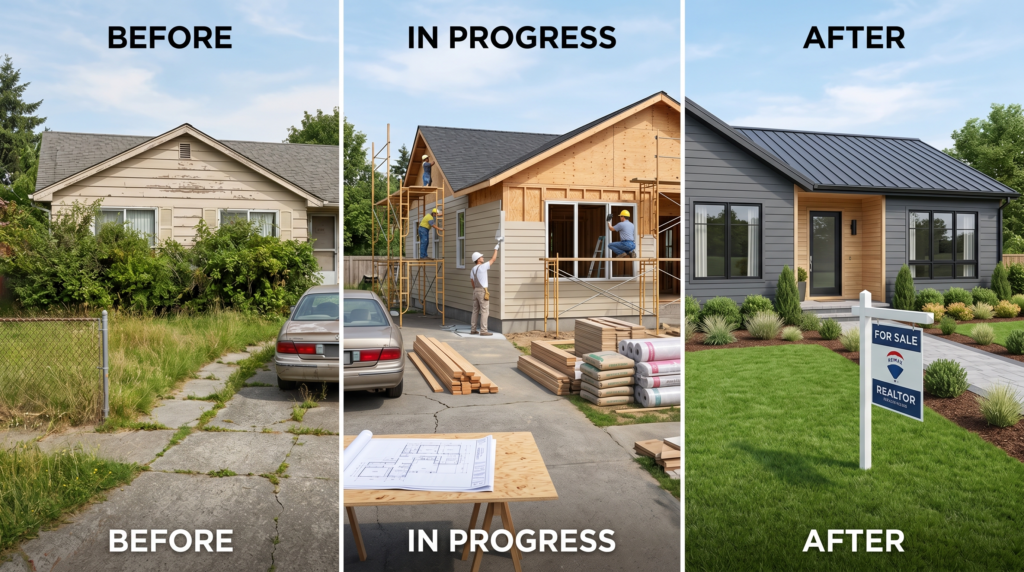
House flipping is one of the best-known real estate investment strategies. The basic idea is simple: buy a property, improve it, and resell it for a profit.
That simplicity is part of the appeal. Unlike long-term rental investing, flipping does not require years of tenant management. Unlike BRRRR investing, it does not depend on a refinance to recover capital. Unlike buying and holding, it is usually designed to produce a shorter-term return.
But house flipping is not just buying an ugly house and making it look better.
A profitable flip is a project-based investment. The investor must buy correctly, estimate repairs accurately, manage contractors, control financing and holding costs, understand resale demand, price the finished property properly, and close the sale before expenses consume the margin.
Small mistakes can become expensive quickly. Paying $15,000 too much, missing $20,000 in repairs, taking three extra months to finish, or overestimating resale value can turn a promising flip into a break-even project or a loss.
The best house flippers are not just good at finding distressed properties. They are good at managing risk. They know their numbers before they buy. They renovate for the target buyer, not for personal taste. They keep a close eye on timeline and budget. They know when to walk away from thin-margin deals.
This guide explains how house flipping works from start to finish, including how to find opportunities, estimate after-repair value, calculate maximum offers, finance a flip, manage renovations, sell the finished property, avoid common mistakes, and decide whether flipping fits your investment goals.
Get Foreclosure Investing Insights Twice a Week
Subscribe to the Foreclosure Flips newsletter for practical ideas on finding deals, analyzing opportunities, and understanding foreclosure-related investing strategies. We send concise updates twice a week so you can stay informed without adding more noise to your inbox.
What Is House Flipping?
House flipping is the process of buying a property, improving or repositioning it, and reselling it for more than the total cost of acquisition, repairs, holding, financing, and resale.
The word “total” is important.
A flip’s profit is not simply the resale price minus the purchase price. True profit is calculated after all project costs are included.
Those costs may include:
Purchase price.
Buyer closing costs.
Repair and renovation costs.
Permit fees.
Utility costs.
Insurance.
Property taxes.
HOA dues.
Loan interest.
Lender points and fees.
Appraisal or inspection fees.
Contractor deposits.
Material costs.
Holding costs.
Staging.
Photography.
Seller closing costs.
Agent commissions.
Buyer credits or concessions.
Contingency reserves.
A property purchased for $180,000 and sold for $280,000 did not produce a $100,000 profit if the investor spent $60,000 on repairs, $15,000 on financing, $8,000 on holding costs, and $22,000 on selling costs.
The actual profit would be much lower.
House flipping can take several forms.
A cosmetic flip may involve paint, flooring, fixtures, landscaping, appliances, and light repairs.
A heavy renovation flip may involve roofing, HVAC, plumbing, electrical, kitchens, bathrooms, structural repairs, layout changes, or additions.
A distressed-property flip may start with a pre-foreclosure, foreclosure, short sale, estate sale, vacant property, or bank-owned home.
A value-add flip may involve solving a specific problem, such as poor layout, outdated finishes, deferred maintenance, code issues, or poor marketing.
The basic structure is the same: buy, improve, sell.
The challenge is making sure the finished resale price is high enough to cover every cost and still leave a profit that justifies the risk.
House Flipping vs. BRRRR vs. Wholesaling vs. Buy-and-Hold
House flipping is one real estate strategy among several. It is useful to compare it with BRRRR, wholesaling, and buy-and-hold investing because many distressed properties could fit more than one path.
| Strategy | Main Goal | Typical Hold Period | How Profit Is Created | Main Risk |
|---|---|---|---|---|
| House Flipping | Short-term resale profit | Months | Buy low, improve, resell | Rehab overruns, resale risk |
| BRRRR | Long-term rental portfolio growth | Long-term hold | Forced appreciation, rent, refinance | Refinance shortfall, cash flow risk |
| Wholesaling | Assign or resell the deal | Days to weeks | Contract spread or assignment fee | Legal compliance, buyer demand |
| Buy-and-Hold | Long-term income and appreciation | Years | Cash flow, appreciation, debt paydown | Tenant, expense, and market risk |
Flipping and BRRRR are closely related because both usually involve buying a property that needs work and creating value through renovation.
The difference is the exit.
A flipper sells the property after renovation.
A BRRRR investor rents the property and refinances it.
Wholesaling is different because the investor may not renovate or hold the property. The wholesaler finds or controls a deal and assigns or resells the opportunity to another buyer, where legally permitted.
Buy-and-hold investing is focused on long-term income, appreciation, tax benefits, and principal paydown. It may involve some renovation, but the purpose is usually ongoing ownership rather than resale.
A property can move between strategies. A planned flip may become a rental if the resale market softens. A BRRRR deal may become a flip if the rental numbers do not work. A wholesale deal may be purchased directly by an investor who decides to renovate and resell.
The strategy should be selected before purchase, but the investor should also know the backup plan.
Who House Flipping Is Best For
House flipping is best for investors who can manage short-term project risk and make disciplined decisions under pressure.
It may be a good fit for investors who:
Can analyze deals quickly and conservatively.
Have access to acquisition and rehab capital.
Understand local resale demand.
Can estimate repairs or work closely with contractors who can.
Are comfortable managing renovation timelines.
Can handle financing and holding costs.
Have strong cash reserves.
Understand buyer expectations in the target price range.
Can make decisions without becoming emotionally attached to the property.
Are willing to walk away from deals with thin margins.
House flipping is less suitable for investors who need predictable income, lack reserves, dislike project management, or cannot tolerate the possibility of delays, budget overruns, and resale uncertainty.
It is also not ideal for investors who are attracted mainly by the visible transformation. The renovation is only one part of the business. A flip succeeds because the numbers work, not because the finished property looks better than it did before.
The best flippers are practical. They renovate for the market, not for themselves. They focus on the buyer profile, comparable sales, budget control, and time-to-sale.
A beautiful renovation can still be a bad flip if the investor overpaid or spent too much.
How House Flipping Works Step by Step
House flipping follows a clear sequence. The exact process varies by market, property, financing, and scope of work, but most flips include these steps.
1. Choose a target market
Before searching for deals, choose the market or submarket.
A strong flipping market usually has enough transaction volume, buyer demand, reliable comparable sales, contractor availability, and price points that support the required profit margin.
The best flipping market is not always the fastest-appreciating market. A hot market can attract heavy competition and reduce margins. A weak market may offer lower prices but slower resale and higher risk.
The ideal market has enough demand to sell the finished property within a reasonable timeframe.
2. Define buyer demand and property type
A flip should be planned around the likely end buyer.
The target buyer may be a first-time homebuyer, move-up buyer, downsizing buyer, investor buyer, or owner-occupant looking for a renovated home.
This affects renovation choices.
A first-time buyer may care about affordability, financing condition, clean finishes, and low near-term maintenance.
A higher-end buyer may expect better materials, layout improvements, curb appeal, and upgraded systems.
An investor buyer may care more about rentability, durability, and price.
The investor should know who will buy the finished property before deciding what to repair or upgrade.
3. Find potential flip deals
Flipping usually requires buying below finished market value. That often means sourcing properties with distress, deferred maintenance, outdated finishes, poor marketing, legal complications, or seller motivation.
Possible sources include pre-foreclosures, foreclosures, short sales, REO properties, probate leads, estate sales, tired landlords, wholesalers, off-market sellers, and distressed MLS listings.
4. Estimate after-repair value
After-repair value, or ARV, is the expected resale value after the property is renovated.
This is one of the most important numbers in the entire flip. If ARV is wrong, every other calculation becomes unreliable.
ARV should be based on comparable sold properties, not wishful thinking. The best comps are recent, nearby, similar in size, similar in bedroom and bathroom count, similar in property type, and similar in finished condition.
5. Estimate repairs
Repair estimating should be detailed. A rough guess is not enough.
The investor should identify the full scope of work, including structural issues, major systems, interior finishes, exterior repairs, landscaping, permits, cleanup, and contingency reserves.
If the investor is new, contractor input is especially important.
6. Calculate maximum allowable offer
The maximum allowable offer is the highest price the investor can pay while still achieving the desired profit.
This number should be calculated before making an offer. It should include every major cost category, not just purchase price and repairs.
7. Secure financing
Financing should be in place before committing to a flip.
Common sources include cash, hard money, private money, bridge loans, business lines of credit, HELOCs, partnerships, and fix-and-flip loans.
The investor should understand all financing costs, including points, interest, fees, draws, inspections, extensions, and minimum interest requirements.
8. Complete due diligence
Before closing, review title, liens, taxes, HOA rules, permit issues, zoning, insurance, utilities, occupancy, repair scope, and resale comps.
The goal is to confirm that the property can be bought, renovated, insured, and resold as planned.
9. Purchase the property
Once the deal passes underwriting and due diligence, the investor closes on the property.
At this point, the clock starts. Holding costs begin immediately, and every delay reduces profit.
10. Finalize renovation scope
After closing, confirm the renovation plan, contractor schedule, materials, permits, and budget.
Ideally, much of this planning should happen before closing so work can begin quickly.
11. Manage contractors and permits
Contractor management is central to flipping. The investor must monitor scope, schedule, quality, budget, and change orders.
Permits should be handled properly. Skipping required permits can create resale, appraisal, insurance, and legal problems.
12. Monitor budget and timeline
A flip should be tracked weekly, sometimes daily.
The investor should compare actual spending to budget and actual progress to schedule. Small delays and overruns become serious if ignored.
13. Prepare the property for resale
Before listing, finish the punch list, clean the property, improve curb appeal, consider staging, arrange professional photography, and confirm the property is ready for buyer inspections and financing.
14. List and market the property
The listing strategy should be based on current market conditions, comparable sales, buyer demand, seasonality, and days on market.
Overpricing can create stale inventory. Underpricing may leave money on the table. The right price should attract serious buyers while protecting margin.
15. Negotiate offers
The highest offer is not always the best offer. Buyer financing, appraisal risk, inspection demands, contingencies, closing timeline, and concessions all matter.
16. Close the resale
Once the buyer closes, the investor receives proceeds and can calculate actual profit.
The actual result should be compared with the original estimate.
17. Review the project
Every flip should end with a review.
What was the projected profit?
What was the actual profit?
Which repairs were underestimated?
Which delays occurred?
Was ARV accurate?
Did buyer demand match expectations?
Which contractor performed well?
What should be changed next time?
Professional flippers improve by reviewing actual results, not just completed projects.
Build Your Investing Knowledge One Email at a Time
Foreclosure investing rewards preparation. Join our 2X week newsletter for straightforward guidance on pre-foreclosures, short sales, BRRRR, flipping, and other strategies investors use to evaluate distressed property opportunities.
How to Find House Flipping Opportunities
A profitable flip usually starts with a good acquisition. In most cases, the investor needs to buy at a price that reflects the property’s condition, risk, and required profit.
Pre-foreclosures
Pre-foreclosures can be a source of flip opportunities because the homeowner may need to sell before the foreclosure process reaches auction.
These deals require respectful seller communication, careful legal compliance, title review, and enough time to close before the foreclosure deadline.
Foreclosures
Foreclosure auctions, sheriff sales, trustee sales, and bank-owned properties can produce flip opportunities.
Auction properties may offer discounts, but they often come with limited inspection access, strict payment rules, occupancy issues, and title risk.
REO properties may be easier to inspect and finance, but competition can be stronger.
Short sales
Short sales can lead to flip opportunities when the lender approves a price low enough to support renovation and resale.
The main challenge is timing. Short sales can take months and may be rejected or countered at a price that does not work.
REO and bank-owned properties
Bank-owned properties may be listed through agents, asset managers, or bank platforms. They are often sold as-is.
These properties may work for flips if the bank’s price reflects the repair needs and resale potential.
Estate sales and probate leads
Inherited properties can be good flip candidates, especially when the home is outdated, vacant, or owned by heirs who do not want to manage repairs.
Probate and estate-related deals require sensitivity and proper legal handling.
Distressed MLS listings
Not all flip deals are off-market. Some are listed publicly but overlooked because they need repairs, have poor photos, are mispriced, have been on the market too long, or do not qualify for traditional financing.
Off-market sellers
Off-market deals may come from direct outreach, referrals, local networking, vacant property research, or distressed-owner lists.
The advantage is potentially less competition. The challenge is that outreach requires consistency and compliance with applicable laws.
Wholesalers
Wholesalers can provide access to investor deals, but their numbers must be verified independently.
Never rely solely on a wholesaler’s ARV, repair estimate, or projected profit.
Investor-friendly agents
A strong investor-friendly agent can help identify distressed listings, price reductions, stale inventory, estate sales, bank-owned properties, and properties with renovation potential.
The agent should understand investor math, not just retail buyer demand.
Tired landlords
Tired landlords may own properties with deferred maintenance, under-market rents, difficult tenants, or management fatigue.
Some of these properties are better BRRRR candidates than flips, but others may work well for resale after renovation.
Code violation and vacant property lists
Properties with code violations or long-term vacancy may indicate owner distress or deferred maintenance.
These leads require careful research. Code violations can also create added costs.
Contractor referrals
Contractors often see properties that need work before investors do. Building contractor relationships can lead to referrals, especially when owners ask about selling instead of repairing.
Foreclosure listing platforms
Because flipping often depends on distressed acquisitions, foreclosure listing platforms can be useful for deal research.
You can begin by reviewing distressed-property opportunities through Foreclosure.com, then screen possible flip candidates based on ARV, repair scope, title risk, acquisition cost, and resale demand.
How to Analyze a House Flip
A house flip should be analyzed before purchase with conservative numbers.
The investor needs to know whether the spread between purchase price and resale value is large enough to cover all costs and still provide a profit worth the risk.
After-repair value
ARV is the estimated resale value after renovation.
This should be based on sold comps, not active listings. Active listings show competition. Sold listings show what buyers actually paid.
Good comps should be recent, close to the property, similar in size, similar in layout, similar in condition after renovation, and located in the same buyer market.
Current as-is value
As-is value is what the property is worth today in its current condition.
This matters because some sellers price distressed properties too close to retail value. If the as-is price is too high, the flip may not work.
Purchase price
The purchase price sets the profit ceiling. A great renovation cannot fully fix a bad acquisition.
The investor should determine the maximum price before making an offer and avoid negotiating beyond that number.
Repair budget
Repair costs should include labor, materials, permits, cleanup, dumpsters, utilities, inspections, landscaping, appliances, fixtures, contingency, and unexpected issues.
Major systems deserve special attention: roof, foundation, plumbing, electrical, HVAC, windows, drainage, sewer line, and structural repairs.
Financing costs
Financing costs may include origination points, interest, underwriting fees, inspection fees, draw fees, appraisal fees, extension fees, and minimum interest charges.
Hard money and private loans can be useful, but they are not cheap. Their cost must be included in the deal.
Holding costs
Holding costs are the costs of owning the property during the project.
These may include property taxes, insurance, utilities, HOA dues, lawn care, security, loan interest, and maintenance.
The longer the project takes, the higher the holding costs.
Closing costs
Buyer closing costs occur when the investor purchases the property. Seller closing costs occur when the investor resells it.
Both should be included.
Selling costs
Selling costs can include agent commissions, transfer taxes, title fees, seller credits, home warranty, staging, photography, and repair concessions after inspection.
These can be significant.
Contingency reserve
A contingency reserve protects against unknown costs.
For light cosmetic projects, the reserve may be lower. For heavy rehabs, older properties, or limited-access deals, the reserve should be higher.
Target profit
The target profit should justify the time, risk, and capital required.
A $15,000 projected profit may not be enough on a project with major renovation risk, expensive financing, and uncertain resale demand. A larger project usually requires a larger profit cushion.
Market risk
The resale market can change during the project. Interest rates can rise. Buyer demand can weaken. Competing listings can increase. Appraisals can come in low.
The investor should understand how much price softness the deal can absorb.
Timeline risk
Time affects profit. Delays increase financing costs, taxes, insurance, utilities, and opportunity cost.
A flip that looks profitable at four months may look much weaker at nine months.
The Maximum Allowable Offer Formula
The maximum allowable offer is the highest price an investor can pay and still meet the required return.
A practical formula is:
Maximum Allowable Offer = ARV − Repairs − Holding Costs − Financing Costs − Selling Costs − Desired Profit
For example:
After-repair value: $300,000
Estimated repairs: $45,000
Holding costs: $8,000
Financing costs: $12,000
Selling costs: $24,000
Desired profit: $35,000
Maximum allowable offer:
$300,000
minus $45,000
minus $8,000
minus $12,000
minus $24,000
minus $35,000
= $176,000
In this example, paying more than $176,000 would reduce the investor’s target profit unless another assumption improves.
The 70% Rule
Many investors use the 70% rule as a quick screening tool.
The 70% rule says an investor should pay no more than 70% of ARV minus repairs.
Example:
ARV: $300,000
70% of ARV: $210,000
Estimated repairs: $45,000
Rough maximum offer: $165,000
This can be useful for fast initial screening, but it should not replace full underwriting.
The 70% rule does not automatically account for local market conditions, financing cost, property taxes, insurance, agent commissions, buyer concessions, permit costs, holding time, or the investor’s required profit.
In some markets, 70% may be too aggressive and unrealistic. In other situations, especially with higher holding costs or heavy rehab risk, 70% may not be conservative enough.
Use the 70% rule as a first filter, not as the final answer.
Example House Flip Deal Math
Here is a simplified flip example.
Assume an investor is analyzing a property with the following numbers:
Purchase price: $170,000
Repairs: $50,000
Buyer closing costs: $6,000
Financing costs: $14,000
Holding costs: $8,000
Selling costs and commissions: $24,000
Contingency: $10,000
Expected resale price: $335,000
Total project cost:
$170,000 purchase price
- $50,000 repairs
- $6,000 buyer closing costs
- $14,000 financing costs
- $8,000 holding costs
- $24,000 selling costs
- $10,000 contingency
= $282,000 total project cost
Projected profit:
$335,000 expected resale price
− $282,000 total project cost
= $53,000 projected profit
On paper, this looks like a reasonable flip.
But now test the downside.
Assume repairs run $10,000 over budget and the property sells for $320,000 instead of $335,000.
Updated total project cost:
$282,000 original project cost
- $10,000 repair overrun
= $292,000
Updated profit:
$320,000 resale price
− $292,000 total project cost
= $28,000 projected profit
The profit dropped from $53,000 to $28,000.
Now assume the project also takes two extra months and adds $5,000 in financing, insurance, tax, and utility costs.
Updated total project cost:
$292,000
- $5,000 added holding and financing costs
= $297,000
Updated profit:
$320,000 resale price
− $297,000 total project cost
= $23,000
The flip still produces a profit, but the margin is much smaller. For many investors, $23,000 may not justify the risk, capital, and time involved.
This is why sensitivity analysis matters.
Before buying a flip, test what happens if:
Repairs are 10% to 20% higher.
The project takes two or three months longer.
The resale price is lower than expected.
The buyer asks for concessions.
Interest costs increase.
The appraisal comes in low.
A strong flip should survive some pressure. If the profit disappears after one or two realistic setbacks, the deal is too thin. Consider signing up for a 14-day $1 trial of Rehab Valuator to help you crunch the numbers.
Financing a House Flip
Most flips require capital for both acquisition and renovation. The financing structure affects speed, cost, risk, and profit.
Cash
Cash gives the investor control and speed. It can make offers more competitive and avoid lender requirements.
The downside is that cash ties up capital and concentrates risk. Even cash buyers should account for opportunity cost.
Hard money loans
Hard money is common in flipping. These loans are usually short-term and asset-based, often designed for acquisition and renovation.
The advantage is speed and flexibility. The drawback is cost. Hard money may include higher interest rates, origination points, draw fees, inspection fees, and extension fees.
A flip funded with hard money must be especially sensitive to timeline.
Private money
Private money may come from individuals, business contacts, local investors, or relationship-based lenders.
It can be flexible, but it should be documented properly with clear terms, repayment obligations, security, and default provisions.
Bridge loans
Bridge loans can help investors acquire and renovate property while planning a resale or refinance.
Like hard money, bridge financing is usually more expensive than conventional financing and should be used with a clear exit.
Business line of credit
Some investors use a business line of credit to fund repairs, deposits, materials, or smaller acquisitions.
This can be flexible, but the investor must manage repayment terms and interest costs.
HELOC
A home equity line of credit may provide accessible capital for experienced investors, but it puts another property at risk.
Using personal home equity to fund flips should be approached carefully.
Partnership capital
A partner may contribute cash, credit, construction expertise, or operational support.
Partnerships require clear written agreements covering capital contributions, decision-making, profit splits, responsibilities, exit rights, and dispute resolution.
Fix-and-flip loans
Some lenders offer specific fix-and-flip loan products. These may fund a percentage of purchase price and renovation costs, with draws released as work is completed.
Investors should understand draw schedules. If the lender reimburses work after completion, the investor may still need cash upfront.
Seller financing
In some cases, the seller may finance part of the purchase. This is less common for distressed flips but can be useful if terms are favorable and legally appropriate.
Financing costs to include
No matter which financing source is used, include:
Origination points.
Interest rate.
Minimum interest period.
Draw fees.
Inspection fees.
Appraisal fees.
Underwriting fees.
Extension fees.
Late fees.
Legal fees.
Title fees.
Required reserves.
Prepayment penalties.
Financing can make a good flip possible, but it can also erase profit if the project takes too long.
Stay Ahead of the Next Deal
Markets move quickly, and good foreclosure opportunities often require fast analysis. Subscribe to our twice-weekly newsletter for investor-focused tips, tools, and market insights designed to help you make better decisions.
The Renovation Phase: Managing Scope, Budget, and Timeline
The renovation phase is where the visible transformation happens. It is also where many flips lose money.
Scope of work
The scope of work should clearly define every planned repair and upgrade.
It should include demolition, framing, electrical, plumbing, HVAC, roofing, windows, flooring, paint, cabinets, counters, fixtures, appliances, exterior repairs, landscaping, cleanup, and punch-list items.
A vague scope creates disputes, change orders, and budget surprises.
Contractor selection
The contractor should be qualified for the project size and type.
Check licensing where required, insurance, references, prior work, availability, communication style, and payment expectations.
A contractor who is good at small repairs may not be the right fit for a full renovation. A contractor who is skilled but unavailable can still damage the timeline.
Permits
Permits should be handled properly.
Unpermitted work can create problems during resale, inspection, appraisal, insurance, and future buyer financing. It can also create legal exposure.
Permit requirements vary by location and type of work. Structural, electrical, plumbing, HVAC, roofing, and additions often require permits.
Budget contingency
Every flip should include contingency.
Older properties and distressed homes often reveal hidden issues after demolition begins. Water damage, termite damage, bad wiring, plumbing leaks, foundation movement, mold, and prior poor workmanship are common surprises.
A contingency reserve is not optional. It is part of responsible underwriting.
Timeline management
Time is money in a flip.
A project that takes two extra months increases financing costs, holding costs, insurance, taxes, utilities, and opportunity cost.
The investor should set a realistic schedule and monitor progress frequently.
Material selection
Materials should match the target resale price and buyer expectations.
The goal is not to use the cheapest possible materials or the most expensive finishes. The goal is to create a finished property that feels appropriate for the market and supports the resale price.
Avoiding over-improvement
Over-improvement is spending money that the resale market will not reward.
Luxury finishes in a modest neighborhood may look good but fail to increase resale value enough to justify the cost.
Renovate for the comparable sales, not for personal taste.
Appraisal and resale standards
If the likely buyer will use financing, the property must be able to pass appraisal and inspection standards.
Health, safety, habitability, and code-related issues matter. A beautiful kitchen will not overcome serious defects in roof, electrical, plumbing, or structural systems.
Utility activation
Utilities may be needed for contractor work, inspections, appraisals, cleaning, HVAC testing, plumbing checks, and buyer walkthroughs.
Delays in utility activation can slow the project.
Inspections
Some investors use pre-listing inspections to identify issues before buyers do. This can reduce surprises during the sale process.
At minimum, major systems should be reviewed before listing.
Change orders
Change orders should be documented in writing. They should include cost, timeline impact, and approval before work proceeds.
Uncontrolled change orders are a common cause of budget overruns.
Project tracking
Track spending and progress regularly.
Compare actual costs against budget by category. Compare actual completion against the schedule. Identify delays early.
Punch list
The punch list includes final items needed before listing: touch-up paint, caulking, hardware, cleaning, missing trim, landscaping, appliance installation, fixture adjustments, and small repairs.
A poorly completed punch list can weaken buyer confidence.
Quality control
Quality matters. Buyers and inspectors will notice sloppy finishes, uneven flooring, poor paint, cheap fixtures, loose hardware, drainage problems, and incomplete repairs.
Quality does not mean luxury. It means the work is complete, clean, functional, and appropriate for the price point.
Selling the Finished Flip
The sale should be planned before renovation begins. The target buyer determines the renovation scope, finish level, layout decisions, and pricing strategy.
Pricing strategy
The list price should be based on completed comps and current competition.
Overpricing can cause the property to sit. A stale listing may require price cuts and signal weakness to buyers.
Underpricing may generate activity but can leave profit behind.
The right price should reflect the property’s condition, location, buyer demand, and recent sales.
Listing timing
Seasonality can matter. In many markets, buyer demand is stronger during certain months and slower during others.
The investor should consider local market patterns when projecting resale timing.
Staging
Staging can help buyers understand layout, scale, and lifestyle appeal. It may be especially useful for vacant homes, awkward layouts, or higher-end flips.
Not every flip needs full staging, but the property should feel clean, finished, and move-in ready.
Photography
Professional photography is important. Many buyers form their first impression online.
Poor photos can reduce traffic even when the renovation is strong.
Curb appeal
Curb appeal affects showings and buyer perception. Landscaping, exterior paint, entryway condition, lighting, house numbers, driveway condition, and front door appearance all matter.
Pre-listing inspection
A pre-listing inspection can help identify issues before buyer inspections. This may reduce renegotiation risk.
It can also help the seller disclose known repairs more confidently.
Buyer financing compatibility
The property should be in condition to support the likely buyer’s financing.
If most buyers in the price range use FHA, VA, or conventional financing, the property must be able to satisfy condition requirements.
Appraisal risk
The buyer’s lender may order an appraisal. If the appraisal comes in below contract price, the deal may require renegotiation, buyer cash, or cancellation.
Strong comps and appropriate pricing reduce this risk.
Negotiation
Offers should be reviewed based on more than price.
Consider financing type, down payment, appraisal gap coverage, inspection terms, closing timeline, contingencies, and buyer credibility.
Repair requests
Even renovated homes may generate inspection requests. Budget for possible concessions or repairs.
Seller concessions
Buyers may ask for closing cost credits, rate buydowns, repair credits, or price reductions. These reduce net profit and should be considered in the underwriting.
Days on market
The longer the property sits, the more holding costs accumulate. Days on market should be monitored closely.
If buyer traffic is weak, review price, photos, showing feedback, staging, and competing listings.
Market shifts
The resale market can change during the renovation. Interest rates, inventory, buyer sentiment, and local competition can all affect the exit.
This is why investors need margin.
Due Diligence Checklist Before Buying a Flip
Use this checklist before purchasing a potential flip.
Confirm ARV with recent sold comps.
Confirm the target buyer profile.
Confirm current as-is value.
Estimate repair scope.
Get contractor estimates where possible.
Add contingency.
Check title.
Check liens.
Check unpaid property taxes.
Check HOA restrictions and dues.
Check permits required.
Check zoning and legal use.
Check flood zone status.
Check insurance availability and cost.
Check utility status.
Check occupancy.
Check access for inspection.
Check resale demand.
Review days on market for comparable sales.
Review competing active listings.
Confirm financing terms.
Calculate all acquisition costs.
Calculate all renovation costs.
Calculate all holding costs.
Calculate all selling costs.
Set maximum allowable offer.
Confirm expected profit.
Run downside scenarios.
Confirm exit strategy.
Prepare backup plan.
A flip should not be purchased because it “feels like a deal.” It should be purchased because the numbers support the risk.
Risks and Common Mistakes
House flipping has several common failure points.
Overpaying
Most flip problems begin at acquisition. If the investor pays too much, there may not be enough margin to absorb normal project risk.
Overestimating ARV
An inflated resale value can make a weak deal appear profitable. Use real comps and conservative assumptions.
Underestimating repairs
Repair costs are often higher than expected, especially in older or distressed properties.
Ignoring holding costs
Taxes, insurance, utilities, loan interest, HOA dues, and maintenance continue during the project.
A delayed flip can become expensive quickly.
Using the 70% rule blindly
The 70% rule is only a screening tool. It does not replace full underwriting.
Over-improving
Spending beyond what the neighborhood supports reduces profit.
Hiring the wrong contractor
Contractor problems can cause delays, budget overruns, poor workmanship, and failed inspections.
Skipping permits
Unpermitted work can create resale problems and legal exposure.
Weak project management
A flip needs active management. Delays and overruns often happen when no one is watching the details.
Ignoring buyer demand
A renovated property must match what buyers in that market want and can afford.
Listing too high
Overpricing can increase days on market and lead to price reductions.
Underestimating resale time
Selling may take longer than expected, especially in slower markets or higher price points.
Running out of capital
A flip can fail if the investor does not have enough reserves to finish the project or carry the property.
Using expensive financing without a backup
High-cost short-term financing creates pressure. If the project is delayed, interest and fees can erode profit.
Failing to insure properly
Renovation properties may require special insurance. A standard policy may not cover vacant or construction-related risks.
Ignoring tax implications
Flip profits are generally treated differently from long-term rental income or long-term capital gains. Investors should consult a tax professional.
Scaling too quickly
Completing one successful flip does not mean the investor is ready to manage several at once. Scaling increases capital needs, contractor complexity, and operational risk.
Learn the Strategies Behind Smarter Foreclosure Investing
Get practical foreclosure investing content delivered twice a week, including deal analysis tips, strategy breakdowns, useful tools, and new resources from Foreclosure Flips. Sign up to keep learning and spotting better opportunities.
Expected Timeline
A house flip often takes longer than expected.
A typical timeline may look like this:
Deal sourcing: ongoing.
Offer and closing: 7 to 45 days, depending on seller and financing.
Planning and permits: one to six weeks.
Renovation: one to six months, depending on scope.
Pre-listing preparation: one to two weeks.
Marketing and sale: days to months, depending on market.
Buyer closing: usually 30 to 45 days after contract.
Total timeline: often three to nine months.
Light cosmetic flips may be completed faster. Heavy rehabs, permit delays, contractor issues, supply problems, buyer financing delays, and slow resale markets can extend the timeline.
Time matters because holding and financing costs accumulate. A flip that produces a strong return in four months may be much less attractive if it takes ten months.
Investors should underwrite realistic timelines, not best-case timelines.
Exit Strategies and Backup Plans
The intended exit for a flip is resale, but every project should have a backup plan.
Reduce price and sell faster
If the market is slower than expected, reducing price may protect capital and stop holding costs from accumulating.
This is not ideal, but it may be better than waiting indefinitely.
Sell as-is to another investor
If the project becomes too large, too expensive, or too time-consuming, selling to another investor may preserve capital.
This is often a lower-profit exit, but it can reduce further risk.
Convert to rental
If the property does not sell at the desired price, it may be possible to rent it.
This only works if the rental numbers support the debt, operating expenses, and management.
Use BRRRR
A planned flip may become a BRRRR deal if the property rents well and can refinance based on improved value.
This requires lender support and positive post-refinance cash flow.
Refinance and hold
If resale timing is poor but the property is stable, refinancing and holding may be an option.
Bring in a partner
A partner may help provide capital, project management, or financing support. This should be handled with clear written terms.
Complete only essential repairs
If the budget becomes tight, the investor may need to prioritize essential repairs and avoid unnecessary upgrades.
This can reduce resale appeal, but it may preserve the project.
Rent temporarily until market improves
In some markets, renting temporarily may help cover carrying costs while waiting for better resale conditions.
This strategy should be used carefully because tenant occupancy can affect resale timing and property condition.
The best time to create a backup plan is before buying the property.
Tools, Resources, and Next Steps
House flipping works best with a structured process.
Useful tools and resources include:
ARV comparable sales tool.
Repair estimate checklist.
Contractor bid template.
Project budget spreadsheet.
Maximum allowable offer calculator.
Hard money lender.
Private money lender.
Title company.
Insurance broker.
Investor-friendly agent.
Listing agent.
Professional photographer.
Staging checklist.
Permit checklist.
Pre-listing inspection checklist.
Foreclosure or distressed-property listing source.
A practical next step is to create a flip analysis worksheet before making offers. The worksheet should include purchase price, repairs, contingency, financing costs, holding costs, selling costs, expected resale price, projected profit, and downside scenarios.
Then use that worksheet to screen potential deals before submitting offers.
You can start by researching distressed-property opportunities through Foreclosure.com, then evaluate each property based on ARV, repair scope, title status, financing cost, resale demand, and maximum allowable offer.
Frequently Asked Questions About House Flipping
What is house flipping?
House flipping is the process of buying a property, renovating or improving it, and reselling it for a profit after all acquisition, repair, holding, financing, and selling costs are included.
How does house flipping work?
An investor finds a property with renovation potential, estimates the after-repair value, calculates repair and project costs, buys below the finished value, completes the renovation, lists the property, and sells it to an end buyer.
Is house flipping profitable?
House flipping can be profitable, but profit depends on buying correctly, estimating repairs accurately, controlling the timeline, managing financing costs, and selling at a realistic price.
How much money do you need to flip a house?
The amount depends on the purchase price, repair budget, financing structure, lender requirements, closing costs, holding costs, and reserves. Even with financing, investors usually need cash for down payment, repairs, contingency, and carrying costs.
Can beginners flip houses?
Beginners can flip houses, but they should start conservatively, use experienced contractors, understand local comps, maintain reserves, and avoid major structural projects until they have more experience.
What is the 70% rule in house flipping?
The 70% rule is a rough screening method that suggests paying no more than 70% of ARV minus repairs. It can be useful as a quick filter, but it should not replace full deal analysis.
How do you calculate profit on a flip?
Flip profit is calculated by subtracting all costs from the resale price. Costs include purchase price, repairs, closing costs, financing costs, holding costs, selling costs, concessions, and contingency.
What is a good profit margin on a house flip?
A good profit margin depends on the project size, risk, timeline, and capital required. Larger or riskier projects generally require larger profit targets. Thin-margin flips can become losses quickly if repairs or resale assumptions change.
How long does it take to flip a house?
Many flips take three to nine months from purchase to resale, depending on renovation scope, permits, contractor performance, financing, market demand, and buyer closing timeline.
Can you flip foreclosed homes?
Yes. Foreclosed homes can be flipped if they are purchased at the right price and the investor properly accounts for repairs, title issues, occupancy, financing, and resale demand.
Is flipping better than BRRRR?
Neither is automatically better. Flipping is designed for short-term resale profit. BRRRR is designed for long-term rental ownership and capital recycling. The better choice depends on the property, market, financing, and investor goals.
What is the biggest risk in house flipping?
The biggest risk is margin compression. Overpaying, underestimating repairs, taking too long, using expensive financing, or selling below the projected price can quickly reduce or eliminate profit.
Do you need a contractor to flip houses?
Most investors need contractors, especially for major repairs. Even experienced investors often rely on licensed trades for electrical, plumbing, HVAC, roofing, structural work, and permitted improvements.
Can you finance a house flip?
Yes. Common financing options include cash, hard money, private money, bridge loans, fix-and-flip loans, business lines of credit, HELOCs, and partnership capital.
What happens if a flip does not sell?
The investor may reduce the price, offer concessions, rent the property, refinance and hold, sell to another investor, or adjust the strategy based on market conditions and cash flow.
Test Your House Flipping Knowledge
You already understand foreclosure investing basics. Now test your knowledge of ARV, repair budgets, holding costs, contractor risk, resale strategy, and profit margins.
Your Quiz Results
Want to Keep Building Your House Flipping Knowledge?
Subscribe to the Foreclosure Flips 2X newsletter for practical investing tips, checklists, worksheets, and new foreclosure investing resources.
Subscribe to the 2X NewsletterAnswer Review
Related Real Estate Investment Strategies
House flipping often begins with distressed acquisition.
Pre-foreclosures may create opportunities to buy directly from owners before auction.
Foreclosures may produce auction, sheriff sale, trustee sale, or bank-owned properties that can be renovated and resold.
Short sales may allow investors to buy properties below mortgage debt if the lender approves the sale.
BRRRR is closely related because both strategies involve buying and renovating. The difference is that flipping sells the property for short-term profit, while BRRRR keeps the property as a rental and refinances after stabilization.
Recommended related guides:
Understanding these related strategies helps investors decide whether a distressed property should be flipped, rented, refinanced, wholesaled, or avoided.
Final Takeaway
House flipping can produce strong short-term profits, but it is not a simple business. It is a margin-management strategy.
The investor must buy at the right price, estimate repairs conservatively, manage contractors, control financing and holding costs, renovate for the target buyer, price the finished property correctly, and sell before costs consume the profit.
The most important part of a flip often happens before closing. A disciplined purchase creates room for repairs, delays, buyer negotiations, and market changes. A bad purchase forces the investor to rely on perfect execution.
A strong flip should still work if repairs run higher, the project takes longer, or the resale price comes in slightly below expectations.
If the deal only works under perfect assumptions, it is not a strong flip.
The right approach is to analyze carefully, buy conservatively, renovate efficiently, monitor the project closely, maintain reserves, and protect the exit strategy from the beginning.
You might also like:
 House Flipping Market Analysis: How to Choose Profitable Areas
 Flip Property Exit Strategies: Maximizing Profit and Minimizing Risk
 Analyzing Neighborhood Trends for Flipping Success
 Estimating Renovation Costs for Flips: A Practical Guide + Free Worksheet
 Top House Flipping Markets for 2026
 Project Management Software for House Flipping