
How to Find Bankruptcy Foreclosure Property Deals
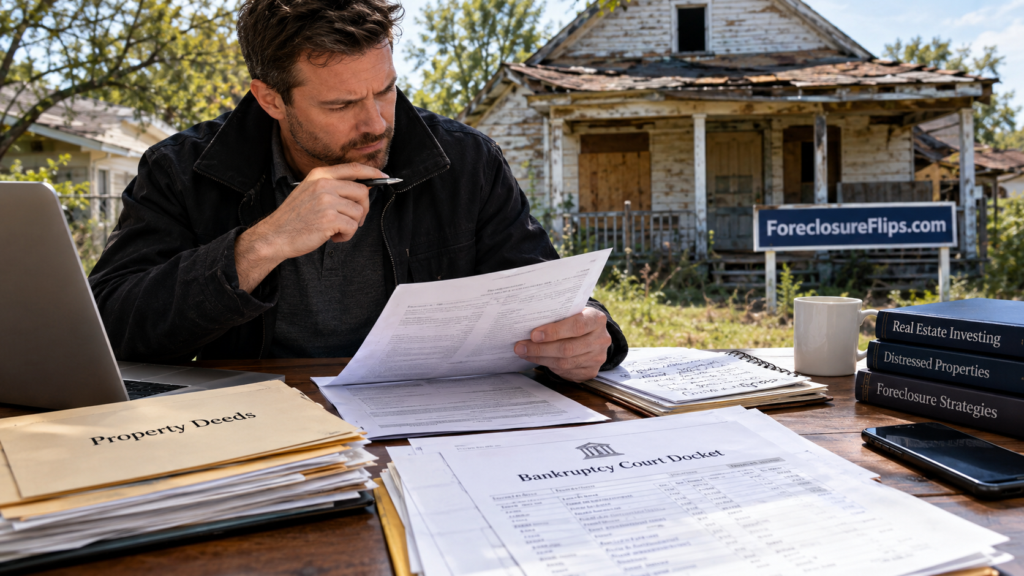
Bankruptcy foreclosure property deals can look like a shortcut to a discounted acquisition. A property appears on a distressed listing search, the owner has a bankruptcy case, and the price seems disconnected from nearby comparable sales. It is tempting to assume that a filing means the property is headed for a quick sale.
That assumption is where many investors lose time. Bankruptcy changes who controls a sale and can pause a foreclosure. It also tells you which court documents to read before you make an offer. In some cases, it may create a court-supervised opportunity to buy an asset. At other times, it simply pauses a foreclosure while the owner reorganizes debt, protects the home, or works through a repayment plan.
Your advantage does not come from treating a bankruptcy filing as a distress signal. It comes from understanding the case status. You also need to identify who has authority to sell and underwrite the property more carefully than the average bidder. This guide gives you a practical research system. You will learn how to find viable opportunities without ignoring legal, title, and timing risks.
This is investor education, not legal advice. Bankruptcy and foreclosure law are technical and local. Before making an offer or bid, ask a qualified real-estate attorney and title professional to advise you on the specific case and property.
Build Your Investing Knowledge One Email at a Time
Foreclosure investing rewards preparation. Join our 2X week newsletter for straightforward guidance on pre-foreclosures, short sales, BRRRR, flipping, and other strategies investors use to evaluate distressed property opportunities.
Step 1: Confirm the case can lead to a sale
A bankruptcy filing does not put real estate up for sale. It creates a legal process that can alter an existing foreclosure, affect control of the property, and require court approval for certain transactions. Your first job is to identify the type of case and what it means for the asset.
In a Chapter 7 case, the court appoints a trustee to administer the estate and liquidate nonexempt assets when doing so can benefit creditors. The U.S. Courts’ Chapter 7 overview explains that filing generally triggers an automatic stay that stops most collection actions, while the trustee evaluates property interests and liens. That can produce an investment opportunity, but most consumer Chapter 7 cases are not asset sales. Never assume a trustee will sell a house simply because the owner filed.
Chapter 13 requires a different mindset. It is designed for people with regular income who seek to retain property while repaying obligations under a plan, often over three to five years. The U.S. Courts’ Chapter 13 guidance notes that a filing can stop foreclosure proceedings and may allow past-due mortgage payments to be cured through the plan. For an investor, that means a Chapter 13 record may be a lead for later monitoring, but it is not permission to pursue a purchase as though the foreclosure were still moving forward.
Start your search with current bankruptcy foreclosure property deals in a market where you already know values, rents, and buyer demand. Use the listings to build a watchlist. Then let the court file and local property records determine whether an opportunity is real.
Step 2: Set a narrow buy box before you search court records
Bankruptcy research can quickly become a time sink. You will see cases involving properties with no equity, complicated liens, owners who intend to keep the home, and assets outside your preferred market. A defined buy box keeps your investigation focused.
Choose one or two neighborhoods and match them to a clear exit. For flips, target older homes in strong resale areas where renovations are predictable. Long-term investors may favor rental neighborhoods with stable demand, sensible taxes, and a rent level that supports the acquisition cost. The more uncertain your access to the property, the more important it is to operate in an area where you know what the finished asset should be worth.
Set your maximum all-in cost before reviewing individual cases. Include acquisition price, title and legal work, repairs, financing, insurance, taxes, utilities, holding costs, and a contingency reserve. Make an equally clear decision about what you will not buy: severe foundation uncertainty, a thin resale margin, a tenant situation outside your capability, or a title issue your attorney cannot resolve within your timeline.
Your goal is not to find the most troubled property. It is to find a property that can become a straightforward investment after the bankruptcy process is understood.
Step 3: Build a pipeline from filings, records, and local market data
The best bankruptcy deal-finding system is not a single website or a single search. It combines a distressed-property watchlist with primary records and regular market monitoring.
First, review bankruptcy-focused listings to identify addresses, neighborhoods, and apparent property type. Save only prospects that match your buy box. Next, use county assessor, recorder, treasurer, planning, permit, and code-enforcement records to match the street address to its parcel number and legal description. This step prevents you from making decisions based on a stale address, an incorrect square-footage figure, or a property with a similar street name.
Then search the bankruptcy case. The PACER Case Locator provides a nationwide index for federal court cases, while the specific bankruptcy court’s docket supplies the detail you need for an active file. Review the docket chronologically. You are looking for the petition date, chapter, debtor name, trustee, motions affecting real property, proposed sale notices, objections, conversion or dismissal activity, and orders.
Think of the docket as a timeline, not a lead list. A document title can tell you that a motion exists, but the body and subsequent entries show whether it was granted, opposed, withdrawn, superseded, or still pending. Do not treat an old notice as permission to make an offer months later.
Finally, keep watching conventional market signals. Recent comparable sales, active competition, rent levels, and days on market determine your exit. The bankruptcy case may explain the path to a potential transaction. It does not validate the price you pay.
Step 4: Read the case file like an investor, not a speculator
Identify the exact property interest
Confirm whether the debtor owns the property, holds it jointly, has an equitable interest, or simply occupies it. Compare the schedules and statements filed in the case with the county ownership record and the legal description. A bankruptcy involving one owner does not automatically mean that the entire property can be sold on the terms you expect.
Determine who can authorize a sale
Depending on the posture of the case, a homeowner, a Chapter 7 trustee, a lender after relief from the stay, or a debtor in a reorganization case may control the next step. Do not rely on a listing description to identify the decision-maker. Look for the party with authority in the current case posture, then have counsel confirm what approvals and documents are needed before you spend money on due diligence.
In a Chapter 7 asset case, a trustee considers whether administering a property will meaningfully benefit the estate. The U.S. Trustee Program’s asset-sale guidance emphasizes that trustees generally sell assets when the transaction produces a meaningful distribution for creditors or another significant benefit. That is one reason a heavily encumbered house may not become a trustee sale even when the owner’s financial position looks distressed.
Follow the documents that change the timeline
Prioritize motions for relief from the automatic stay, notices or motions to sell real property, orders authorizing a sale, plan-confirmation documents, abandonment notices, and case dismissal or conversion entries. These documents help you distinguish a paused foreclosure from an approved sale path.
A stay is not a permanent outcome, and a case can change chapters, be dismissed, or develop new objections. Keep a dated log with the document number, event, next deadline, and what it means for your investment thesis. It is a simple practice that prevents you from acting on stale information.
Build a lien and title map before discussing price
Bankruptcy schedules may reveal creditors, but they are not a substitute for title work. Ask a title company to search recorded mortgages, tax liens, judgment liens, mechanics’ liens, easements, unpaid assessments, and other exceptions. The treatment of a lien can depend on priority, notice, court orders, and state law.
Your attorney and title professional should explain the path to marketable title under the actual proposed transaction. If you plan to finance or resell quickly, that answer is more important than an attractive opening price. A discount cannot compensate for an issue that stops your exit.
Evaluate condition without crossing a line
Bankruptcy does not give you a right to enter, inspect, photograph through windows, or disturb occupants. Review only lawful sources: exterior observations from public areas, assessor data, permits, prior listings, aerial imagery, and contractor input based on what you can verify. If access later becomes available through the authorized seller, inspect thoroughly before you remove contingencies or finalize a price.
Budget with humility. A property that looks merely dated can conceal plumbing, electrical, roof, mold, or structural costs. In a limited-access situation, use a larger contingency and lower your maximum price accordingly.
Step 5: Underwrite the deal that may actually close
A useful bankruptcy acquisition model has three layers. Start with the property model: conservative after-repair value or stabilized rental value, repairs, and realistic market time. Next, calculate the transaction model: purchase price, title costs, legal expenses, court-related requirements, financing, insurance, taxes, utilities, and carrying costs. Then assess the process model: expected approval timeline, likelihood of objections, access limitations, and your fallback plan if the deal does not close.
For a renovation or resale opportunity, Rehab Valuator can help you organize the acquisition, rehab, funding, and exit assumptions in one place. The value is not a polished spreadsheet. It is the discipline of checking whether the margin survives a repair overrun, a closing delay, or a lower resale price.
Use sold comparable properties rather than optimistic active listings. Then test the downside. Ask whether your profit remains adequate if renovation costs rise by 15 to 20 percent. Consider whether you can carry the property if the sale process takes several additional months. Finally, decide whether you still want the deal if title review requires a different exit or lender. A durable investment survives more than one version of the future.
Step 6: Make offers through the correct channel
Once your research supports a potential acquisition, match your next action to the case. A proposed trustee sale, a lender-controlled foreclosure after proper relief, and a homeowner sale subject to bankruptcy approval are not interchangeable. Your attorney can help confirm the right party, required notices, approval process, and purchase agreement protections.
Come prepared with proof of funds, a clear offer structure, and a realistic closing timeline. But do not confuse speed with pressure. An offer that ignores title requirements, access limits, court approval, or funding deadlines may make you look unprepared and expose your earnest money or reputation.
Keep communication professional and factual. Do not make claims about the owner’s case, promise a result you cannot deliver, or pressure someone who may be represented by counsel. The most credible investor is the one who understands the process, respects its boundaries, and can close on the terms proposed.
When to walk away from a bankruptcy deal
Pause when the property does not match the legal description or ownership record. Stop when you cannot establish who has authority to sell. Reconsider the deal if the potential equity is thin after a conservative title, repair, and holding-cost estimate.
You should also walk away when your strategy depends on a court result that has not happened, access you have not been granted, or a future refinance that is not firmly available. A property can be genuinely distressed and still be a poor investment.
Finally, do not chase a filing simply because it is fresh. The best bankruptcy foreclosure property deals are often the ones where the process has become clear enough for you to assess risk—not the ones with the most confusing paperwork.
Turn a court filing into a disciplined acquisition plan
Start with one market, a narrow buy box, and a manageable number of leads. For each promising address, verify ownership, study the docket, order title work, estimate condition conservatively, and calculate a maximum all-in price. Do this for several cases before you make an offer. You will quickly learn which document patterns create real opportunities and which merely signal delay.
Bankruptcy can complicate a foreclosure, but it can also create a more transparent research trail for the investor willing to read it. Let the court record show you what is possible. Allow your underwriting to decide whether it is profitable. When both align, you have done more than find a distressed listing—you have found an opportunity you can explain, finance, and own with confidence.
You might also like:
 The Complete Foreclosure Due Diligence Checklist for Investors + Free Template
 Title Search for Foreclosure Properties: Investor Essentials
 Foreclosure Investing: How to Buy, Analyze, and Profit From Foreclosed Homes
 Judicial vs Non-Judicial Foreclosure for Investors
 Bankruptcy Property Due Diligence Checklist
 How Earnest Money Works in Distressed Property Deals