
Posts Tagged ‘Distressed Properties’
HUD Home Investing When the Numbers Work

HUD home investing can be a useful strategy when you understand the rules before you bid. These properties are not traditional foreclosure auction deals, and they are not the same as ordinary MLS listings. HUD homes are properties acquired by the U.S. Department of Housing and Urban Development after foreclosure on an FHA-insured mortgage. For…
Read MoreTax Lien vs Tax Deed Investing for Distressed Deals

Understanding tax lien vs tax deed investing is important before you bid on any tax-delinquent property opportunity. These two strategies sound similar, but they are not the same deal. In a tax lien sale, you are usually buying a lien connected to unpaid property taxes. In a tax deed sale, you may be bidding to…
Read MoreHow to Buy a Bankruptcy House as an Investor
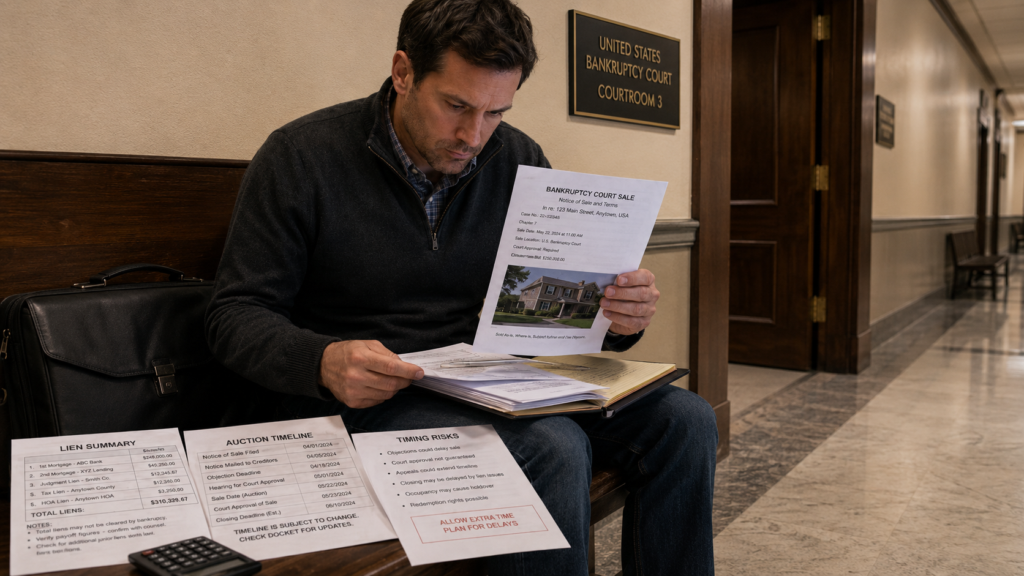
Bankruptcy house investing can create opportunities for real estate investors, but it is not the same as buying a standard foreclosure, REO property, or off-market distressed home. When a property is involved in bankruptcy, the sale may be controlled by a trustee, a debtor, a lender, the bankruptcy court, or some combination of those parties.…
Read MoreAuction Houses vs Online Foreclosure Auctions

Online foreclosure auctions have made distressed-property bidding more accessible, but easier access does not automatically make the deal safer. You may be able to bid from your laptop instead of standing at a courthouse, but you still need to understand deposits, buyer premiums, title risk, due diligence limits, closing rules, and payment deadlines. As an…
Read MoreTax Delinquency vs Mortgage Foreclosure for Investors

Understanding tax delinquency vs foreclosure helps investors separate two very different types of distressed-property opportunities. A homeowner who is behind on mortgage payments is not in the same situation as an owner who has unpaid property taxes. Both can lead to investor opportunities, but the process, timeline, risks, and profit model are different. Mortgage foreclosure…
Read MoreRochester Foreclosure Market 2026

The Rochester foreclosure market is not a high-price downstate market and should not be analyzed like New York City. It is a lower-basis, highly competitive upstate market where investor returns depend on buying correctly, controlling repair costs, understanding local code requirements, and matching the property to a realistic rental or resale exit. Rochester can be…
Read MoreBuffalo Foreclosure Market 2026

The Buffalo foreclosure market gives New York investors a very different set of opportunities than the New York City metro. Acquisition prices are lower, entry points are more approachable, and some properties can support rental or value-add strategies without the same capital burden found downstate. The tradeoff is that Buffalo’s lower price point does not…
Read MoreNew York City Metro Foreclosure Market 2026

The New York City Metro foreclosure market is not a simple distressed-property market. It is a court-driven, high-cost, record-heavy market where the best opportunities usually come from legal-file review, lien research, building-condition diligence, and submarket-specific exit planning. For this post, “New York City Metro” refers primarily to the New York side of the metro: the…
Read MoreMulti-Family Foreclosures How to Analyze the Deal

Multifamily foreclosure investing can be attractive because one acquisition may give you multiple rental units, several income streams, and a value-add opportunity in a single deal. But a multifamily foreclosure is not just a bigger version of a single-family foreclosure. You’re not only buying a building. You’re buying an income-producing asset with leases, tenants, expenses,…
Read More