
Can You Redevelop That Foreclosure Profitably?
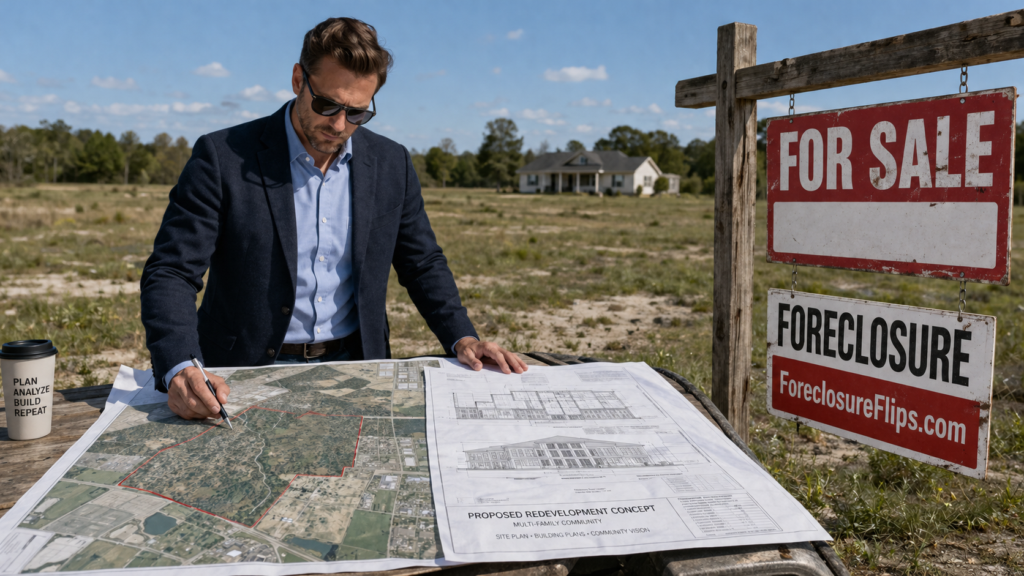
A badly deteriorated foreclosure can tempt you to view the house as an obstacle and the lot as the real opportunity. Sometimes that conclusion is correct. In other cases, zoning restrictions, site conditions, demolition costs, or approval delays consume the profit you expected.
Foreclosure redevelopment feasibility requires you to underwrite two assets at once: the structure you can see and the development site underneath it. Before you bid, determine what you could legally build, what the property can physically support, and whether the finished value justifies the additional risk.
Get Foreclosure Investing Insights Twice a Week
Subscribe to the Foreclosure Flips newsletter for practical ideas on finding deals, analyzing opportunities, and understanding foreclosure-related investing strategies. We send concise updates twice a week so you can stay informed without adding more noise to your inbox.
Start With Two Competing Investment Plans
Do not assume redevelopment represents the highest and best use simply because the existing property needs extensive repairs. Begin with two preliminary investment scenarios:
- Renovate the existing structure and sell or refinance it.
- Demolish, expand, convert, or replace the structure.
Apply the same purchase price, financing assumptions, holding costs, and profit requirements to both models. This side-by-side comparison often exposes redevelopment ideas that sound attractive but produce weaker risk-adjusted returns than a conventional foreclosure flip.
A redevelopment model also needs a longer time horizon. Renovation may require several months, while demolition, design, permitting, and new construction could extend the project well beyond a year.
This framework works best for infill properties where streets, neighboring development, and municipal services already exist. Raw land generally requires additional infrastructure and entitlement analysis.
Once you have both scenarios on paper, use the following feasibility tests to determine whether redevelopment is legally possible, physically practical, and financially worthwhile.
Test 1: Confirm What You Can Build by Right
A foreclosure’s lot size does not determine its redevelopment value. Local zoning controls permitted uses, density, setbacks, height, lot coverage, parking, and other development standards.
Check zoning and property overlays
Review the municipal zoning map and development code. You should also ask the local planning department whether the parcel falls within a historic district, design-review area, floodplain, redevelopment zone, or other overlay.
A use that appears permitted may still require a variance, special exception, site-plan approval, or rezoning. Each discretionary approval adds cost, time, and uncertainty.
Request written or independently verifiable confirmation whenever possible. Verbal guidance may help you screen a property, but it should not carry your final acquisition decision.
Calculate practical development yield
Suppose the zoning code appears to permit four residential units. Parking requirements, setbacks, fire access, stormwater controls, an easement, or limited lot width may reduce the workable plan to two.
Focus on practical yield rather than theoretical density. An architect or land-use professional can prepare a preliminary density study when redevelopment potential drives your offer.
You do not need permit-ready plans at this stage. Instead, secure a credible buildable scenario and identify the assumptions that could invalidate it.
Test 2: Determine Whether the Site Supports the Plan
Legal development capacity does not guarantee physical feasibility. The property itself may contain constraints that force a redesign or make construction uneconomical.
Review boundaries, title, and access together
Order the appropriate survey and title work during your contract period. Compare the survey with recorded easements, access rights, restrictive covenants, encroachments, and the legal description.
A detached garage over a boundary line, an unclear shared driveway, or a utility easement through the proposed building footprint can disrupt your redevelopment plan. These conditions may also affect financing, insurability, and resale.
Screen soil and flood exposure
The USDA’s Web Soil Survey can support an initial review of mapped soil conditions. However, a mapping tool cannot replace site-specific engineering when your project includes a new foundation, major grading, retaining walls, or substantial additions.
A local geotechnical engineer can investigate soil strength, fill material, groundwater, drainage, and other conditions that influence foundation design and construction costs.
Check the FEMA Flood Map Service Center for official flood-hazard mapping. Flood exposure can affect building elevations, insurance, financing, site work, and buyer demand.
Verify utility service
Utility lines near the parcel do not prove that your project can connect economically. Confirm the location and condition of existing service, available capacity, connection points, tap fees, impact fees, and required upgrades.
You should also determine whether demolition will terminate or complicate existing service rights. Include utility work and off-site improvements as separate budget items rather than hiding them inside a general contingency.
Test 3: Price the Entire Redevelopment Process
Many investors compare the acquisition price with the projected completed value but underestimate the expenses between those two figures.
Your redevelopment budget may need to include:
- Demolition, debris removal, and disposal
- Architectural and engineering fees
- Surveys, soil testing, and environmental work
- Permit, utility, and municipal impact fees
- Site preparation, drainage, and grading
- Construction financing costs
- Property taxes, insurance, and security
- Sales commissions and closing costs
- Construction and schedule contingencies
Obtain current local contractor input instead of relying solely on a generic cost-per-square-foot estimate. Labor, material, demolition, and site-work costs can vary substantially by market and property condition.
A platform such as Rehab Valuator can help you organize acquisition, construction, financing, carrying costs, and exit value within one underwriting model.
Include the financial cost of time
A six-month flip and an eighteen-month redevelopment project are not comparable simply because they show similar projected dollar profits.
Longer projects create additional interest expense, taxes, insurance, utilities, security costs, and market exposure. They also delay the point when you recover your invested capital.
Prepare both a base schedule and a delayed schedule. The downside version should account for slower permits, design revisions, contractor delays, and a later construction start.
When a modest delay eliminates the expected return, the acquisition price is too aggressive.
Test 4: Investigate Environmental History
Most residential foreclosures will not require an extensive environmental investigation. Certain properties, however, deserve closer scrutiny.
Pay particular attention to:
- Former gas stations
- Dry cleaners
- Automotive repair shops
- Small industrial buildings
- Agricultural properties
- Sites near known commercial contamination
- Properties with buried tanks or unusual chemical storage
The EPA’s guidance on All Appropriate Inquiries explains the process used to evaluate environmental conditions and potential contamination liability.
A Phase I environmental site assessment generally examines historical records, regulatory databases, previous uses, neighboring properties, and visible site conditions. The findings may identify the need for sampling or additional investigation.
Foreclosure sellers and lenders often provide limited property representations. That makes independent environmental research more important when the site’s history raises legitimate concerns.
Test 5: Work Backward to Your Maximum Bid
Do not begin with the seller’s asking price and try to make the redevelopment numbers fit. Start with the completed project and work backward.
Use the following structure:
Expected completed value
Minus construction and site-work costs
Minus design, engineering, and permit expenses
Minus financing and carrying costs
Minus selling or stabilization costs
Minus contingency
Minus your required profit
Equals your maximum acquisition budget
A reliable foreclosure redevelopment feasibility analysis should still produce an acceptable return under less favorable density, cost, schedule, and resale assumptions.
Run a downside case that assumes:
- Fewer buildable units
- Higher construction costs
- A longer approval period
- Additional site work
- Higher interest expense
- A lower resale or stabilized value
The opportunity should not require every favorable assumption to occur. A project that works only under the best-case scenario offers speculation, not a defensible investment margin.
Your underwriting only matters if the purchase contract gives you enough time and access to verify its assumptions.
Protect Your Investigation Period
Foreclosure contracts and seller addenda may limit access, contingencies, representations, or the buyer’s ability to renegotiate. Review those provisions before spending heavily on surveys, engineers, or design work.
Your investigation period should provide enough time to evaluate the issues that control redevelopment feasibility. Depending on the project, that may include:
- Zoning and density confirmation
- Survey and title review
- Soil or geotechnical investigation
- Utility verification
- Environmental review
- Preliminary construction pricing
- Financing feasibility
Discuss the contract language with a local real estate attorney, particularly when redevelopment forms the basis of your offer.
Create an issue log to keep the investigation organized. Record each unresolved assumption, the professional responsible for reviewing it, the deadline, the estimated cost, the potential schedule effect, and the required resolution.
This process prevents an unanswered question from quietly becoming a post-closing expense.
Buy the Feasible Project, Not the Exciting Idea
A foreclosure with redevelopment potential can create value that conventional buyers overlook. That opportunity comes from proving a better use—not merely imagining one.
Compare renovation with redevelopment, confirm the buildable plan, investigate the site, price the full schedule, and apply downside assumptions to your offer. When the numbers still work after those tests, you are evaluating a defensible redevelopment project rather than speculating on a cheap foreclosure.
You might also like:
 Finding Contractors for House Flips: The Investor’s Playbook
 House Flipping: How to Find, Analyze, Renovate, and Sell a Profitable Flip
 Cleanout Costs Investors Forget on Foreclosure Flips
 How to Calculate After Repair Value Before You Buy
 Why Utility Problems Can Kill a Foreclosure Flip
 Title 24 Requirements for Home Renovation Before You Flip