
Property Appreciation and Foreclosure Deal Analysis
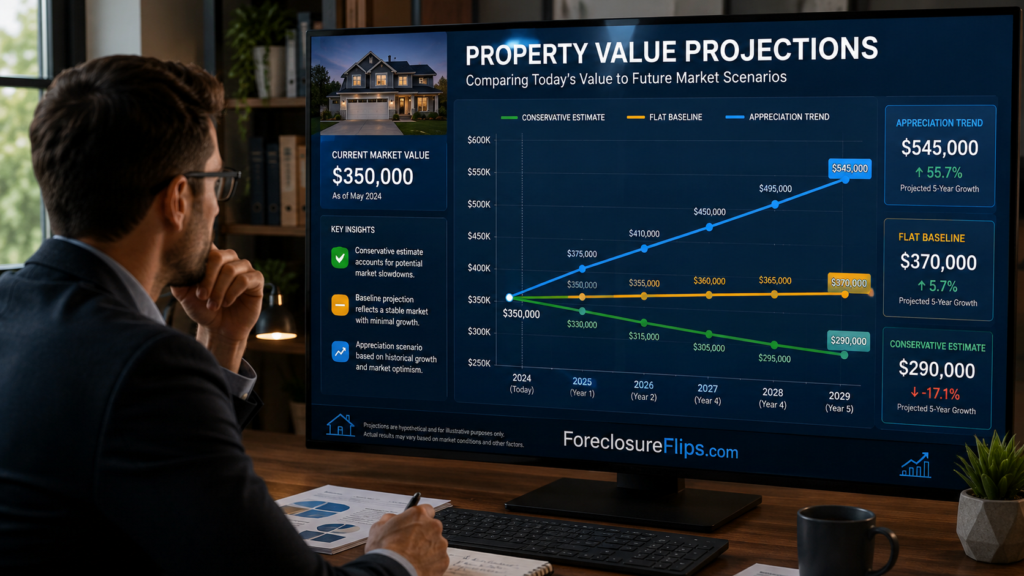
Property appreciation can improve the return on a foreclosure investment, but it cannot repair a weak acquisition. When a deal works only because you expect the market to raise the property’s value, you are speculating on future conditions rather than buying at a supportable price.
That distinction matters in distressed-property investing. Foreclosure timelines, repair surprises, title issues, financing costs, and resale delays already create uncertainty. Adding aggressive appreciation assumptions can make an acceptable-looking projection far more fragile than it appears.
A disciplined analysis gives appreciation a limited role: it is potential upside after the purchase price, repair budget, and exit strategy already produce an acceptable return.
Get Foreclosure Investing Insights Twice a Week
Subscribe to the Foreclosure Flips newsletter for practical ideas on finding deals, analyzing opportunities, and understanding foreclosure-related investing strategies. We send concise updates twice a week so you can stay informed without adding more noise to your inbox.
The Appreciation Trap in a Distressed Deal
Suppose a property has a current after repair value of $300,000. Your acquisition and renovation analysis produces an estimated profit of only $8,000 at that value.
The market has recently appreciated, so you assume the property will be worth $330,000 by the time the renovation is complete. That additional $30,000 turns the project into an attractive deal on paper.
The problem is that the profit does not come from buying correctly or creating sufficient value. It comes from predicting what buyers will pay several months from now.
A small change in the forecast can eliminate the return:
- Prices remain flat instead of rising.
- Renovation takes four months longer than planned.
- Mortgage rates reduce buyer demand.
- More competing listings enter the neighborhood.
- Insurance or property taxes affect affordability.
- The strongest comparable sale proves to be an outlier.
- The renovated property sells below the projected price.
Property appreciation can occur while an individual deal still loses money. Your property may have an inferior location, poor layout, overbuilt renovation, title complication, or price ceiling that prevents it from tracking the broader market.
Historical Growth Is Evidence, Not a Forecast
Housing-price indexes help you measure previous market movement. They do not guarantee that the same rate will continue.
The FHFA House Price Index tracks changes in single-family property values across national, state, metropolitan, county, ZIP code, and census-tract levels using a weighted repeat-sales methodology. That geographic detail is useful because property appreciation varies considerably between markets and submarkets.
The FRED house-price series also allows you to review long-term and recent FHFA data across the United States, states, and many metropolitan areas. Historical charts can reveal growth, stagnation, and periods of decline rather than a permanently rising line.
Use that data to understand context. Do not simply take the previous year’s percentage increase and add it to your resale value.
If a market appreciated 8% last year, several very different outcomes may follow:
- Appreciation continues at 8%.
- Growth slows to 2%.
- Prices remain flat.
- The market declines.
- The metro appreciates while the subject neighborhood does not.
- Entry-level homes outperform higher-priced homes.
- Renovated properties behave differently from unrenovated inventory.
Past appreciation can support a market narrative, but current comparable sales must support the value used in your acquisition model.
Underwrite Three Versions of the Same Deal
Instead of entering one future resale value, calculate three scenarios.
Downside case
The downside case assumes that market conditions become less favorable before resale. Depending on the property and market, you might model:
- A 3% to 5% reduction in resale value
- A longer marketing period
- Higher seller concessions
- Additional financing and holding costs
- A repair contingency
- A lower buyer-appraisal outcome
This scenario shows whether the project can absorb ordinary adversity without creating a material loss.
Base case
The base case should use the property’s supportable current after repair value. It assumes the renovated property could be listed and sold under current market conditions, without adding unearned appreciation.
Your value should come from recent comparable sales, adjusted for location, size, condition, design, amenities, and likely renovation quality.
The base case is where the deal should meet your required return.
Upside case
The upside case may include moderate appreciation, faster completion, stronger buyer demand, or lower-than-expected repair costs.
This scenario shows what could improve the result. It should not determine the maximum purchase price.
Consider this simplified project:
| Assumption | Downside | Base | Upside |
|---|---|---|---|
| Resale value | $285,000 | $300,000 | $318,000 |
| Purchase and closing | $175,000 | $175,000 | $175,000 |
| Repairs | $58,000 | $55,000 | $52,000 |
| Holding, financing and resale costs | $49,000 | $43,000 | $39,000 |
| Estimated profit | $3,000 | $27,000 | $52,000 |
The upside result is appealing, but the downside case shows that the margin can almost disappear. Whether the deal is acceptable depends on your required return, risk tolerance, and confidence in the underlying estimates—not on the best possible outcome.
Separate Market Appreciation From Created Value
Not every increase in projected value is appreciation.
Suppose you purchase a distressed property for $160,000 and spend $60,000 correcting major deficiencies. Comparable renovated homes currently sell for $310,000.
The difference between the property’s current distressed value and its completed value may result from several sources:
- Buying below current as-is market value
- Resolving title or occupancy problems
- Completing repairs
- Improving the layout or utility
- Upgrading condition and presentation
- General market appreciation
Created value is tied to actions you can plan, price, and execute. Market appreciation depends on factors you cannot control.
Keep the two sources of value separate in your analysis. Otherwise, you may attribute too much of the projected return to the renovation when the model actually depends on rising market prices.
Read Appreciation at the Smallest Useful Level
National housing trends provide context, but they do not price a foreclosure deal.
The Federal Reserve Bank of Richmond has noted that local investing allows smaller operators to track community-level housing conditions rather than relying heavily on broad indicators. That local focus is particularly important when distressed properties sit near neighborhood boundaries or in markets with uneven demand.
Review appreciation and market activity at several levels:
Metropolitan area
Metro data can show the overall direction of employment, housing supply, population, transaction volume, and prices.
City or ZIP code
This level may reveal that one part of the metro is appreciating while another remains flat. However, ZIP codes can still include several distinct neighborhoods and housing types.
Neighborhood and buyer segment
Recent sales within the subject’s competitive area deserve the most weight. Pay attention to the price range, property type, school assignment, condition, and likely buyer pool.
A 2,500-square-foot renovated home may not follow the same pricing trend as a 1,100-square-foot starter home in the same ZIP code. Likewise, condominium appreciation may differ from detached-home appreciation.
Property-specific ceiling
Every neighborhood has a practical price range. An extensive renovation may produce a property that exceeds what local buyers are willing or able to pay.
Future appreciation should not be used to justify over-improving the home beyond the support shown by comparable sales.
Adjust the Holding Period Without Adding Automatic Growth
The longer you own a property, the greater the possibility that its market value will change. A longer period also increases exposure to costs and adverse events.
For a flip expected to sell in six months, even a strong annual appreciation forecast may create limited additional value. A 4% annual rate does not mean the property will necessarily gain exactly 2% during a six-month project.
Housing transactions are seasonal, local sales may be limited, and appreciation does not occur in a smooth monthly pattern.
For a rental or BRRRR property, a longer holding period makes appreciation more relevant to long-term wealth. Even then, the property should satisfy the immediate strategy through cash flow, debt coverage, refinance assumptions, reserves, or another measurable return.
Do not rely on appreciation to compensate for persistent negative cash flow or an unsupported refinance value.
Use Appreciation to Rank Deals, Not Rescue Them
Property appreciation can help you compare two otherwise acceptable opportunities.
Assume both deals meet your minimum return using current values. One is located in an area with improving employment, limited inventory, strong buyer demand, and recent price growth. The other is in a stagnant submarket with declining transaction volume.
The first property may offer better upside. Appreciation potential becomes a secondary selection factor after both deals pass the primary underwriting tests.
Useful appreciation indicators include:
- Recent closed-sale trends
- Listing inventory and absorption
- Days on market
- Sale-to-list price ratios
- New construction and permitting
- Employment and population trends
- Property-tax and insurance pressure
- Local rent growth
- Price reductions and expired listings
- Buyer financing conditions
No individual indicator predicts future prices. Together, they help you identify whether market conditions support, weaken, or contradict an appreciation assumption.
Make the Deal Work Before the Market Helps You
A foreclosure investment should produce an acceptable result using the property’s current supportable value.
Build the offer from conservative comparable sales. Include realistic repairs, financing charges, taxes, insurance, utilities, legal costs, selling expenses, and contingency. Stress-test the resale value and timeline before considering future price growth.
Once the base case works, property appreciation can improve the return. It may increase resale proceeds, strengthen a refinance, or build additional rental equity over time.
That upside is valuable, but it should remain upside.
When appreciation is required to prevent a loss, the purchase price is too high, the margin is too thin, or the strategy carries more risk than the projected return justifies.
Want To Know What Properties Banks Are About To List?
Learn how to find deeply discounted properties. Get instant access to pre-foreclosures, REOs, and short sales updated daily!