
Why Wholesaling Disclosure Can No Longer Be Boilerplate
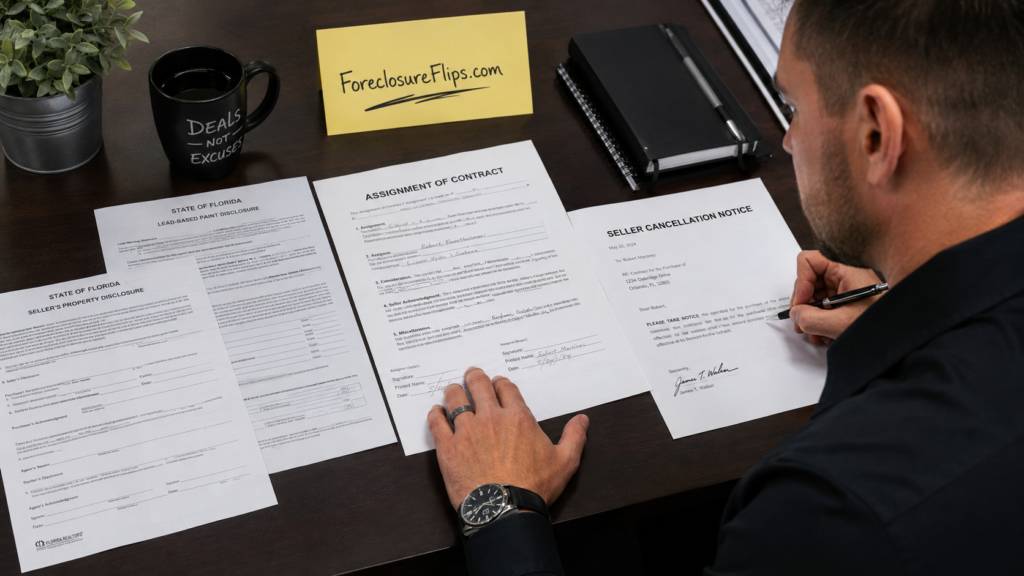
A focused real estate wholesaler analyzing legal paperwork spread across a desk, specifically comparing various state disclosure forms, a signed assignment contract, and a formal seller cancellation notice.

Wholesalers once treated disclosure as a clause buried inside the purchase agreement. New state laws now place it at the center of the transaction. Louisiana gives sellers five calendar days to cancel and requires a formal cancellation notice. Oregon requires registration or a real estate license and extends disclosure into advertising. Arizona allows a seller…

Read More

Property Appreciation and Foreclosure Deal Analysis

A professional investor analyzing a detailed data visualization that compares a property's current market value with three distinct future projections: a conservative estimate, a flat baseline, and an upward appreciation trend. The scene emphasizes clear, distinguishable line graphs or comparative charts integrated into the environment, highlighting the contrast between the cautious, stagnant, and growth-oriented market scenarios. At the bottom of the data visualization is the URL ForeclosureFlips.com

Property appreciation can improve the return on a foreclosure investment, but it cannot repair a weak acquisition. When a deal works only because you expect the market to raise the property’s value, you are speculating on future conditions rather than buying at a supportable price. That distinction matters in distressed-property investing. Foreclosure timelines, repair surprises,…

Read More

Pre-Foreclosure Due Diligence When Tax Debt Threatens Closing

A focused real estate investor intensely reviewing a spread of legal documents, including tax lien certificates, a calendar with highlighted closing deadlines, and itemized lists for capital repairs. The scene features a professional workspace with a laptop displaying financial data and property photographs, emphasizing crisp details on the paperwork, architectural plans, and a serious, analytical atmosphere. On the laptop we can see the URL ForeclosureFlips.com

A pre-foreclosure seller may need to close by a specific date to stop an auction, satisfy a tax authority, complete a relocation, or meet another financial deadline. That urgency can create an acquisition opportunity, but it can also pressure you to risk money before you control the property. Consider this scenario. You submit an offer…

Read More

Buying Distressed Property With Little Cash Down

A confident Gen Z woman in modern business-casual attire, sitting in a contemporary workspace with a view of a weathered, distressed brick building through the window. She is focused on a dual-monitor setup displaying complex financial spreadsheets, real estate contracts clearly labeled with terms like "Seller Financing Agreement" and "Private Capital," and a digital whiteboard outlining a low-cash-down acquisition strategy. The room is filled with professional markers of success, such as high-end technology and minimalist decor, while physical blueprints and legal documents are spread across her desk. Natural daylight illuminates the scene, highlighting her determined expression as she analyzes the investment logistics of the property.

The promise that you can buy distressed property with little money down is partly true, but it is often explained badly. You may be able to reduce the amount of your own cash used for the purchase. That does not mean the transaction requires no capital. Distressed properties still need deposits, title work, insurance, repairs,…

Read More

How City-Owned Properties for Real Estate Investors Work

Two Gen Z male real estate investors in modern business-casual attire, standing on a city street and evaluating a weathered, municipal-owned house next to a vacant lot. They are engaged in a serious discussion, with one gesturing toward the property while the other looks on analytically. The scene captures the contrast between their sharp, contemporary appearance and the aged textures of the urban redevelopment site under clear, natural light.

City-owned property investing can give you access to vacant houses, abandoned buildings, infill lots, and surplus parcels that are not marketed like conventional real estate. These properties may have reached municipal ownership through tax foreclosure, code enforcement, demolition proceedings, donation, or an earlier redevelopment effort. The purchase price can be low, but municipalities usually have…

Read More

How to Find City-Owned Homes Before Other Investors

Two young professional women in modern Gen Z business-casual attire confer with a helpful male city tax collector in a government office setting. They are gathered around a desk layered with property maps and official documents. The collector is leaning forward with an engaged and supportive expression, pointing to specific entries on a spreadsheet. The background features typical municipal office elements like filing cabinets, rows of binders, and a city seal on the wall, with bright natural light illuminating the collaborative scene.

Searching for city-owned homes for sale can uncover opportunities that never appear on the major residential listing platforms. Municipalities, counties, redevelopment agencies, and land banks may hold houses, vacant lots, commercial parcels, and abandoned structures acquired through tax foreclosure, code enforcement, donation, or public projects. These properties are not automatically bargains. Some require extensive repairs,…

Read More

When Creative Financing Does Not Fit a Foreclosure Deal

A group of focused real estate investors in a modern boardroom, leaning forward with intense expressions. They are closely watching a digital presentation filled with complex financial diagrams and data. The scene features sharp business attire and dramatic bright office lighting that emphasizes their concentration and the glow from the screen.A group of focused real estate investors in a modern boardroom, leaning forward with intense expressions. They are closely watching a digital presentation filled with complex financial diagrams and data. The scene features sharp business attire and dramatic office lighting that emphasizes their concentration and the glow from the screen.

A creative financing foreclosure strategy may allow you to buy with seller financing, acquire title subject to an existing mortgage, use a lease-option, or structure payments over time. These methods can reduce the amount of new acquisition financing you need. But creative terms cannot repair a transaction that lacks time, equity, lender flexibility, or clear…

Read More

Subject-To Deals in Pre-Foreclosure Investing

A focused scene at a kitchen table where a professionally dressed female real estate investor and a casual-clothed female single-parent homeowner are intently reviewing a stack of mortgage papers and a legal agreement. The lighting is warm and natural, emphasizing the textures of the printed documents and the determined, collaborative expressions on their faces as they discuss the details of the pre-foreclosure contract.

A subject to pre-foreclosure acquisition allows you to take title to a property while the seller’s existing mortgage remains in place. You agree to make the mortgage payments, but you do not formally become the borrower unless the lender approves an assumption. That distinction is central to the deal. You may own the property after…

Read More

How to Build a Distressed Property Buy Box

Two young male Gen Z real estate investors in modern business-casual attire lead a strategic discussion in a glass-walled conference room. They are focused on a collaborative "buy box" strategy for distressed properties, with one investor gesturing toward a shared screen or document. Surrounding them at the sleek conference table, a small group of colleagues participates actively, showing expressions of engagement and contribution. The scene features bright, natural office lighting and a contemporary professional atmosphere that emphasizes teamwork and financial planning.

A distressed property buy box helps you decide which foreclosure, pre-foreclosure, tax-delinquent, probate, vacant, or repair-heavy properties are actually worth your time. Without one, it is easy to chase every lead that looks discounted and then waste hours on deals that do not match your capital, market, repair capacity, or exit strategy. Your buy box…

Read More

Seller Financing for Distressed Property Investors

Two female real estate investors meeting with two male sellers in their living room discussing providing seller financing on their property that needs repair.

Seller financing distressed property deals can help you structure acquisitions when a seller needs speed, certainty, income, or a cleaner exit. Instead of the buyer using a traditional lender for the full purchase price, the seller agrees to receive part of the payment over time. That can be useful when a property needs repairs, the…

Read More

How to Find More Deals From One Property Owner

Real estate investor sitting in her luxurious home office with a cup of coffee researching multiple properties owned by the same seller using a laptop, smiling at the results of her findings.

Most investors look at one property, run the numbers, and decide whether to make an offer. That is a reasonable starting point, but it may also cause you to miss the bigger opportunity. Before you focus only on one address, ask a better question: what else does this owner control? One vacant lot, tired rental,…

Read More