
Why Wholesaling Disclosure Can No Longer Be Boilerplate
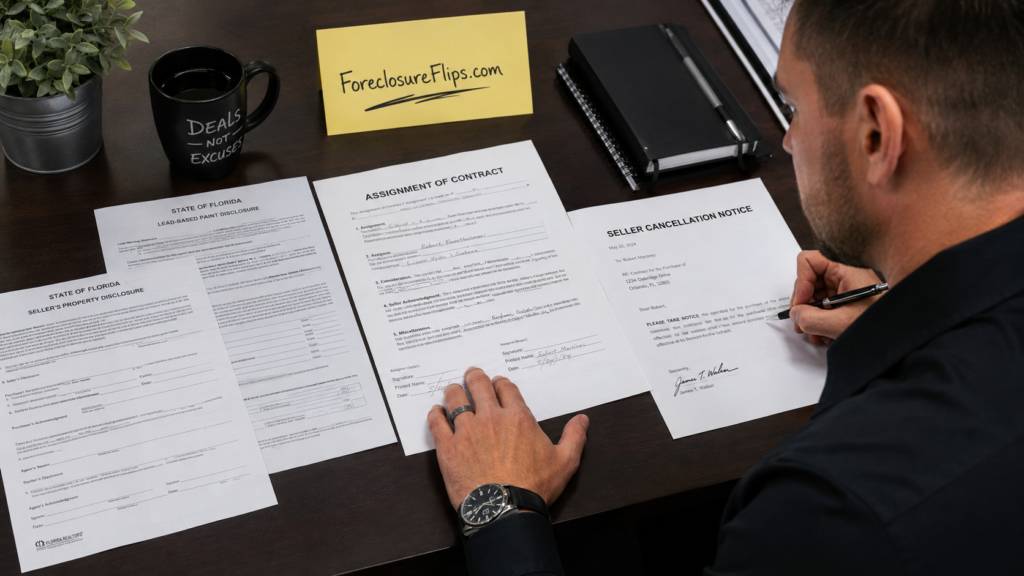
Wholesalers once treated disclosure as a clause buried inside the purchase agreement. New state laws now place it at the center of the transaction.
Louisiana gives sellers five calendar days to cancel and requires a formal cancellation notice. Oregon requires registration or a real estate license and extends disclosure into advertising. Arizona allows a seller or buyer to cancel before closing when a wholesaler omits required status language.
The pattern reaches far beyond contract drafting. Wholesaling disclosure requirements now affect marketing, document timing, earnest money, cancellation rights and the enforceability of the deal itself.
Stay Ahead of the Next Deal
Markets move quickly, and good foreclosure opportunities often require fast analysis. Subscribe to our twice-weekly newsletter for investor-focused tips, tools, and market insights designed to help you make better decisions.
States Are Regulating the Entire Wholesale Transaction
Traditional wholesale contracts often focused on one question: whether the purchase agreement allowed assignment.
That question still counts, but it no longer defines the full compliance analysis. State laws increasingly regulate the wholesaler’s status, the language presented to each party, the timing of disclosure and the way the property or contractual interest reaches the market.
Different states have adopted different models. Some require a written disclosure before the seller signs. Others require disclosure to both sellers and end buyers. Several attach cancellation rights to missing language, while Oregon now requires either wholesaler registration or a qualifying real estate license.
Advertising creates another dividing line. A state may distinguish between marketing the property itself and marketing an equitable or contractual interest. The difference can affect whether the activity falls within a wholesaling statute or crosses into licensed brokerage.
As a result, a contract that works in one state may create an unenforceable agreement, regulatory penalty or advertising violation in another.
Louisiana Adds a Five-Day Cancellation Window
Louisiana’s new rules illustrate how far wholesaling regulation has moved beyond the assignment paragraph.
Louisiana Act 807 took effect August 1, 2026. It requires a wholesaler to disclose an intent to assign, transfer, sell or market contractual rights or an equitable interest for financial gain before the seller signs each related agreement.
The law also requires language advising the seller to obtain legal counsel. Sellers receive at least five calendar days to cancel for any reason without penalty. Each agreement must display the cancellation deadline near the seller’s signature and include the mandatory cancellation notice adopted by the Louisiana Real Estate Commission.
Louisiana also requires a deposit of at least 1% of the purchase price and restricts where the parties may hold those funds. A violation can leave the contract voidable until title transfers and can trigger a civil penalty of as much as $5,000 per violation.
The statute does not merely require honesty about an assignment. It controls the documents, signature process, cancellation clock, deposit and remedies available to the seller.
Oregon Extends Disclosure Into Advertising
Oregon uses a different regulatory structure.
Since July 1, 2025, an individual conducting residential property wholesaling in Oregon generally needs either a residential property wholesaler registration or a qualifying real estate license. The registration process includes an application, fingerprinting, a background check and a fee.
The state’s residential wholesaling rules also require a prescribed written disclosure. The wholesaler must provide it to potential sellers and buyers before entering a contract, as well as to brokers who help market the interest or represent a potential buyer.
Oregon carries that disclosure into advertising. Property-related advertisements must include the required information, although qualifying social media posts may link to a separate compliant disclosure page.
When a wholesaler fails to disclose before contracting with the seller, the seller may cancel without penalty and retain the earnest money. The Oregon Real Estate Agency can also suspend or revoke a registration, prohibit a licensee from wholesaling, impose civil penalties or issue a cease-and-desist order.
Oregon therefore treats wholesaling as a regulated business activity, not simply a private contract strategy.
Arizona Gives Both Sides a Cancellation Remedy
Arizona takes a narrower approach but still places disclosure before the binding agreement.
Under Arizona’s wholesale real estate statute, a wholesale buyer must disclose that status in writing to the property owner. A wholesale seller must disclose to the end buyer that the seller holds an equitable interest rather than legal title and may not have the ability to convey title directly.
The law protects both sides of the assignment chain. If the wholesale buyer omits the seller disclosure, the property owner may cancel before escrow closes and retain the wholesaler’s earnest money. If the wholesale seller fails to disclose to the end buyer, that buyer may cancel without penalty and recover the earnest money.
Arizona does not mirror Louisiana’s five-day window or Oregon’s registration system. It shows why a generic national disclosure paragraph cannot reliably cover every jurisdiction.
One Assignment Clause Cannot Cover Every State
The expansion of wholesaling disclosure requirements creates several points of variation among state laws.
One state may require disclosure only to the property owner. Another may require separate forms for the owner, end buyer and participating brokers. Cancellation periods may run for a fixed number of calendar days, a set number of business days or until closing when the wholesaler omits required language.
States can also define the regulated activity differently. Some focus on assignments. Others cover options, equitable interests, marketing activity or certain back-to-back closings. A transaction structure that falls outside one statutory definition may fall squarely inside another.
Remedies vary as well. Missing language can cost the wholesaler the earnest money, allow a party to cancel, expose the wholesaler to damages or make the contract unenforceable. Registration and licensing rules add separate administrative penalties.
The result resembles a series of state transaction systems rather than one national wholesaling rule.
Marketing Can Trigger the Rule Before a Seller Signs
Wholesaling compliance no longer begins and ends at contract execution.
Oregon requires disclosure in property advertising, while Louisiana creates a presumption of wholesaling when someone markets contractual rights or equitable interests for sale. Those provisions shift attention to websites, email campaigns, social media posts and buyer-list messages.
The wording of an advertisement can affect how regulators classify the activity. Marketing “a house for sale” can imply authority to sell the real estate itself. Marketing “contractual rights” or an “equitable interest” describes a different legal position.
A wholesaler who has not taken title usually controls a contract right, not the property. State advertising rules increasingly expect the marketing language to preserve that distinction.
This creates a compliance issue before the end buyer reviews an assignment agreement. The first social post, email or online listing may already fall within the state’s disclosure rules.
Missing Language Can Destroy an Otherwise Profitable Deal
Disclosure failures create more than technical defects.
A wholesaler may secure a favorable purchase price, locate an end buyer and negotiate a strong assignment fee, only to lose the transaction because the original agreement omitted required language.
Louisiana allows the seller to void a noncompliant contract before title transfers. Oregon allows a seller to cancel and keep the earnest money when the wholesaler fails to provide the required disclosure. Arizona gives cancellation rights to either side of the wholesale chain, depending on which disclosure the wholesaler omitted.
These remedies place the contract’s value at risk. The wholesaler may also incur marketing expenses, title charges, inspection costs and reputational damage before the defect emerges.
A signed agreement no longer guarantees a controlled deal when state law gives another party a continuing right to cancel.
Multi-State Wholesaling Now Requires Version Control
A multi-state operation can no longer rely on one purchase agreement, one assignment form and one advertising template.
Each market may require different definitions, notices, signature placement, cancellation deadlines and recordkeeping. The applicable rule can also depend on the property type, the wholesaler’s license status and the way the transaction reaches the end buyer.
This turns compliance into a document-management function. State-specific contract packets require clear version dates. Marketing templates need jurisdiction-specific language. Transaction records need to show when each party received the disclosure and when any cancellation period expired.
Changes in state law can affect pending lead pipelines as well as new contracts. Louisiana applied Act 807 to agreements completed on or after August 1, 2026, while Oregon built its requirements around a July 1, 2025 implementation date.
A contract library without state and effective-date controls can place outdated language into a current transaction.
Disclosure Has Become a Core Wholesaling Function
The national trend does not point toward a single uniform wholesaling law. It points toward more state involvement and greater variation.
Louisiana now combines assignment disclosure with legal-counsel language, a cancellation period, a mandatory notice and deposit rules. Oregon requires registration or licensure and regulates advertising. Arizona places written status disclosures on both sides of the assignment.
Other states may choose different definitions, licensing rules or remedies. The common direction remains clear: regulators increasingly expect wholesalers to identify their role before another party becomes bound.
Wholesaling disclosure requirements have moved beyond optional contract language. They now shape how a wholesaler markets the opportunity, secures the agreement, manages the cancellation period and preserves the right to complete or assign the transaction.
The assignment clause still plays a role. It now sits inside a much larger state-specific compliance system.
You might also like:
 How to Find More Deals From One Property Owner
 Seller Financing for Distressed Property Investors
 Flip Property Exit Strategies: Maximizing Profit and Minimizing Risk
 Best Cities for House Flipping: Top Locations for High ROI in 2025
 Real Estate Investor Mentorship for Portfolio Freedom
 How to Track Distressed Sellers Without Chasing Bad Leads