
How Discounted New Homes Can Undercut Your Flip’s ARV
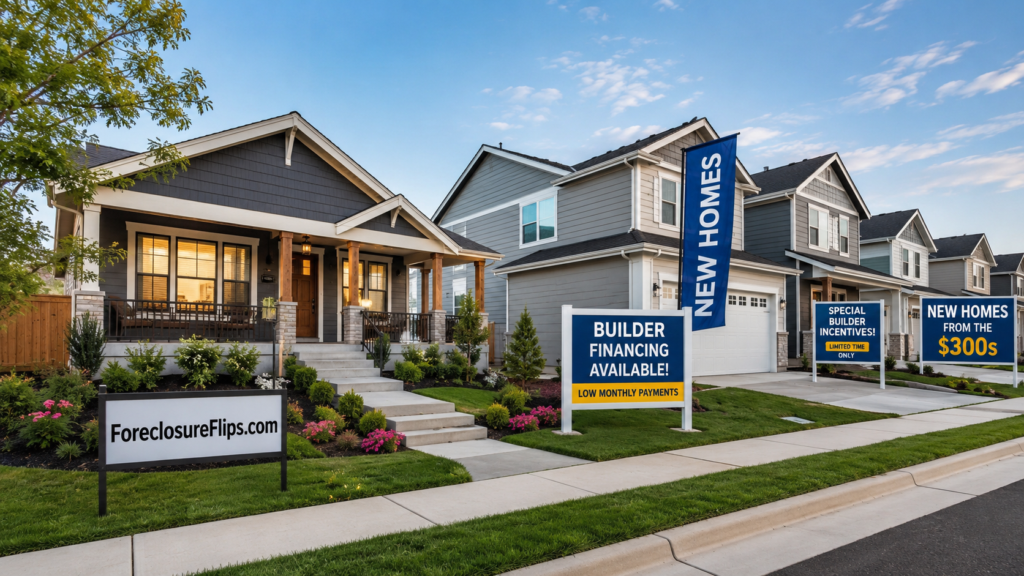
Newly constructed homes sold for approximately 10% less than existing homes in June 2026, the widest gap in nearly 60 years. Builders also carried more than nine months of inventory and used price cuts, mortgage-rate buydowns and closing-cost assistance to generate sales.
That combination creates direct new construction competition for house flippers. A renovated home may look appropriately priced against recent resale comps but still lose buyers to a new property with a warranty, lower monthly payment and less cash due at closing.
The greatest pressure falls on suburban flips that serve the same price range and buyer profile as nearby builder communities.
Learn the Strategies Behind Smarter Foreclosure Investing
Get practical foreclosure investing content delivered twice a week, including deal analysis tips, strategy breakdowns, useful tools, and new resources from Foreclosure Flips. Sign up to keep learning and spotting better opportunities.
New Homes Sold About 10% Below Existing Homes
The median new-home price fell to $398,300 in June 2026, while the median existing-home price reached $440,600. That placed the typical new home about 10% below the typical resale home, according to a Reuters analysis of the housing market. The gap marked the widest discount for new construction in almost six decades.
National medians do not compare identical houses. New construction varies from existing inventory in location, lot size, square footage and regional concentration. Builders have also introduced smaller floor plans and lower-priced product lines to reach buyers constrained by mortgage rates.
Even with those differences, the price reversal carries a clear implication for flip exits. Buyers no longer assume that a newly built home will cost more than a renovated resale.
New-home inventory reached 485,000 properties in June, equal to 9.3 months of supply at the current sales pace. New-home sales remained 5.6% below the previous year despite a modest monthly increase.
A builder carrying completed inventory faces ongoing interest, taxes, insurance, maintenance and community expenses. Those carrying costs create pressure to reduce the effective purchase price before the next reporting period or sales quarter ends.
Builders Can Cut the Payment Without Cutting the Price
Price reductions represent only one part of the competition.
The National Association of Home Builders reported that 62% of builders used sales incentives in June. Thirty-five percent reduced prices, and the average reduction reached 6%. Builders had used incentives at a rate of at least 60% for 15 consecutive months.
Those incentives often include permanent or temporary mortgage-rate buydowns, closing-cost credits, free upgrades and reduced lot premiums.
A flipper usually competes through the sale price, property condition and design. A large builder can also compete through a preferred lender, allowing the builder to subsidize the financing package instead of recording the entire concession as a lower price.
That distinction changes how buyers compare the two homes.
A Rate Buydown Can Beat a Lower Resale Price
Consider a renovated home and a new home both priced at $400,000. With a 20% down payment, the buyer would finance $320,000.
At a 6.75% mortgage rate, principal and interest would total approximately $2,076 per month. A builder-sponsored permanent buydown to 5.75% would reduce that payment to about $1,867.
The difference approaches $210 per month, or roughly $2,500 during the first year.
A flipper could reduce the asking price by several thousand dollars without matching the payment advantage. Lowering the resale price from $400,000 to $395,000 would reduce the monthly principal-and-interest payment by only about $26 at the higher rate.
The rate incentive therefore changes the buyer’s economics more than the recorded sale prices suggest. That gap sits at the center of new construction competition for house flippers.
Closing-cost assistance adds another advantage. A builder credit of $10,000 can preserve the buyer’s cash for moving expenses, furnishings or reserves. A resale priced slightly below the new home may still require more money at settlement.
Closed Comps May Hide Builder Concessions
A new home that closes for $410,000 enters public records as a $410,000 sale. The recorded price may not show a $12,000 closing credit, a funded rate buydown or an included upgrade package with equal clarity.
That creates a problem when recent new-home sales enter an ARV analysis.
Freddie Mac’s guidance on sales concessions explains that appraisers analyze whether financing or sales concessions affected a comparable property’s sale price. Any adjustment should reflect the market’s reaction to the concession rather than automatically equal its face value.
Verifying that reaction can prove difficult when the public record lacks the full incentive package. MLS notes may identify seller-paid closing costs, but they may not explain the cost or duration of a mortgage-rate buydown. Builder websites and lender promotions can change after the sale closes.
The comparable may therefore support a particular price while hiding the financial assistance that helped produce it.
A resale comp presents a similar limitation when builder incentives change after that property closes. An updated flip that sold for $450,000 four months ago may no longer establish the current ceiling if a nearby builder has since reduced prices and introduced subsidized financing.
Suburban Flips Face the Most Direct Competition
New construction creates the strongest pressure where builder communities overlap with the same buyers targeted by renovated existing homes.
A three-bedroom suburban flip may compete with a new three-bedroom model even when the two properties sit several miles apart. Buyers often search by school district, commute, monthly payment and price range rather than subdivision boundaries.
Online listings place those options beside each other. The buyer sees the renovated home’s mature lot and established neighborhood alongside the new home’s warranty, current building standards and lender incentives.
This form of new construction competition for house flippers often appears in growing suburban and exurban markets with:
- Several active subdivisions in the same price range
- Completed builder inventory rather than future lots alone
- Similar square footage and bedroom counts
- Shared school districts or commuting routes
- Buyer demand concentrated around monthly affordability
- Large national builders with affiliated mortgage operations
An urban infill flip may face little comparable new construction. A suburban property surrounded by expanding developments can face dozens of competing units before renovation ends.
Builder Inventory Can Lower the Exit Ceiling During Rehab
A flip begins with an ARV based on the market available at acquisition. The property reaches buyers weeks or months later.
Builders can change their offers during that interval.
A nearby development may introduce a lower-priced floor plan, reduce lot premiums or discount completed homes. The builder may also increase closing assistance to meet quarterly sales targets or clear inventory before opening another phase.
Consider a suburban flip with an initial ARV of $440,000. Recent renovated resales support that price, while nearby new homes list between $425,000 and $450,000.
During the rehab, the builder reduces a comparable completed model to $410,000 and adds a mortgage-rate incentive. The flip still offers a larger lot and established location, but the builder has created a new price anchor below the original exit assumption.
A $20,000 reduction in the flip’s sale price can consume a substantial portion of the expected profit. A longer marketing period adds loan interest, utilities, insurance, taxes and maintenance.
Our free real estate investor calculators can model lower exit prices and extended holding periods alongside the original projection.
Active Builder Offers May Carry More Weight Than Older Comps
Closed sales document past transactions. Active builder offers show what a buyer can purchase now.
A model advertised at $425,000 with a permanent rate buydown and $10,000 toward closing costs may pose more competition than a renovated resale that closed for $415,000 several months earlier.
The builder’s sticker price alone does not capture the complete offer. Monthly payment, cash due at closing, warranty protection and included upgrades all influence the buyer’s comparison.
Standing inventory also provides a signal. A subdivision with several completed homes, repeated price changes and expanding incentives indicates stronger pressure to produce sales. A community with only future lots and steady contracts presents a weaker immediate threat.
Builder activity does not automatically invalidate existing-home comps. It introduces current competition that older sales may not reflect.
Renovated Homes Still Hold Advantages in the Right Market
Discounted new construction will not undercut every flip.
Renovated existing homes can offer larger lots, mature landscaping, established neighborhoods, shorter commutes and architectural features that production builders cannot reproduce. Some buyers also prefer completed neighborhoods over years of nearby construction.
Older homes may carry lower association fees or no HOA obligation at all. A well-located renovation can also provide access to employment centers, schools and commercial districts that newer subdivisions cannot match.
The pressure increases when the flip resembles the builder’s product but lacks a clear advantage. Similar square footage, floor plans, locations and price points create the closest comparison.
Design upgrades alone may not support a premium when the competing new home includes a warranty and subsidized financing.
Builder Incentives Now Belong in Flip Exit Analysis
The June price gap shows how aggressively builders have responded to excess inventory and weak affordability. New homes sold below existing homes nationally, while financing incentives reduced monthly payments and upfront costs further.
Traditional comps capture only part of that competition. A recorded sale price may conceal a rate buydown or closing credit, while a resale from several months earlier may predate the builder’s current incentive package.
New construction competition for house flippers therefore extends beyond nearby sale prices. It includes standing inventory, advertised financing, buyer closing costs and the pace at which builders change offers.
The risk concentrates in suburban markets where renovated resales and new homes pursue the same buyer. In those locations, a flip’s exit value depends not only on what comparable homes sold for, but also on the complete package builders offer when the renovation reaches the market.
You might also like:
 House Flipping Market Analysis: How to Choose Profitable Areas
 Flip Property Exit Strategies: Maximizing Profit and Minimizing Risk
 Analyzing Neighborhood Trends for Flipping Success
 House Flipping: How to Find, Analyze, Renovate, and Sell a Profitable Flip
 Best Cities for House Flipping: Top Locations for High ROI in 2025
 How to Calculate After Repair Value Before You Buy