
Market Value Mistakes That Ruin Foreclosure Deals
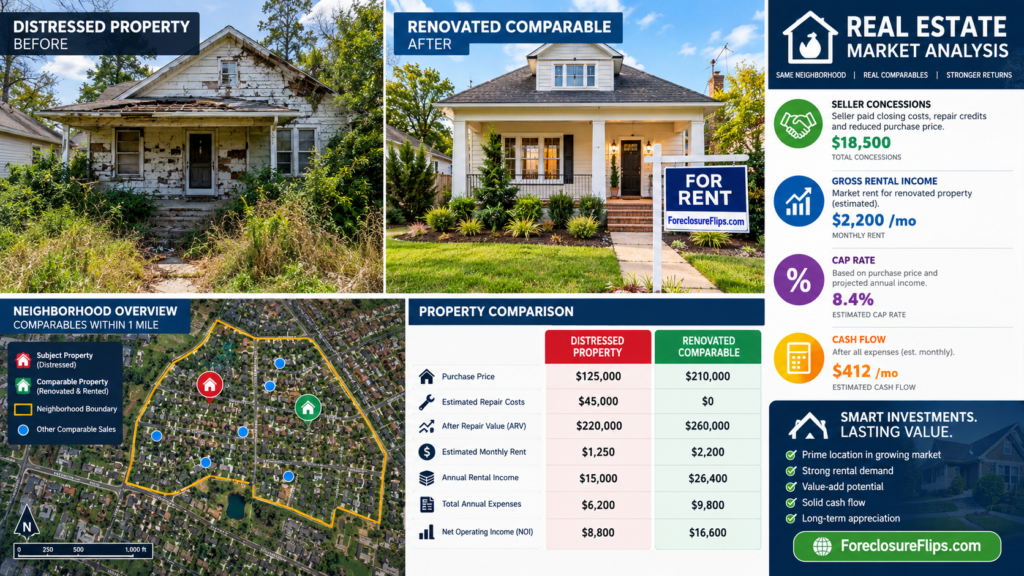
A foreclosure can look like a $40,000 discount when the comp sheet is wrong by $25,000. That valuation error can consume most of the profit before a hidden repair, financing delay, or resale concession appears.
The common problem is not a lack of comparable sales. It is using the wrong sale for the question being asked: an old closing in a changing market, a renovated house against a damaged subject, a concession-heavy transaction, or a comp from a stronger pocket nearby.
A reliable foreclosure market value estimate starts by testing why each comp belongs in the analysis, not by averaging the three highest nearby sales.
Get Foreclosure Investing Insights Twice a Week
Subscribe to the Foreclosure Flips newsletter for practical ideas on finding deals, analyzing opportunities, and understanding foreclosure-related investing strategies. We send concise updates twice a week so you can stay informed without adding more noise to your inbox.
The $310,000 Estimate Uses Three Weak Comparables
Assume you are reviewing a vacant foreclosure that needs roughly $55,000 of work. A quick search produces three nearby sales:
| Comparable | Sale price | What the first pass misses |
|---|---|---|
| Comp A | $315,000 | Sold 10 months ago |
| Comp B | $305,000 | Fully renovated and sold with a $12,000 seller credit |
| Comp C | $320,000 | Similar size, but across a school boundary |
| Subject | — | Vacant, dated, damaged kitchen, older roof |
A simple average lands near $313,000. On paper, a $180,000 purchase can look comfortably below market.
Those three sales answer different questions. Comp A may describe an older market. Renovated Comp B says more about resale value than current as-is value, while Comp C may belong to a different buyer pool.
Correct those mismatches before they reach your maximum offer.
Comp A Sold 10 Months Ago
Closed sales are historical evidence. Their usefulness depends partly on what happened between the sale date and the date you are valuing the foreclosure.
FHFA’s research on appraisal time adjustments explains that comparable sales can become outdated when local prices move and that market-condition, or time, adjustments can account for price changes between the comp sale and the valuation date.
A ten-month-old sale is not automatically unusable. The problem begins when you carry its price forward without checking whether buyers are still paying the same amount.
Check current listings and pending sales before using the old price
Suppose similar homes sold around $310,000 last winter, while comparable active listings now sit at $295,000 after repeated price reductions. Pending sales are taking longer, and newer closings are clustering below $300,000.
Those signals do not produce an automatic percentage adjustment. They do tell you that a $315,000 historical sale deserves less weight unless other evidence supports it.
In a thin market, an older comp may remain necessary, but current listings, pending transactions, and newer sales should test whether the old price still reflects today’s competition.
Comp B Was Renovated and the Foreclosure Is Not
Comp B has the right square footage, lot size, age, and bedroom count. It also has a new roof, updated kitchen, fresh bathrooms, functioning HVAC, and retail-ready condition.
The foreclosure has an older roof, damaged cabinets, worn flooring, and deferred maintenance.
Those properties can occupy different price ranges even when their basic specifications match. Freddie Mac’s current property-condition guidance requires appraisal reports to describe condition and quality accurately and account for deficiencies that affect market value or marketability.
Do not subtract rehab cost from a renovated sale
If the renovated home sold for $305,000 and your contractor estimates $55,000 of work, subtracting $55,000 does not automatically make the foreclosure worth $250,000 as-is.
Your rehab budget measures what the work may cost you. The market adjustment measures how buyers price the difference between the two properties.
A buyer purchasing the distressed house may also price in construction risk, limited financing options, carrying time, unknown defects, and the inconvenience of managing a renovation. Conversely, some improvements may cost more than the value they add.
The cleaner approach is to find dated or distressed sales that resemble the property’s current condition and use renovated sales primarily to support the resale analysis.
Comp B Included a $12,000 Seller Credit
Comp B’s $305,000 recorded price looks straightforward until the transaction terms are reviewed.
Assume the seller paid $12,000 toward the buyer’s closing costs and interest-rate buydown. Public records may still show a $305,000 sale even though the concession helped support that price.
The Appraisal Foundation’s seller-concession guidance explains that appraisers should identify, verify, and analyze sales and financing concessions because they can affect the meaning of a comparable sale price.
A concession does not require a dollar-for-dollar subtraction in every case. Instead, ask whether buyers in that market would have paid the same price without the incentive.
MLS remarks, agent confirmation, and closing information can help answer that question. If the concession influenced the price, treating $305,000 as a clean cash-equivalent sale can push the valuation too high.
Comp C Sits Across a School Boundary
Comp C sits less than a mile away and sold for $320,000. A radius search therefore makes it look attractive.
The property also sits across a school boundary, beyond a major road, and inside a subdivision where similar houses consistently sell at a premium.
Distance alone does not make it comparable.
Keep comps inside the buyer’s actual search area
Start with the subject subdivision, immediate neighborhood, or other area where buyers view homes as substitutes. Expand only when the local sales pool is too small.
School assignments, flood zones, gated access, waterfront or view influence, lot pattern, HOA boundaries, traffic exposure, and municipal lines can create price differences over very short distances.
When buyers routinely pay $20,000 more on the other side of a boundary, importing those sales into the foreclosure analysis can manufacture equity that the subject does not have.
A strong comp from farther away in the same competitive market can be more useful than a closer sale that attracts a different buyer.
ARV Is Not Today’s As-Is Value
After-repair value estimates what the property may sell for after the planned renovation. As-is value estimates what buyers would likely pay in its present condition.
Mixing those two questions is one of the most expensive foreclosure market value mistakes.
Assume the renovated sales support an ARV near $300,000 after correcting the earlier comp problems. Better condition-matched sales show that dated properties nearby trade between $220,000 and $230,000.
The $70,000 to $80,000 gap does not represent free equity. It includes value you still have to create through renovation, plus the market’s current discount for condition and execution risk.
Use separate comps for purchase and resale
For the acquisition, prioritize sales that resemble what you are buying now: dated houses, deferred maintenance, estate sales, REOs, or other properties that needed work.
At resale, use renovated properties that resemble the product you expect to sell. Match the finish level realistically. A mid-grade rehab should not rely on luxury flips simply because their prices improve the spreadsheet.
Keeping the two sets separate prevents a future value from quietly becoming today’s acquisition value.
The Corrected Comp Set Drops the Value
Return to the original $313,000 average.
Comp A receives less weight because the market has softened since its sale. Renovated Comp B remains useful for ARV but needs scrutiny for both condition and the $12,000 concession. Location weakens Comp C because buyers pay a premium across that school boundary.
A second search uncovers two dated homes in the subject’s immediate competitive area. They sold for $222,000 and $229,000. Both needed updating, and neither crossed the school boundary.
Now the valuation has two more useful ranges:
- Current as-is evidence: approximately $220,000 to $230,000 before subject-specific adjustments
- Renovated resale evidence: approximately $290,000 to $300,000 after reviewing current market direction and transaction terms
The lower range informs the acquisition; the upper range helps underwrite the planned exit. Keeping them separate gives you a better basis for deciding what to pay.
The Lower Value Cuts the Maximum Offer
Suppose you settle on a $295,000 resale estimate. Rehab totals $55,000. Financing, holding, closing, and selling expenses add another $48,000, while your required profit is $35,000.
Those assumptions leave about $157,000 for the purchase before an additional contingency.
A $180,000 bid based on the original comp sheet would consume $23,000 of that margin before the project starts.
This is where the foreclosure market value estimate connects to the rest of the underwriting. A platform such as Rehab Valuator can keep acquisition price, rehab, financing, holding expenses, and resale assumptions in the same model. The software cannot decide whether Comp C belongs in the set, but it can show what happens financially when a weak valuation enters the deal.
Recheck the Comparables Before Increasing the Bid
Bidding pressure makes valuation mistakes expensive because every extra dollar paid comes out of a finite spread.
Before raising an offer, go back through the actual sales. Check whether each closing is recent enough for the current market, whether its condition matches the valuation question, whether concessions influenced the price, and whether buyers view its location as a substitute for the subject.
Keep ARV out of the as-is analysis until you are modeling the completed project.
A solid foreclosure market value estimate may give you a lower number than the first comp search. That is useful information. The goal is not to make the property qualify as a deal; it is to find the price at which the deal still works when the comp sheet survives scrutiny.
You might also like:
 House Flipping Market Analysis: How to Choose Profitable Areas
 Flip Property Exit Strategies: Maximizing Profit and Minimizing Risk
 House Flipping: How to Find, Analyze, Renovate, and Sell a Profitable Flip
 How to Calculate After Repair Value Before You Buy
 How Discounted New Homes Can Undercut Your Flip’s ARV
 How Low Housing Transaction Volume Can Hide Market Weakness