
When Negative Gearing Can Pay Off for Foreclosure Investors
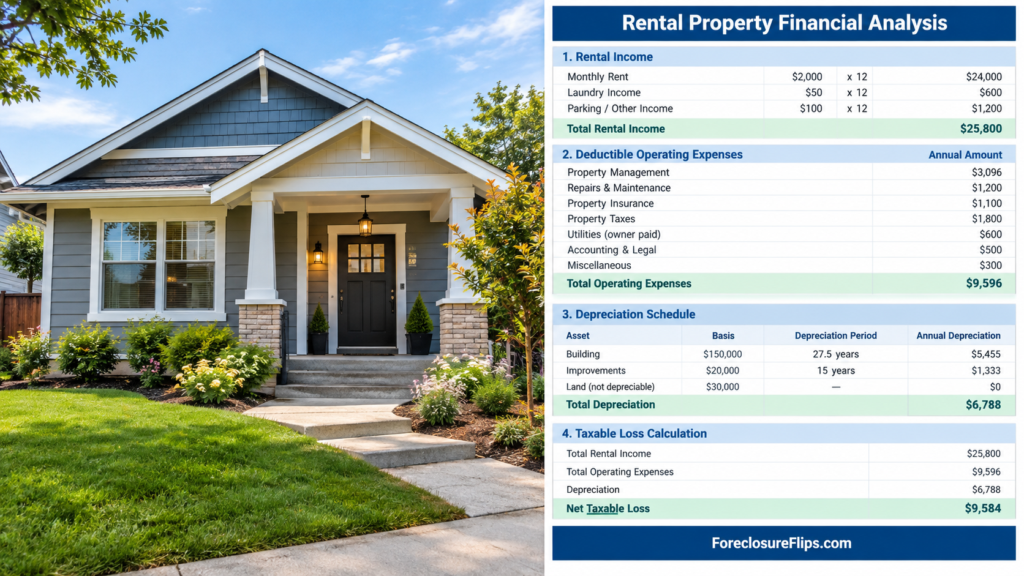
A foreclosure rental can show a tax loss even while the property is building equity and putting cash in your pocket.
That is the useful version of negative gearing. Interest, operating expenses, and depreciation push taxable rental income below zero, creating a loss that may reduce other taxable income now or become useful later.
The strategy gets weaker when the tax loss comes mostly from real cash leaving your account every month. A negative gearing tax strategy for foreclosure investors should improve an otherwise sound long-term deal, not justify a rental that never works.
Get Foreclosure Investing Insights Twice a Week
Subscribe to the Foreclosure Flips newsletter for practical ideas on finding deals, analyzing opportunities, and understanding foreclosure-related investing strategies. We send concise updates twice a week so you can stay informed without adding more noise to your inbox.
Start With the Difference Between a Cash Loss and a Tax Loss
Negative gearing is a familiar term in Australia and other markets, but U.S. tax rules generally describe the result as a rental real estate loss.
For an investor, the label matters less than the math.
Suppose a renovated foreclosure collects $30,000 in annual rent. Mortgage interest, taxes, insurance, maintenance, management, and other deductible cash expenses total $24,000. Before depreciation, the property has $6,000 left.
Now assume allowable depreciation adds another $9,000 deduction.
For tax purposes, the rental may show a $3,000 loss even though deductible cash expenses did not exceed the rent.
Compare that with another property collecting the same $30,000 but requiring $33,000 of deductible cash expenses before depreciation. Add the same $9,000 depreciation deduction and the tax loss becomes $12,000, but you were already writing checks to support the property.
Both rentals may be negatively geared for tax purposes. The first is usually the stronger position because a noncash deduction is doing more of the work.
Depreciation Is Often the Biggest ‘Loss’
Once a foreclosure is rehabilitated and placed in service as a residential rental, the building generally begins generating depreciation deductions.
Under the IRS rules explained in Publication 527, residential rental buildings are generally depreciated over 27.5 years under the general depreciation system. Land is not depreciable.
Imagine buying a distressed house for $190,000 and allocating $35,000 of the purchase basis to land. You then complete capital improvements before placing the property in service.
The resulting depreciable basis can create deductions for years without requiring an equivalent annual cash payment.
That is why a tax loss and an economic loss are not the same thing.
A Foreclosure Rehab Can Create More Deductions Than Expected
Foreclosure investors often spend heavily before the first tenant moves in.
Some costs become part of the property’s basis and are depreciated. Others may qualify as current rental expenses depending on the work, timing, and tax rules.
Once the property is operating, common deductions can include mortgage interest, property taxes, insurance, management fees, utilities paid by the owner, maintenance, and qualifying repairs.
Principal payments do not work the same way as interest. Paying down loan principal builds equity but generally does not create a current rental expense deduction.
That difference is important when you compare taxable income with actual cash flow.
Cost Segregation Can Pull Some Deductions Forward
A cost segregation study may identify parts of a rental property that qualify for shorter recovery periods instead of the building’s 27.5-year schedule.
Depending on the facts, certain appliances, flooring, fencing, landscaping, or site improvements may fall into shorter-lived categories.
Current IRS bonus depreciation guidance provides a 100% special depreciation allowance for certain qualifying property acquired after January 19, 2025. Eligible shorter-life components identified through cost segregation may qualify, while the residential rental building itself generally does not.
Accelerating depreciation can create a larger tax loss in the early years, but the deduction only has immediate value if the tax rules let you use it.
Passive-Loss Rules Can Negate the Immediate Tax Benefit
This is where a negative gearing strategy can fall apart.
Rental real estate is generally treated as a passive activity for federal income-tax purposes. Passive losses usually offset passive income, not wages or other nonpassive income.
One important exception applies to qualifying rental real estate in which you actively participate. The IRS Publication 925 explains that eligible taxpayers may deduct up to $25,000 of rental real estate loss against nonpassive income.
That allowance begins phasing out once modified adjusted gross income exceeds $100,000 and is generally reduced to zero at $150,000.
So an investor can deliberately create a $20,000 rental loss and still discover that the deduction cannot reduce salary income this year.
Real estate professionals have another path
Different treatment can apply if you qualify as a real estate professional and materially participate in the rental activity.
The federal test generally requires more than 750 hours of services during the year in real property trades or businesses in which you materially participate, along with more than half of your personal-service time spent in those businesses. Material participation rules still need to be satisfied.
For a full-time real estate operator, that can make rental losses far more useful than they are for an investor with a separate full-time occupation.
Suspended Losses Can Still Have Value
A passive loss you cannot use today does not necessarily disappear.
Disallowed passive losses generally carry forward. They may offset passive income in future years and can become deductible when you dispose of your entire interest in the activity in a qualifying fully taxable transaction, subject to the applicable rules.
That makes timing part of the strategy. A $15,000 deduction you can use this year is more valuable than one that sits suspended for years.
Your tax adviser should estimate both the amount of the loss and when you are likely to benefit from it.
Run the Tax Savings Against the Actual Cash Shortfall
A deduction is worth only the tax it saves.
Suppose a foreclosure rental produces a $12,000 deductible loss and you can use the full amount this year. At a hypothetical 24% marginal federal income-tax rate, the federal tax reduction associated with that loss would be about:
$12,000 × 24% = $2,880
If creating the loss required you to put $12,000 of additional cash into the property, the tax savings alone do not make the strategy attractive.
Now change the example.
Assume the property produces roughly break-even cash flow, while depreciation and other noncash deductions create the same $12,000 tax loss. The $2,880 potential federal tax benefit now comes without the same $12,000 operating cash drain.
That is a much better use of negative gearing.
Buying a Foreclosure Below Stabilized Value Can Improve the Trade-Off
Foreclosure investors have another source of return that can make early negative gearing easier to tolerate.
Suppose you acquire a distressed house for $180,000, spend $45,000 on the rehab, and end up with a stabilized rental worth $285,000.
Before considering financing, closing costs, or selling expenses, the purchase and rehab total $225,000 against $285,000 of estimated value.
You have created a value spread even if first-year rental cash flow is weak.
Add principal reduction, possible rent growth, and appreciation, and the investment has more than one way to create return while depreciation generates a tax loss.
A later refinance may also let you replace expensive acquisition debt or recover part of your invested capital if value and income support it. Those benefits should exist independently of the tax deduction.
Know When Negative Gearing Is Really Just a Bad Rental
Tax language can make poor cash flow sound more sophisticated than it is.
Be cautious when the property needs several optimistic assumptions at once:
- Rent must rise quickly to cover expenses.
- Appreciation has to be strong for the return to work.
- The refinance requires much lower future rates.
- Large repairs are not included in the cash-flow forecast.
- You cannot currently use the tax loss.
- The property consumes cash with no clear path to stabilization.
A tax deduction does not repair those weaknesses.
Likewise, spending extra money merely because the expense may be deductible is backwards. Make necessary repairs, carry appropriate insurance, and operate the property well. Then claim the deductions the law allows.
Underwrite the Property Twice
For a negative gearing tax strategy for foreclosure investors, run two versions of the deal.
First, ignore the tax benefit.
Calculate rent, vacancy, operating expenses, debt service, capital expenditures, expected appreciation, equity creation, and your likely exit. Decide whether the property has a credible long-term investment case.
Then add the tax layer.
Estimate depreciation, deductible expenses, cost-segregation benefits if appropriate, and the rental loss. After that, determine whether you can use the loss now or whether passive-activity rules are likely to suspend it.
Our free real estate investor calculators can help you test the property economics before your CPA adds the tax consequences.
Keeping the two analyses separate prevents a deduction from hiding a weak investment.
Make the Tax Loss Work for the Property
The strongest negative gearing strategy is rarely about losing as much cash as possible.
Instead, you want legitimate deductions—especially depreciation—to reduce taxable rental income while the property builds equity, produces acceptable cash flow, or moves toward stronger cash flow over time.
A foreclosure bought below stabilized value can give you more room to make that approach work. Rehab can create equity, a later refinance may improve the capital structure, and future rent increases can strengthen operations.
Still, the tax benefit has to survive the passive-loss rules, and the property has to survive without it.
Used carefully, a negative gearing tax strategy for foreclosure investors can improve after-tax returns while you build a rental portfolio.
Turn it into an excuse for permanent negative cash flow, and you simply have a losing property with a deduction attached.
You might also like:
 BRRRR Method Explained: Building Wealth Through Real Estate
 Property Refinancing Strategies in BRRRR to Recycle Capital
 BRRRR Method Case Studies: Real-World Investor Success Stories
 BRRRR Investing: How to Buy, Rehab, Rent, Refinance, and Repeat
 How Debt to Income Ratio Affects Property Investors
 Learn How One Multifamily Real Estate Deal Can Lead to More