
What a Property Deed Reveals in Foreclosure Deals
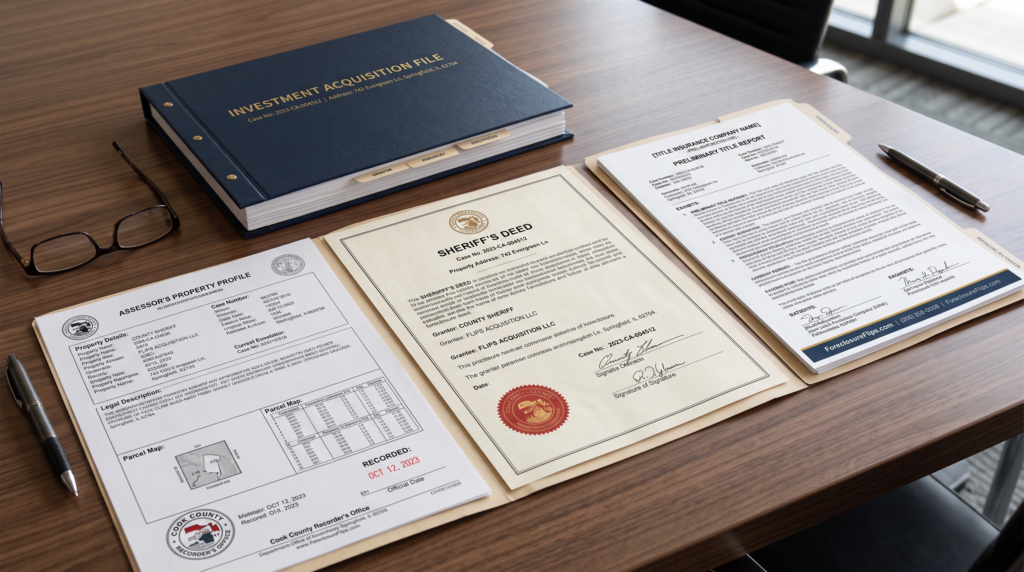
A recorded deed can put your name in the land records without proving that every lien, ownership problem, or foreclosure defect disappeared with the sale.
That gap is easy to miss because the deed looks final. It names the buyer, describes the property, and records the transfer. In a foreclosure acquisition, however, the document also reflects the type of sale, the interest conveyed, and sometimes the limits of the protection received.
Understanding what a property deed establishes—and what remains outside it—helps explain why two foreclosures bought for the same price can carry very different title and resale risk.
Learn the Strategies Behind Smarter Foreclosure Investing
Get practical foreclosure investing content delivered twice a week, including deal analysis tips, strategy breakdowns, useful tools, and new resources from Foreclosure Flips. Sign up to keep learning and spotting better opportunities.
The Deed Records a Transfer, Not the Entire Title Story
A deed is the written instrument used to transfer an ownership interest in real property. It normally identifies the grantor, the grantee, and the legal description, then becomes part of the public land records after recording.
Title is broader. It refers to the legal ownership interest itself, including rights and claims attached to the property. A deed is evidence of a transfer in that chain; it is not a complete history of every interest affecting the parcel.
The St. Lucie County Clerk’s deed guidance explains that a deed transfers title or an interest in real property and separates it from a deed of trust, which functions as a mortgage rather than an ordinary ownership transfer.
A correctly recorded deed may show that the foreclosure purchaser received the interest conveyed at sale. Separate title work can still reveal easements, taxes, senior liens, restrictions, or defects that affect the property.
The legal description can carry more weight than the street address
Street addresses help identify a property. The legal description identifies the land the instrument actually conveys.
A detached garage on a separate parcel, an omitted condominium parking space, or a description copied incorrectly from an earlier instrument can affect value and resale even when the street address looks right.
The Deed Type Changes the Protection Behind the Transfer
The word “deed” does not describe one universal level of protection. Different forms can carry different promises about ownership and prior title problems.
The American Bar Association’s residential deed guidance distinguishes general warranty, special warranty, quitclaim, and sheriff’s deeds.
| Deed type | General effect | Investor relevance |
|---|---|---|
| General warranty deed | Broad warranties that can extend beyond the current owner’s period of ownership | Stronger contractual protection if an older title claim appears |
| Special or limited warranty deed | Warranties generally limited to problems arising during the grantor’s ownership | Common when an institutional seller limits responsibility for older defects |
| Quitclaim deed | Transfers whatever interest the grantor has, if any, without title warranties | The document itself offers little protection against defects |
| Sheriff’s or foreclosure deed | Transfers the interest produced by the foreclosure process under applicable law | Risk depends heavily on lien priority, procedure, and state law |
The label alone does not prove that title is marketable. State law controls the effect of the instrument, while the foreclosure process determines which interests were cut off.
REO sellers may provide limited warranties
A bank that acquired a property through foreclosure may have owned it only briefly. Institutional sellers therefore may use a special or limited warranty deed rather than the broader warranties associated with a conventional owner sale.
That does not make the acquisition defective. More of the protection comes from title examination and title insurance because the seller’s promises cover a narrower period.
Quitclaim language deserves context
A quitclaim deed transfers whatever interest the grantor holds without making the warranties found in a warranty deed. The grantor could own the entire property, a partial interest, or no valid interest at all.
In an investment file, a quitclaim deed may appear when someone releases an ownership interest or helps cure a title problem. Its role in the chain is more useful than the name by itself.
A Deed of Trust Is Doing a Different Job
The terminology can be confusing because a deed of trust contains the word “deed” but ordinarily serves as a security instrument for a loan.
The St. Lucie County Clerk’s deed guidance specifically separates a deed from a deed of trust, describing the latter as a form of mortgage rather than an ownership-transfer document.
County records may therefore contain both documents for the same property. The security instrument helps identify the loan being enforced; the later foreclosure deed documents the transfer produced by the sale.
For a distressed-property file, confusing the two can distort the history. One document explains how the debt was secured, while the other can show how ownership eventually changed after enforcement of that debt.
The Winning Bid May Come Before Full Ownership Rights
Foreclosure auctions do not always move directly from “sold” to unrestricted ownership.
Depending on the jurisdiction, the successful bidder may first receive a certificate of sale, wait through an objection or confirmation period, or remain subject to redemption rights. The deed may be issued before or after some of those steps, depending on state law.
Michigan provides a useful example. State Treasury’s foreclosure transfer guidance explains that after foreclosure by advertisement, a sheriff’s deed is recorded while the former homeowner may retain legal title and possession during the redemption period. The purchaser holds an equitable interest until that period expires or the property is redeemed.
An auction result can therefore create a valuable interest without immediately producing the same possession and resale rights available after the foreclosure becomes final.
Recording delays can affect carrying costs
Title insurance, permanent financing, permit applications, utility changes, resale, and possession actions may depend on the status of the foreclosure and local recording rules.
When a project assumes renovation begins immediately after the auction, a deed or redemption timeline can push interest, taxes, insurance, and other holding costs beyond the original budget.
Five Entries Can Change the Deal
A property deed is short compared with a title report, but several entries can affect the investment.
1. Grantee name
The name receiving title affects ownership, insurance, financing, accounting, and eventual resale. An auction registered personally but intended for an LLC can create complications when the sale rules do not permit a post-auction change.
2. Grantor or issuing authority
A conventional owner, bank, sheriff, trustee, court officer, estate representative, or government agency may convey under different authority and with different warranties.
That entry also helps explain why a particular form of deed appears in the chain.
3. Legal description
The deed may reveal multiple parcels, excluded land, condominium elements, or a description that does not match the property assumed during underwriting.
A mismatch between the parcel being evaluated and the land actually conveyed can affect value far more than a cosmetic repair missed during inspection.
4. Conveyance language
Warranty language can show how much responsibility the grantor accepts for title problems. A limited or no-warranty transfer places more risk outside the seller’s promises.
The ABA’s guidance notes that a sheriff’s deed issued through foreclosure can provide substantially less warranty protection than an ordinary general warranty deed.
5. Recording information
Instrument numbers, recording dates, and prior-document references connect the transfer with the public chain of title.
Those entries can expose missing releases or unusual transfers that call for closer title review. They can also make it easier to trace how the current foreclosure fits into earlier mortgages, conveyances, and ownership changes.
A Recorded Deed Does Not Clear Every Cost
Senior liens may survive a junior foreclosure. Property taxes, municipal charges, association claims, easements, restrictions, or federal interests can require separate analysis. Problems in the foreclosure procedure can also create title questions that are not visible on the face of the deed.
Deed warranties and title examination solve different problems. A warranty determines what promises the grantor makes about title, while a title search examines the public record for claims and defects affecting ownership.
That gap often appears at resale. A buyer or refinance lender may require marketable, insurable title even when the current owner has a recorded instrument. Discovering a defect at that stage can delay closing or create legal expense that never appeared in the acquisition budget.
A bargain auction price loses part of its advantage when months of title work are required before the property can be refinanced or sold.
The Deed Becomes More Useful When Read With the Rest of the File
Consider a $180,000 sheriff-sale purchase with an expected $290,000 resale after renovation. The spread looks attractive until title work identifies a senior obligation that survived the foreclosure and a redemption period that delays possession.
Neither cost was created by the deed. The document simply did not remove them.
That makes the property deed a starting point rather than the whole ownership analysis.
A foreclosure title file connects the conveyance with the foreclosure case, lien search, tax status, auction terms, title commitment, and ownership entity. Together, those records show whether the acquired interest can be financed, insured, renovated, and resold on the timeline used in the investment model.
The same review can uncover smaller problems with large practical effects. A vesting error may interfere with financing. An omitted parcel can reduce usable land. An unreleased lien can delay resale. A deed issued in the wrong entity name can complicate accounting, insurance, or a future transfer.
Ownership Has to Support the Exit
Foreclosure investing puts unusual weight on the document that follows the sale because the seller may not provide the broad assurances found in an ordinary transaction.
A recorded conveyance is still a major milestone. It places the transfer in the public record and connects the new owner to the chain of title.
Profitability depends on what that ownership allows next. Clean title, insurable ownership, lawful possession, correct vesting, and an accurate legal description affect whether the property can move from acquisition to renovation and eventually to the next buyer.
The deed records the transfer. Investment results depend on everything the transfer carries with it.
You might also like:
 How Bankruptcy Can Delay an Investment Foreclosure Deal
 Foreclosure Investing: How to Buy, Analyze, and Profit From Foreclosed Homes
 Title Search for Foreclosure Properties: Investor Essentials
 New York City Metro Foreclosure Market 2026
 Buffalo Foreclosure Market 2026
 Before You Buy a Tear-Down Foreclosure, Prove the Deal