
BRRRR Method: Why the Refinance Decides the Deal
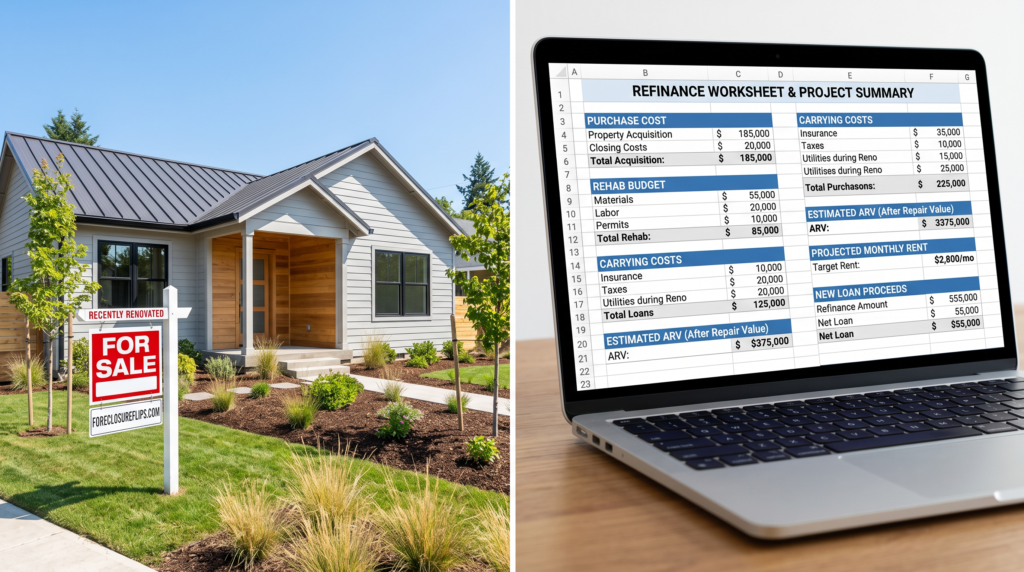
A BRRRR deal can look profitable until the refinance leaves $20,000 trapped in the property. The purchase was below market, the rehab stayed near budget, and the tenant is paying on time—yet a lower appraisal or smaller permanent loan can still derail the capital-recycling plan.
That is the pressure point in the BRRRR method. Buying and renovating create the equity, but the refinance determines how much of the original cash actually comes back.
Looking backward from that second closing exposes the numbers that decide the result: completed value, qualifying rent, loan size, seasoning, and the amount of capital left in the property.
Build Your Investing Knowledge One Email at a Time
Foreclosure investing rewards preparation. Join our 2X week newsletter for straightforward guidance on pre-foreclosures, short sales, BRRRR, flipping, and other strategies investors use to evaluate distressed property opportunities.
Put the Refinance at the Center of the Analysis
BRRRR stands for buy, rehab, rent, refinance, repeat. The sequence is simple enough. Its economics are not.
A property can succeed at the first three stages and still produce a weak result if refinance proceeds fall short. Lower appraisals, loan-to-value limits, seasoning requirements, higher rates, or insufficient qualifying rent can all reduce the cash returned.
One useful way to view the strategy is as a project with two closings. The first gets control of the property. At the second, the amount of capital coming back becomes clear.
Four numbers shape the refinance
The refinance checkpoint comes down to four figures:
- Total cash invested before refinance
- Stabilized property value
- Maximum permanent loan amount
- Cash remaining after refinance costs
Suppose the acquisition costs $145,000. Renovation adds $45,000, while financing, taxes, insurance, utilities, and other carrying expenses add another $10,000.
Total basis before refinance: $200,000.
After renovation, comparable sales support a $260,000 value. At 75% loan-to-value, the theoretical permanent loan is $195,000. Before refinance costs, about $5,000 of the original capital remains invested.
Reduce the appraisal to $240,000 and proceeds fall to $180,000 at the same loan-to-value. Roughly $20,000 now remains in the property before closing costs. The purchase and renovation did not change. Only the refinance did.
A Big Purchase Discount Can Hide a Weak Deal
Distressed properties naturally attract attention when the purchase price sits far below renovated value. That spread can be useful, but it is not the same as usable equity.
Consider two properties.
Property A
- Purchase: $125,000
- Rehab: $75,000
- Basic pre-refinance cost: $200,000
Property B
- Purchase: $155,000
- Rehab: $35,000
- Basic pre-refinance cost: $190,000
Property A looks cheaper at acquisition. Its larger rehab, however, adds construction risk, more time without rent, and more opportunity for overruns. Property B starts at a higher price but reaches stabilization with a lower basic cost.
Financing and holding expenses can widen that difference further.
Foreclosure discounts only help when the total basis remains comfortably below the value and debt the finished rental can support.
The Rehab Has Two Jobs
Flip renovations are judged largely by what a resale buyer will pay. A BRRRR renovation also has to function as a durable rental.
That changes where some of the money goes. Luxury finishes may photograph well without producing enough additional rent to justify their cost. A new electrical panel, roof repair, durable flooring, or replacement HVAC system may create less visual impact but reduce near-term maintenance risk.
Layout changes can affect both rent and value. A legal bedroom may improve both in one market, while sacrificing useful storage for a cramped room may hurt tenant appeal elsewhere.
Done well, the rehab budget supports completed value, market rent, and manageable maintenance after permanent financing.
Rent Has to Work in Two Different Models
The rent collected from the tenant and the rent recognized by a lender are not always the same number.
Freddie Mac’s current rental income requirements show one way conventional underwriting treats rent. In qualifying situations where a lease is used, 75% of gross monthly rent is generally used, with the remaining 25% accounting for vacancy, operating costs, maintenance, and other expenses.
A $2,000 monthly lease may therefore contribute $1,500 under that calculation.
Your property-level model still includes taxes, insurance, vacancy, repairs, capital expenditures, management, owner-paid utilities, association dues, and debt service. The lender calculation addresses qualification; the investment model shows whether the rental is worth holding.
Those numbers should leave enough room that extracting equity does not produce a property with almost no monthly margin.
Seasoning Can Keep Capital Tied Up Longer
Short-term acquisition financing makes speed attractive: buy, renovate, lease, and move into permanent financing quickly. The refinance product may not follow that schedule.
Fannie Mae’s current cash-out refinance rules generally require an existing first mortgage being paid off through a cash-out refinance to be at least 12 months old, subject to specified exceptions. At least one borrower also generally must have been on title for six months, again with stated exceptions.
Those rules do not create a universal wait for every BRRRR loan; portfolio lenders, DSCR programs, commercial lenders, and other products can use different standards. The point is that the assumed refinance product belongs in the acquisition model before closing.
A six-month hard-money budget can become expensive if permanent financing takes longer. Extension fees, interest, insurance, and taxes raise the amount the eventual refinance has to recover.
The Appraisal Can Change the Capital-Recycling Plan
The projected after repair value may look solid at acquisition and still come under pressure several months later.
Comparable sales age. New inventory appears. Buyer demand changes, or the completed renovation may not match the quality assumed in the original analysis.
A second refinance model at a lower value exposes that sensitivity. If the BRRRR method only works with a $300,000 appraisal, running the same deal at $285,000 shows how much capital remains trapped when the market is less generous.
The same test works with a lower loan-to-value or higher permanent rate. One favorable outcome should not carry the entire investment thesis.
Full Cash Recovery Is Not the Only Good Result
Many BRRRR examples celebrate pulling every invested dollar back out. Full recovery can be useful, but it can also encourage maximum leverage.
Suppose one refinance returns nearly all invested cash but leaves thin monthly cash flow. Another leaves $20,000 in the property and produces stronger debt coverage, more equity, and room for repairs or vacancy.
The second may be the better rental.
A more complete scorecard includes cash remaining in the deal, post-refinance loan-to-value, monthly cash flow, operating reserves, equity cushion, and expected maintenance. Return on the capital still invested can then be compared with other opportunities.
Foreclosure Flips’ free real estate investor calculators can also help separate acquisition and holding assumptions before those figures are rolled into the refinance model.
Distressed Properties Add Costs Before the Rent Starts
Foreclosures, REOs, and other distressed acquisitions can fit the strategy because repairs may create both equity and rental value. They also carry costs that simplified examples often skip.
Title problems can delay closing, occupants can postpone access, and disconnected utilities can hide system failures. Code violations, vandalism, water damage, or missing mechanical equipment may surface only after possession.
Every extra dollar spent before stabilization raises the amount the refinance has to recover. The useful discount is the room left after acquisition costs, rehab, financing, holding expenses, title work, occupancy costs, and contingency have all been counted.
The Next Deal Should Not Weaken the First One
The final “R” makes repetition sound automatic. In practice, a rental with minimal reserves, aggressive leverage, and thin cash flow may have returned plenty of money while becoming more vulnerable to the next vacancy or major repair.
The BRRRR method becomes stronger when the completed property still works after the cash comes back. Sensible leverage, realistic rent, adequate reserves, and a supportable appraisal create a healthier base for another acquisition.
The five letters describe the sequence. What follows the refinance is the real investment result: a stable rental, manageable debt, usable equity, and enough liquidity to pursue another property without relying on the first one to perform perfectly.
You might also like:
 BRRRR Method Explained: Building Wealth Through Real Estate
 Property Refinancing Strategies in BRRRR to Recycle Capital
 BRRRR Investing: How to Buy, Rehab, Rent, Refinance, and Repeat
 Why Better Real Estate Comps Data Makes Better Deals
 Learn How One Multifamily Real Estate Deal Can Lead to More
 How Private Credit Risk in Real Estate Is Changing Deal Finance