
Foreclosure Closing Costs Investors Often Underestimate
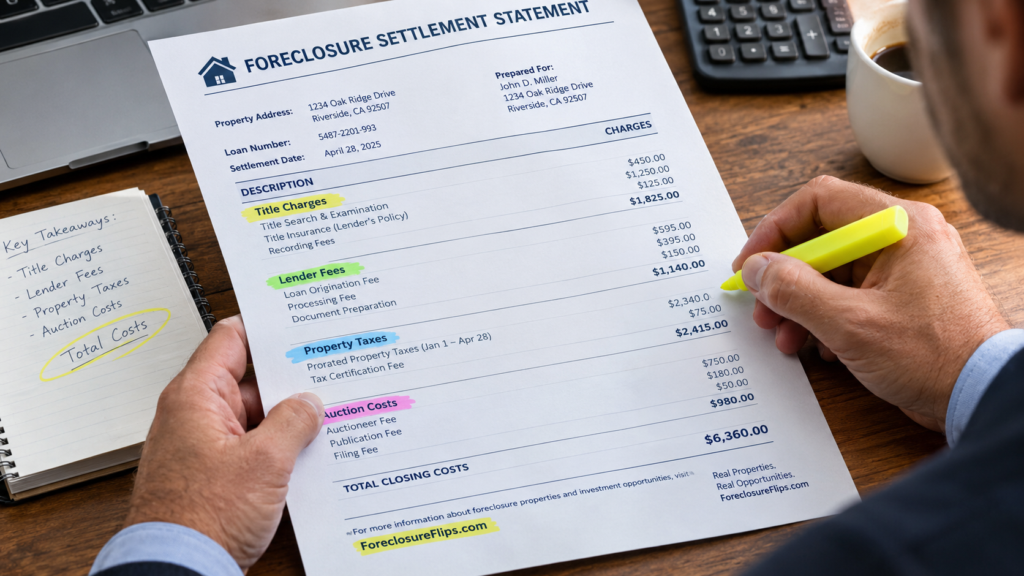
A foreclosure can look profitable at the winning bid and much thinner by the time the settlement statement arrives. The missing margin usually does not come from one dramatic surprise. It disappears through a stack of smaller charges that never made it into the acquisition model.
Title work, recording fees, transfer taxes, lender charges, auction premiums, prepaid interest, escrow funding, legal review, and unpaid property obligations can all increase the cash required to close. Some become part of the property’s basis. Others affect financing or tie up capital.
That is why foreclosure closing costs belong in the offer calculation before the contract is signed or the auction bid is placed. The useful number is the amount required to acquire the property and move it into the next stage of the investment.
Stay Ahead of the Next Deal
Markets move quickly, and good foreclosure opportunities often require fast analysis. Subscribe to our twice-weekly newsletter for investor-focused tips, tools, and market insights designed to help you make better decisions.
Start With the Settlement Statement, Not the Winning Bid
Consider a foreclosure acquired for $165,000. The original model works at that price, but the closing file adds the following:
| Closing item | Estimated amount |
|---|---|
| Purchase price | $165,000 |
| Title, settlement, and owner’s policy | $2,400 |
| Recording and transfer charges | $2,100 |
| Loan points, origination, and appraisal | $5,600 |
| Auction or transaction fee | $2,475 |
| Legal review and document work | $1,500 |
| Tax, insurance, and escrow funding | $3,200 |
| Total cash tied to acquisition | $182,275 |
The $17,275 difference is not one type of cost. Some charges are true transaction expenses, some fund future obligations, and others belong to the financing package.
From an investment standpoint, all of them affect liquidity. A deal that works only at the $165,000 headline price may already be too tight before rehab begins.
Title and Settlement Charges Can Rise After the Search
A basic title quote may cover the search, settlement services, and title insurance. Distressed-property files can add curative work that was not obvious when the quote was prepared.
The CFPB’s title service fee guidance explains that title charges can include the title search, lender’s title policy, and closing services.
Old liens and recording problems can add legal work
An unreleased mortgage, incorrect legal description, judgment, probate issue, or missing satisfaction can require affidavits, releases, corrective instruments, or attorney involvement.
The legal bill may be modest. The larger expense can come from delay when a hard-money loan, insurance policy, or contractor schedule keeps running while the issue is cleared.
A lender’s title policy does not protect your equity
A lender’s policy protects the lender’s insured interest. An owner’s policy protects the buyer’s insured ownership interest, subject to policy exceptions and exclusions.
That difference carries extra weight in foreclosure acquisitions because institutional sellers may provide limited warranties and cash buyers may have no lender requiring title coverage.
Recording and Transfer Charges Depend on the Jurisdiction
Government charges vary by state, county, and municipality.
Recording fees apply when deeds, mortgages, satisfactions, or related documents enter the public record. Transfer, documentary, or conveyance taxes may be based on the sale price, loan amount, or another statutory calculation.
Who pays also varies. Local custom does not control when an REO addendum, auction notice, or government sale terms allocate the expense differently.
The CFPB’s Loan Estimate rules separate transfer taxes from recording fees because they arise from different calculations.
For two otherwise similar deals, these local charges can produce different acquisition costs.
Financing Costs Can Reduce the Foreclosure Discount
A financed foreclosure can carry charges that never appear in the listing price or auction result:
- Origination fees
- Discount points
- Appraisal charges
- Lender legal fees
- Draw or inspection charges
- Wire and funding fees
- Extension fees on short-term financing
Two points on a $150,000 loan cost $3,000 before interest begins. Add an appraisal, lender legal fees, or construction draw charges and financing can remove several thousand dollars from the projected margin before the property produces income or reaches resale.
This becomes especially relevant when poor property condition requires bridge or hard-money financing instead of a lower-cost conventional loan.
Auction Fees Can Push the Bid Above the Real Ceiling
A $150,000 winning bid is not always a $150,000 acquisition.
Some foreclosure and tax-sale auctions add buyer’s premiums, platform fees, deed-preparation charges, court costs, transfer taxes, or other transaction expenses. A 5% buyer’s premium alone raises a $150,000 bid to $157,500 before title or financing costs.
Bid deposits require separate treatment. A deposit credited to the purchase price is not an additional expense, but it still ties up cash before closing and may be forfeited if the winning bidder fails to perform.
Prepaid Interest and Escrow Funding Increase Cash to Close
Not every dollar due at settlement is a fee.
A lender may collect prepaid interest through the end of the closing month and an initial escrow balance for future property taxes and insurance. Those amounts increase cash to close even though they fund future obligations.
A closing early in the month may require more prepaid interest than one near month-end. Escrow requirements can also change with tax due dates and insurance timing.
Separating fees from prepaids gives a cleaner view of profitability while still showing how much liquidity the transaction requires.
Property Taxes Can Cost More Than the Current Bill
Property taxes can affect a foreclosure purchase through current-year prorations, delinquent balances, special assessments, or obligations the sale terms leave with the buyer.
A conventional purchase may include familiar seller credits. A foreclosure sale can allocate taxes differently, particularly when the seller uses its own addendum or the property sells through a public auction.
The IRS’s real-estate basis guidance identifies certain settlement charges, including title fees, recording fees, transfer taxes, and some obligations assumed by the buyer, as costs that can affect basis. Loan-acquisition costs can receive different treatment.
The accounting treatment does not change the cash required to close, but it can affect how those costs are handled later.
REO Addenda Can Shift Costs Back to the Buyer
A local purchase contract may assign certain charges to the seller. Bank-owned properties often add institutional forms that change those expectations.
The seller may limit credits, require the buyer to pay specific transfer or recording charges, impose daily extension fees, or use a preferred closing process.
The relevant allocation is the one in the executed REO documents, not the custom that applies to a conventional resale.
Legal Problems Can Add Both Fees and Delay
Attorney involvement varies by state and transaction, but distressed deals can generate legal work through title defects, bankruptcy history, probate, entity ownership, occupancy, or foreclosure-case questions.
A $1,500 legal bill may be manageable. One additional month of hard-money interest, insurance, taxes, utilities, and contractor rescheduling can cost much more.
Legal expense and delay expense therefore deserve separate lines in the model.
Replace the Budgeted Closing-Cost Percentage With Real Quotes
A flat closing-cost allowance works for early screening. It becomes less reliable once an offer is taking shape.
Assume a property supports a maximum total acquisition cost of $175,000 after repairs, financing, holding expenses, resale costs, contingency, and required profit.
The preliminary model sets aside $5,000 for foreclosure closing costs, leaving $170,000 for the purchase price.
Actual quotes later show:
- Title and settlement: $2,600
- Government charges: $2,300
- Lender fees: $4,800
- Legal and document work: $1,400
- Auction premium: $3,000
Total closing-related cost reaches $14,100.
If the acquisition ceiling stays at $175,000, the supported purchase price falls to about $160,900. The property did not change. The underwriting became more complete.
A deal-analysis platform such as Rehab Valuator can keep acquisition, financing, rehab, holding, and resale assumptions in the same project model so settlement costs do not sit outside the projected return.
Divide the Closing Statement Into Three Buckets
A cleaner model separates each line item by what it does financially.
Acquisition costs
Title charges, recording costs, transfer taxes, and certain legal or settlement expenses may become part of the property’s tax basis depending on the facts and applicable rules.
Financing costs
Points, origination charges, lender appraisal fees, draw fees, and other loan expenses belong with the financing model because they change the cost of leverage.
Cash tied up at closing
Escrow deposits, prepaid taxes or insurance, and refundable deposits can increase liquidity needs without functioning like permanent transaction expenses.
This separation prevents “cash to close” and “closing costs” from being treated as interchangeable numbers.
The Discount Has to Last Beyond the Closing
Foreclosure closing costs rarely destroy a deal through one line item. The problem appears when several reasonable charges stack on top of an offer that was already close to the maximum price.
Title and settlement fees reduce available cash. Financing charges raise the cost of leverage. Auction premiums increase acquisition cost, while prepaids and escrow requirements reduce liquidity. Taxes and legal issues can add direct expense and delay.
These costs belong beside repairs and holding expenses when the maximum offer is calculated.
The winning bid shows what you paid for the property. The settlement statement shows what it cost to acquire it.
You might also like:
 Treasury Yields and Distressed Housing Deals
 How to Buy a Bankruptcy House as an Investor
 Auction Houses vs Online Foreclosure Auctions
 How to Structure Real Estate Partnerships for Foreclosure Deals
 Foreclosure Environmental Due Diligence Before You Buy
 Cash for Keys After Foreclosure: When Paying Makes Sense