
Cash for Keys After Foreclosure: When Paying Makes Sense
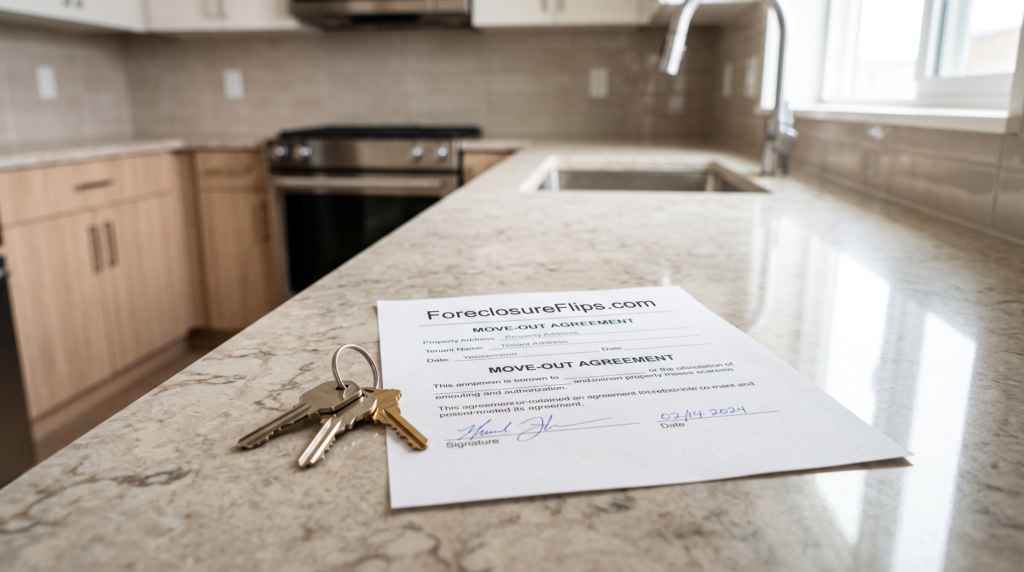
An occupied foreclosure can stall a profitable project after the purchase is already complete. A $4,500 relocation payment may look expensive until the alternative includes months of carrying costs, attorney fees, delayed construction, and no reliable date for getting inside the property.
That is where cash for keys after foreclosure can change the economics. The payment buys something the acquisition price did not: an agreed path to vacant possession.
In practical terms, the comparison is simple. If a voluntary move-out costs less than the likely expense of delay, legal action, and added property risk, it can preserve margin that would otherwise disappear after closing.
Get Foreclosure Investing Insights Twice a Week
Subscribe to the Foreclosure Flips newsletter for practical ideas on finding deals, analyzing opportunities, and understanding foreclosure-related investing strategies. We send concise updates twice a week so you can stay informed without adding more noise to your inbox.
Start With the Property You Cannot Yet Use
Consider an auction purchase at $165,000. The renovation budget is $55,000, and the projected resale value supports the deal. Title transfers, but the former owner is still living in the house.
Each month without possession adds $3,600 in interest, taxes, insurance, utilities, and other carrying expenses. A three-month delay costs $10,800 before legal fees, cleanup, security, or damage enter the numbers. Construction cannot begin, short-term financing keeps accruing interest, and the expected resale date moves farther out.
A $4,500 voluntary relocation agreement now looks different. Even after allowing for legal review and a short transition period, the cost may sit well below the modeled expense of waiting.
The opposite result is also possible. An occupant who is already preparing to leave may require little intervention, while a large relocation demand could exceed the probable cost of the legal process. The value of the agreement comes from comparing two real costs rather than assuming that paying for possession is always good or always bad.
Occupancy Status Changes the Deal
Occupancy status affects both timing and price. Three occupied homes on the same street can create three very different files.
The former owner remains
A former owner may still occupy the property while deed issuance, court confirmation, redemption rights, or state possession procedures run their course.
The legal timeline depends on the state and foreclosure process. Until lawful possession is available, the renovation schedule remains exposed to delay.
Once the purchaser has authority to address possession, a voluntary agreement can turn an open-ended timeline into a specific move-out date. That can be especially valuable when financing costs are high or contractors are scheduled to start quickly.
A tenant has a lease
A bona fide tenant may retain rights after foreclosure. The FDIC’s Protecting Tenants at Foreclosure Act guidance explains that a successor in interest generally must provide at least 90 days’ notice to vacate and, in many circumstances, honor a bona fide lease through the end of its term.
State and local law can provide additional protection. A tenant with eight months left on a valid lease therefore creates a different holding-cost profile from a former owner expected to leave shortly after the sale.
When both sides agree, a voluntary relocation payment can shorten that period. The payment compensates the tenant for leaving earlier; it does not replace existing legal rights.
No one can confirm who is inside
Auction records do not always identify the occupant.
The person could be the former owner, a tenant, a relative, or someone with no obvious connection to the recorded title. Until that status is established, the file contains several unanswered costs at once: the legal route to possession, the likely move-out date, possible lease rights, and the condition of an interior that may not have been inspected.
That uncertainty belongs in the acquisition price rather than being treated as a problem for after closing.
A Cash-for-Keys Payment Is Buying a Result
The strongest cash for keys after foreclosure agreements tie the payment to a clear handoff rather than a vague promise to leave.
A fixed vacancy date
A specific date gives the project a usable schedule. Contractor access, utilities, insurance changes, debris removal, and renovation can all be planned around that handoff.
“Within a few weeks” leaves the most expensive part of the deal unresolved.
An agreed property condition
Vacant does not necessarily mean empty or undamaged. Furniture, trash, vehicles, missing fixtures, or stripped building components can add thousands of dollars after the occupant leaves.
The agreement can define the expected condition at handoff, including removal of personal belongings and retention of fixtures or appliances that belong with the property. Photographs taken when the agreement is signed can provide a useful reference point.
Everyone in possession is accounted for
An agreement with one person solves little if other residents remain.
Occupant names, tenancy claims, and actual possession may not line up neatly with the foreclosure record. Local counsel can address the agreement structure when multiple occupants or disputed rights are involved.
Payment follows the handoff
The CFPB’s foreclosure tenant guidance describes cash for keys as money a bank or new owner may offer to help an occupant move from a foreclosed property.
From an investment standpoint, the cleanest exchange links payment to completed vacancy. A final walk-through can confirm that the property is empty, the agreed condition has been met, and keys or other access devices have been surrendered.
The Right Number Comes From the Cost of Delay
There is no standard relocation amount that fits every foreclosure. The upper limit is shaped by the expense that earlier possession can realistically avoid.
Suppose the property carries $3,500 per month in financing, taxes, insurance, utilities, and security. The expected possession process could add three months, plus $2,500 in legal and filing costs.
That produces roughly $13,000 of direct exposure before any extra cleanup or damage:
- Three months of carrying costs: $10,500
- Legal and filing allowance: $2,500
- Estimated direct exposure: $13,000
A negotiated $5,000 relocation payment plus $750 for legal documentation could save more than $7,000 under those assumptions.
The calculation becomes more conservative when the legal timeline is uncertain. A range can show the effect of a two-, three-, or four-month delay rather than relying on one forecast.
Schedule disruption belongs in the same analysis. Missing a contractor window or extending a hard-money loan can cost more than the basic monthly carrying figure suggests.
Price the Possession Problem Before Buying
The most expensive cash-for-keys mistake can occur before anyone discusses relocation: the property is purchased as though it were vacant.
Assume a foreclosure supports a $155,000 acquisition before occupancy is considered. The underlying numbers include a $300,000 after repair value, $52,000 of repairs, $24,000 of financing and holding costs, $21,000 of selling costs, an $8,000 title reserve, and a $40,000 required profit.
Now the occupancy file adds:
- Possible extra carrying costs: $9,000
- Legal expense: $2,000
- Cleanup and security reserve: $2,000
That creates $13,000 of possession exposure. Using the same profit target, the supported purchase price falls from $155,000 to about $142,000.
If cash for keys after foreclosure later produces vacant possession for $6,000 all-in, the unused portion of the reserve improves the result. A refusal that leads to the full $13,000 formal-process cost still leaves the original margin protected.
Foreclosure Flips’ Foreclosure Auction Bid Calculator separates eviction and cash-for-keys costs from title risk, liens, repairs, taxes, buyer premiums, and target profit. Keeping possession on its own line prevents it from disappearing inside a generic contingency.
When a Voluntary Agreement Creates More Risk
Cash for keys is not a shortcut around ownership or tenant law.
A winning auction bid may still be followed by deed issuance, court confirmation, redemption, or another post-sale requirement. Negotiating possession before the purchaser has legal authority can complicate an otherwise workable deal.
Tenant protections create a separate boundary. Federal law can preserve notice periods and lease rights, while state or local rules may go further. Utility shutoffs, lock changes, intimidation, or other self-help tactics can create liability instead of shortening the timeline.
Early payment carries a simpler financial risk. Once relocation funds are released, the incentive tied to vacancy and property condition may disappear.
Vague terms can cause the same problem. A written agreement that identifies the vacancy date, occupants, condition, belongings, access devices, and payment event gives both sides a clearer understanding of what completes the deal.
Vacant Possession Has Its Own Price
An occupied foreclosure is not economically identical to the same property delivered vacant, even when the purchase price, repair scope, and resale value are unchanged.
Cash for keys after foreclosure can reduce that gap by converting an uncertain possession timeline into a defined cost and date. The arrangement is most valuable when the payment remains below the realistic cost of delay and respects the legal rights of the people occupying the property.
More importantly, the underwriting lesson appears earlier. Possession has a cost whether it shows up as relocation money, attorney fees, added interest, delayed construction, property cleanup, or several of those expenses at once.
When that cost is included before the purchase, a successful move-out agreement improves the deal rather than rescuing one that was overpriced from the start.
You might also like:
 Treasury Yields and Distressed Housing Deals
 Foreclosure Environmental Due Diligence Before You Buy
 Foreclosure Investing: How to Buy, Analyze, and Profit From Foreclosed Homes
 Riverside–San Bernardino Foreclosure Market 2026
 New York City Metro Foreclosure Market 2026
 Before You Buy a Tear-Down Foreclosure, Prove the Deal