
How Passive Activity Rules Trap Real Estate Investor Losses
You buy a foreclosure, renovate it, refinance into long-term debt, and put a tenant in place. After depreciation and other expenses, the rental shows an $18,000 tax loss—even though the property produces positive cash flow.
You expect that loss to reduce income from your flips or day job. Then you learn that some or all of it may have to wait.
That’s where the passive activity rules for real estate investors enter the picture. Your level of participation, income, other passive investments, and real estate activities can determine whether you use a rental loss now or carry it into a future year.
Get Foreclosure Investing Insights Twice a Week
Subscribe to the Foreclosure Flips newsletter for practical ideas on finding deals, analyzing opportunities, and understanding foreclosure-related investing strategies. We send concise updates twice a week so you can stay informed without adding more noise to your inbox.
Why a Rental Loss May Not Reduce Your Other Income
Federal tax law separates income and losses into different categories rather than letting every loss offset every type of income.
The tax code generally treats rental activities as passive, including rental real estate. That classification applies even when you spend substantial time overseeing the property, unless an exception changes the result. Section 469 of the Internal Revenue Code establishes the underlying passive activity loss rules.
Consider an investor who earns:
- $90,000 from a job
- $35,000 from an active house-flipping business
- A $20,000 tax loss from a rental property
You cannot assume the $20,000 rental loss automatically reduces the other $125,000 of income.
First, you need to determine whether the rental loss stays passive and whether one of the exceptions allows you to use some or all of it against nonpassive income.
That distinction becomes especially relevant when you acquire distressed properties with more than one possible exit. A foreclosure purchased as a flip may later become a BRRRR property or long-term rental, putting part of your portfolio under a different set of loss rules.
Start With the Default Rule: Rentals Are Usually Passive
The default rule is fairly straightforward.
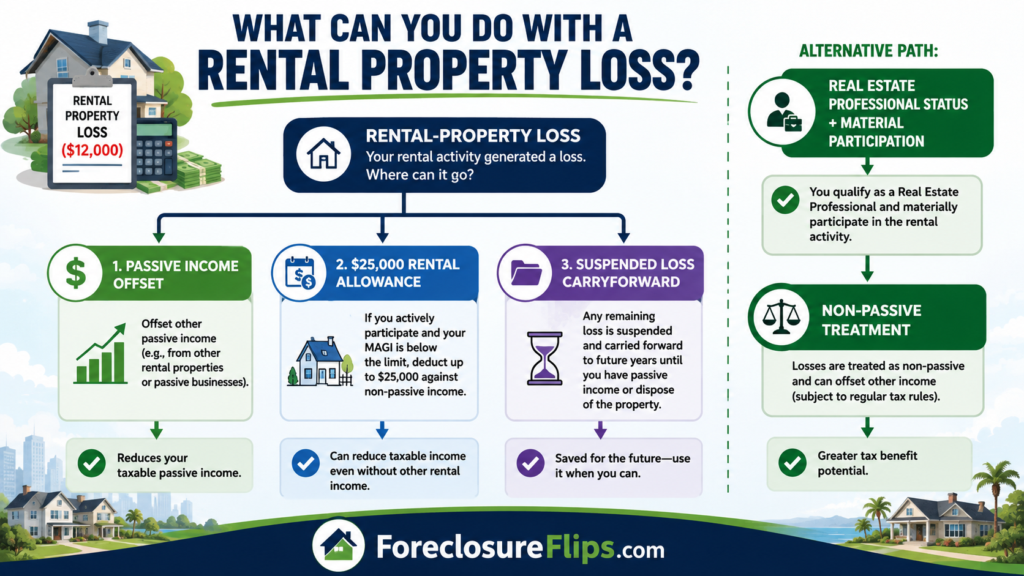
The tax code normally classifies rental activity as passive. When your passive deductions exceed your passive income, the passive activity rules can prevent you from deducting the excess against nonpassive income during the current year.
You don’t necessarily lose the deduction.
Instead, the rules generally carry the disallowed loss forward. You may use it later when you generate sufficient passive income or when another event allows the loss to become deductible.
The IRS summarizes this framework in its passive activity loss guidance, including the treatment of unused losses and the exceptions available to some rental-property owners.
Passive income can absorb passive losses
Suppose one rental produces a $12,000 passive loss while another passive activity generates $9,000 of income.
The $9,000 of passive income can generally absorb $9,000 of the passive loss, leaving $3,000 subject to the remaining limitation rules.
Wages don’t count as passive income. Neither does portfolio income such as ordinary interest and dividends.
For investors building a portfolio, that means a loss from one property may become usable as other passive properties begin producing taxable income.
Active Participation Can Unlock Up to $25,000
Real estate gets a special exception that can allow some investors to deduct rental losses against nonpassive income.
If you actively participate in rental real estate, you may qualify for a special allowance of up to $25,000.
Active participation uses a lower standard than material participation. The IRS gives examples such as approving tenants, setting rental terms, and approving repair or capital expenditures. You must also generally own at least 10% of the rental activity by value throughout the year.
For a foreclosure investor who buys, renovates, rents, and personally makes the major management decisions, clearing the participation standard may not require an enormous amount of time.
Income creates the next hurdle.
The $25,000 allowance phases out
For single taxpayers and married couples filing jointly, the maximum special allowance generally works like this:
| Modified adjusted gross income | Maximum potential allowance |
|---|---|
| $100,000 or less | $25,000 |
| $110,000 | $20,000 |
| $125,000 | $12,500 |
| $140,000 | $5,000 |
| $150,000 or more | $0 |
The allowance falls by 50 cents for every dollar that modified adjusted gross income exceeds $100,000 and generally disappears at $150,000. Different rules apply to married taxpayers filing separately. The current Form 8582 instructions provide the calculation used for the rental real estate special allowance.
That phaseout can catch successful investors by surprise.
Income from a strong year of flips, employment, or other activities may push you above the range where the special rental allowance provides much benefit.
Active Participation and Material Participation Are Not the Same
These two terms sound interchangeable. Tax law treats them differently.
Active participation mainly enters the discussion when you claim the special rental real estate allowance described above.
Material participation uses a higher standard and asks how substantially you participated in an activity.
Several tests can establish material participation. Three of the most relevant for hands-on investors include:
- Participating for more than 500 hours during the year
- Performing substantially all the participation in the activity
- Participating for more than 100 hours and at least as much as any other individual
Other tests can apply, so don’t treat 500 hours as the universal threshold.
Keep records of the work you perform. Calendars, project-management records, emails, mileage records, contractor communications, leasing records, and similar documentation can help reconstruct your participation.
Material Participation Alone Usually Doesn’t Fix a Rental Loss
Here is the part that often creates confusion.
You might personally handle tenant selection, approve every repair, manage contractors, collect rents, and spend hundreds of hours working on your rentals.
Rental real estate normally remains passive anyway.
To treat qualifying rental real estate losses as nonpassive through the real estate professional rules, you generally need to clear two separate hurdles:
- Qualify as a real estate professional for the year.
- Materially participate in the applicable rental real estate activity.
Material participation by itself doesn’t automatically convert an ordinary long-term rental into a nonpassive activity.
Real Estate Professional Status Changes the Analysis
The real estate professional rules can substantially alter the result for investors who spend most of their working time in real estate.
You generally qualify as a real estate professional for a tax year when both of these conditions apply:
- More than half of the personal services you perform in trades or businesses during the year occur in real property trades or businesses in which you materially participate.
- You perform more than 750 hours of services in those real property trades or businesses during the year.
Qualifying real property trades or businesses can include development, redevelopment, construction, reconstruction, acquisition, conversion, rental, operation, management, leasing, and brokerage.
That definition has obvious relevance for active foreclosure investors.
If you spend significant working time acquiring, renovating, converting, managing, or otherwise operating real property as a genuine trade or business, some of those activities may contribute to the real estate professional analysis.
But clearing the 750-hour and more-than-half tests doesn’t finish the job.
You still need material participation in the rentals
The rules generally treat each rental real estate interest as a separate activity when evaluating material participation.
A qualifying real estate professional can elect to treat all interests in rental real estate as one activity, which can change how the material participation tests apply. The decision can also affect what happens when you eventually sell one property, so grouping should not become an automatic year-end checkbox.
For investors with several foreclosure rentals, this can become one of the more consequential tax-planning decisions in the portfolio.
Your Flipping Business and Rental Portfolio Can Get Different Treatment
Imagine that you renovate and sell four houses during the year while holding two former foreclosure acquisitions as rentals.
You work full time in the business and spend hundreds of hours finding properties, managing rehabs, dealing with contractors, and selling completed flips.
That activity does not automatically make losses from the two rentals nonpassive.
Your tax analysis needs to separate the questions:
Do your real estate activities allow you to qualify as a real estate professional?
Then:
Did you materially participate in the rental activity under the applicable rules?
This distinction explains why two investors with nearly identical portfolios can receive different current-year treatment for the same $20,000 rental loss.
Their participation and other income can differ even when the properties look nearly identical.
What Happens to a Suspended Rental Loss?
A suspended loss doesn’t disappear because you couldn’t use it this year.
The passive activity rules generally carry the unused amount into later tax years. Future passive income may free up part or all of that loss.
A complete sale can provide another route.
When you dispose of your entire interest in a passive activity through a transaction in which you recognize all of the gain or loss, and the buyer isn’t related to you, the IRS generally allows previously suspended passive losses from that activity in full for that year.
For a BRRRR investor, that creates an important distinction between annual cash flow and lifetime tax treatment.
A deduction you cannot use today may still have economic value later.
Track the Tax Loss Alongside the Property’s Actual Performance
Don’t let a large Schedule E loss convince you that the property itself performs poorly.
Depreciation can produce a tax loss while the rental generates positive cash flow. Conversely, a property can produce a useful tax deduction while consuming cash every month.
Track both.
When reviewing a foreclosure that you plan to hold, calculate rent, vacancy, repairs, capital expenditures, financing costs, taxes, insurance, property management, and reserves without relying on a potential tax benefit to rescue the deal.
Our free real estate investor calculators can help you evaluate the operating numbers before you decide whether a distressed property works better as a rental than a resale.
Once the deal works on its own economics, the tax treatment becomes another part of the return rather than the reason you bought the property.
Know Where Your Rental Loss Will Go Before Year-End
The passive activity rules for real estate investors become far easier to manage when you look at them before your accountant starts preparing the return.
If a foreclosure or planned flip becomes a rental, track your participation from the beginning. Separate rental activities from your flipping operations, preserve records of the work you perform, and keep a running schedule of passive income and suspended losses.
Next, determine which path applies to you: ordinary passive treatment, the active-participation rental allowance, or real estate professional status combined with material participation.
The distinction can determine whether a $20,000 rental loss reduces this year’s taxable income or sits on the sidelines until a later year.
For an investor deciding whether to flip, refinance, or hold a distressed property, that isn’t just a tax-form issue. It changes the after-tax economics of the exit you choose.
You might also like:
 BRRRR Investing: How to Buy, Rehab, Rent, Refinance, and Repeat
 BRRRR Method Explained: Building Wealth Through Real Estate
 BRRRR Method Pros and Cons for Real Estate Investors
 Why Missing Middle Housing Is Missing
 Assumable Mortgages for Real Estate Investors
 Real Estate Professional Status: Do Your Hours Qualify?