
Why Missing Middle Housing Is Missing
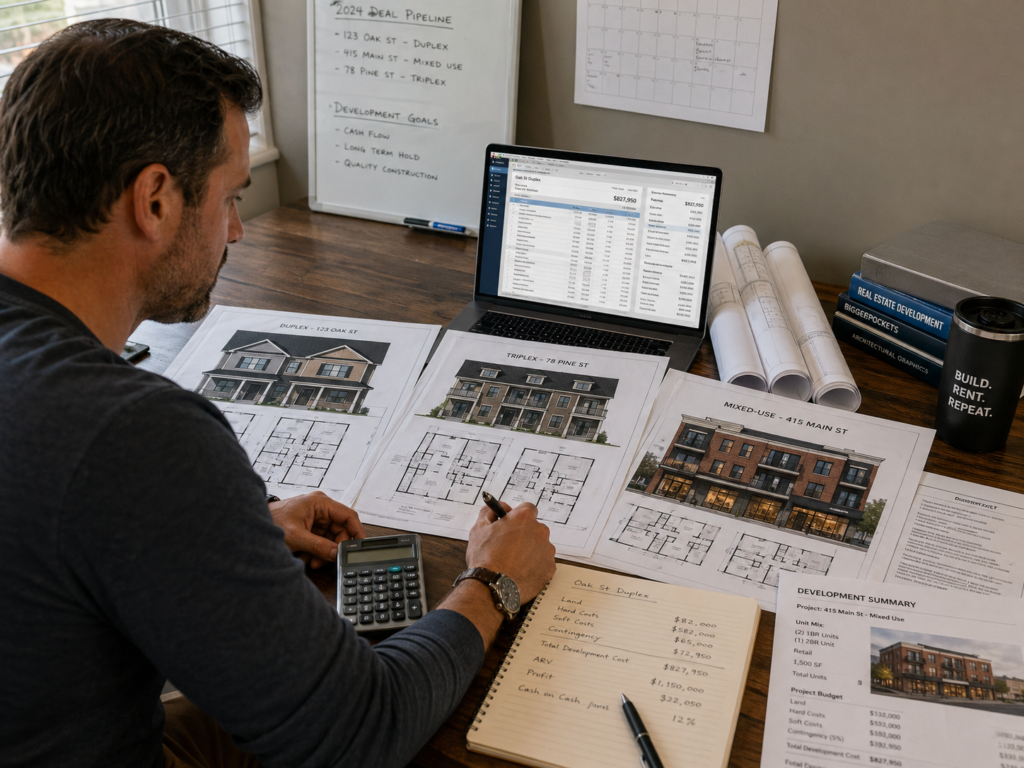
Drive through many American cities and suburbs and the pattern is hard to miss. On one side, there are detached single-family homes. On the other, there are large apartment complexes that feel out of scale with the neighborhoods around them.
What is often missing is everything in between.
Duplexes. Triplexes. Fourplexes. Small apartment buildings. Cottage courts. Townhomes. Live-work buildings. Human-scaled mixed-use projects. These are not unusual building types historically. In many older neighborhoods, they are part of the natural urban fabric.
But in many places, they have become difficult or impossible to build.
That gap is commonly called missing middle housing. It describes housing types that sit between detached single-family homes and large apartment buildings. These buildings can add more housing without turning every neighborhood into a high-rise district.
For real estate investors, small developers, and house flippers, this matters. Missing middle housing is not just a planning concept. It can also be a practical development strategy.
Build Your Investing Knowledge One Email at a Time
Foreclosure investing rewards preparation. Join our 2X week newsletter for straightforward guidance on pre-foreclosures, short sales, BRRRR, flipping, and other strategies investors use to evaluate distressed property opportunities.
What Missing Middle Housing Means
Missing middle housing generally refers to house-scale buildings with multiple units that fit into existing residential neighborhoods. The concept includes duplexes, triplexes, fourplexes, courtyard apartments, bungalow courts, townhomes, small multiplexes, and neighborhood-scale mixed-use buildings.
The core idea is simple. A neighborhood can have more housing options without relying only on detached houses or large apartment complexes.
The organization Missing Middle Housing defines these buildings as house-scale housing types with multiple units that are compatible in form and scale with single-family homes. That compatibility is important. Missing middle housing is not about forcing towers into low-rise neighborhoods. It is about allowing more flexible, human-scaled housing forms.
A duplex can look like a large house. A triplex can sit comfortably on a residential block. A fourplex can provide multiple rental units without looking like a commercial apartment complex. A small mixed-use building can place a few apartments above a neighborhood-serving business.
These housing types used to be common. In many cities, they still exist in older neighborhoods built before modern zoning codes became more restrictive.
Why the Middle Went Missing
Missing middle housing did not disappear because people stopped needing it. It disappeared because many communities made it difficult to build.
The reasons vary by market, but several patterns show up repeatedly.
Single-family zoning limited what could be built
Many residential areas were zoned to allow only one detached house per lot. That meant duplexes, triplexes, quads, and small apartment buildings were excluded by default.
Even where the land could physically support more housing, the zoning code often would not allow it.
This created a binary development environment. Builders could construct detached homes in one area or larger apartment buildings in another, but smaller multifamily projects were often squeezed out.
Parking rules made small projects harder
Parking requirements can make missing middle projects difficult to finance or design.
A fourplex may physically fit on a lot, but if the zoning code requires two parking spaces per unit, the project may become unworkable. The building footprint shrinks, the site plan becomes inefficient, or the project no longer pencils out.
For small infill projects, parking can be one of the biggest constraints.
Larger projects often receive more institutional attention
Big apartment projects attract institutional developers, lenders, consultants, and professional management firms. Detached homes are familiar to builders, appraisers, lenders, and buyers.
The middle is more complicated.
A triplex or small mixed-use building may not fit cleanly into standard lending, appraisal, construction, or permitting expectations. The project may be too small for institutional capital but too complex for a typical single-family builder.
That is one reason small developers are so important. Missing middle housing often requires local knowledge, flexible thinking, and careful budgeting.
Land and construction costs changed the math
Even when zoning allows missing middle housing, the numbers can be challenging.
High land prices, construction costs, interest rates, and permitting delays can make smaller projects harder to execute. A large apartment building can spread soft costs across many units. A duplex or fourplex has fewer units to absorb those same costs.
The Urban Institute has noted that high land costs and higher loan rates can impede construction of small apartment buildings and missing middle housing. For investors, this is why careful feasibility analysis matters before pursuing a site.
Why Detached Homes and Huge Apartments Dominate
The current development pattern is not accidental. It is the result of rules, financing systems, risk preferences, and market habits.
Detached single-family homes are familiar. They are easy to understand, easy to appraise, and widely accepted by zoning codes in residential areas. Large apartment complexes are also familiar to professional developers because they can support dedicated teams, institutional financing, and economies of scale.
Missing middle projects sit in a less comfortable zone.
They may require zoning interpretation, neighborhood engagement, variance requests, utility coordination, creative financing, or a construction budget that needs to be extremely tight. That creates friction.
But friction can also create opportunity.
Investors who learn how to evaluate small multifamily and infill development projects may find deals others overlook. A side yard, oversized lot, obsolete structure, corner parcel, vacant infill lot, or underused commercial property may have potential that is not obvious at first glance.
Stay Ahead of the Next Deal
Markets move quickly, and good foreclosure opportunities often require fast analysis. Subscribe to our twice-weekly newsletter for investor-focused tips, tools, and market insights designed to help you make better decisions.
Bringing the Middle Back Through Small Development
Bringing back missing middle housing does not require every investor to become a large developer. In many cases, the opportunity starts with modest, practical projects.
That might include converting a single-family property into a duplex where allowed, building an accessory unit, adding a second structure on an oversized lot, carving off a side yard, building a small duplex, or repositioning an older small multifamily property.
The key is to think in terms of highest practical use, not just current use.
A property may currently function as a single rental house, but the land may support more. An older structure may sit on a lot large enough for an additional unit. A corner parcel may be suitable for a small mixed-use concept. A tired duplex may be repositioned into a stronger long-term rental asset.
The AARP Livable Communities resource on missing middle housing explains that these housing types can provide more housing choices at different price points while fitting into existing communities. That is the practical appeal. Missing middle housing can add supply without requiring every project to be massive.
The Investor Case for Missing Middle Housing
For investors, missing middle housing can create several advantages.
First, it can improve land efficiency. A duplex, triplex, or quad may create more income from the same parcel than a single detached rental.
Second, it can diversify income. Multiple units reduce dependence on one tenant. A vacancy in one unit does not necessarily mean the property produces no income.
Third, it can improve exit options. Depending on the market and project structure, the investor may be able to hold the property as a rental, refinance it, sell it to another investor, or potentially sell units individually if local rules and project design support that path.
Fourth, it can align with local housing needs. Many communities need more rental options, smaller homes, workforce housing, and neighborhood-scale density.
But the strategy is not automatic. The project still has to work financially.
Why Analysis Matters Before You Build

Missing middle housing can look simple from the outside. A duplex seems straightforward. A triplex feels manageable. A fourplex may look like a scaled-up house.
But small development can be unforgiving.
There are fewer units to absorb mistakes. A $25,000 budget miss on a large apartment complex may be inconvenient. A $25,000 miss on a duplex can materially damage the return.
That is why investors need to analyze the full project before committing. The numbers should include acquisition cost, land basis, site work, design, engineering, permits, utility connections, construction, financing, contingency, holding costs, rent assumptions, operating expenses, taxes, insurance, and exit value.
This is where a tool such as Rehab Valuator can support the process. Investors can use structured software to organize development assumptions, build budgets, analyze projected returns, and present the project more professionally.
The goal is not to make a weak project look strong. The goal is to identify whether the project actually works.
Real-World Examples of Missing Middle Opportunities
A missing middle project may begin with something as simple as an oversized side yard.
For example, an investor may own a rental house on a larger lot. If local zoning, setbacks, access, utilities, and subdivision rules allow it, that unused land may support a new duplex or additional rental structure. The original property remains an asset, while the side yard becomes a new income-producing project.
Another example is an older single-family home in a neighborhood where duplexes are now permitted. Instead of renovating only for resale, the investor may evaluate whether a conversion or redevelopment creates more long-term value.
A third example is a small multifamily property with poor layout, outdated finishes, and below-market rents. The opportunity may not be ground-up construction. It may be repositioning an existing missing middle asset that has been poorly managed or underimproved.
A fourth example is a small mixed-use building in a walkable area. A few residential units above a small commercial space can provide diversified income while supporting neighborhood activity.
Each example requires different analysis. A side-yard duplex is not the same as a renovation. A quad conversion is not the same as a ground-up small apartment building. A mixed-use project is not the same as a single-family flip.
The common thread is that the investor needs a disciplined way to evaluate scope, cost, value, income, and risk.
Funding the Project Professionally
Small development projects often need a stronger funding presentation than a basic flip.
A lender or private capital partner will want to understand the site, zoning, budget, timeline, completed value, income potential, and exit strategy. They may also want to see the investor’s assumptions, comparable sales, rent comps, contractor estimates, and contingency planning.
This is another area where organized software can help. A strong project presentation can make the investor look more credible and prepared.
For investors who want a deeper system for deal analysis, lender presentations, and project planning, the Inner Circle Mentorship may be worth reviewing. Missing middle projects often involve more moving parts than simple cosmetic flips, so guidance and process can matter.
Start Small and Build a Repeatable Model
Not every investor should start with a ground-up fourplex or mixed-use building.
A more practical path may be to begin with smaller projects: a duplex renovation, a side-yard infill opportunity, a single-to-two-unit conversion, or a small multifamily repositioning. These projects can teach the investor how zoning, budgeting, financing, and construction management actually work.
The important thing is to document the numbers.
What was the original budget? What did site work actually cost? Which contractor bids were accurate? Which line items were missed? Did rents match the original projection? Did the completed value support the plan?
For investors who want to test a more structured workflow, the 14-Day $1 Trial of Rehab Value Premium can be a practical way to start organizing budgets, project assumptions, and deal analysis in one place.
The Bottom Line
America does not only need detached single-family homes and huge apartment complexes. It also needs the missing middle: duplexes, triplexes, quads, small multifamily buildings, cottage courts, townhomes, and human-scaled mixed-use projects.
These housing types disappeared from many markets because zoning, parking rules, financing systems, and development economics made them harder to build.
But they can come back.
For investors and small developers, missing middle housing can be a powerful opportunity. It can create more housing, improve land use, generate rental income, and bring human-scaled development back into neighborhoods.
The key is discipline. Before building, investors need to understand the site, the zoning, the budget, the rents, the completed value, the financing, and the exit strategy.
Missing middle housing is not just a design idea. It is a development model. And for investors willing to learn the numbers, it may be one of the most practical ways to create value in today’s housing market.
Want to Partner With Foreclosure Flips?
Build visibility with an audience interested in foreclosure deals, rehabs, rentals, and investment strategy. Learn More
You might also like:
 BRRRR Method Explained: Building Wealth Through Real Estate
 BRRRR Method Pros and Cons for Real Estate Investors
 BRRRR Investing: How to Buy, Rehab, Rent, Refinance, and Repeat
 How To Build Real Wealth With a New Construction Rental Portfolio
 Top BRRRR Markets for 2026
 Risks of Rent-to-Own Deals for Property Investors