
How Adjustable-Rate Mortgages Create Distress
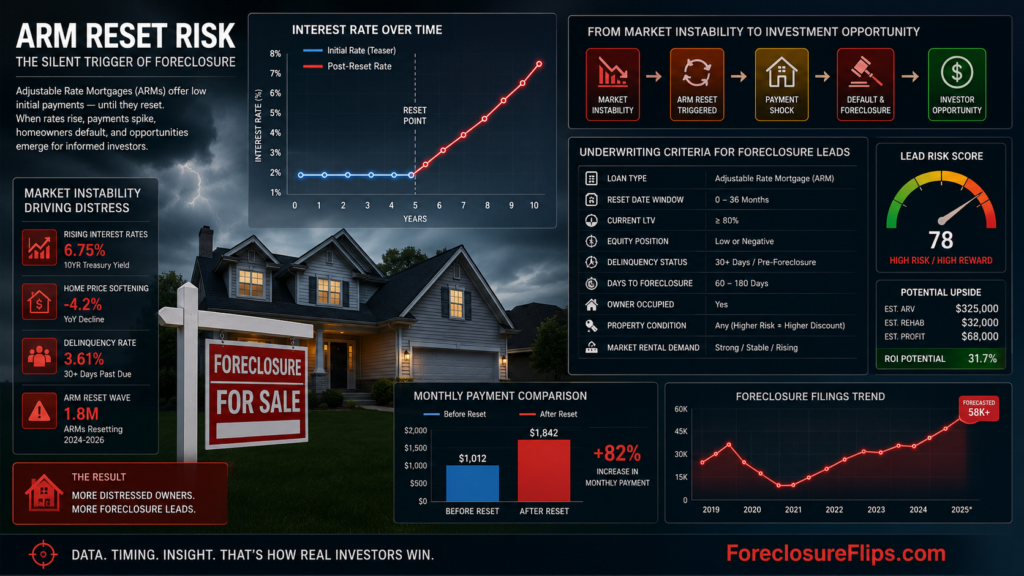
An adjustable-rate mortgage can remain affordable for years and then become a serious financial problem after the initial fixed-rate period expires. The borrower may have qualified based on a low introductory payment, only to face a substantially higher obligation when the rate resets.
That transition creates a specific type of distressed-property lead. The problem isn’t simply that the borrower missed a payment. The underlying loan has changed, and the higher payment may continue unless interest rates fall, the loan is modified, or the property is sold.
Understanding the reset mechanics helps you identify adjustable-rate mortgage foreclosure leads earlier, estimate whether the distress is temporary or structural, and determine whether enough equity remains for a workable purchase.
Build Your Investing Knowledge One Email at a Time
Foreclosure investing rewards preparation. Join our 2X week newsletter for straightforward guidance on pre-foreclosures, short sales, BRRRR, flipping, and other strategies investors use to evaluate distressed property opportunities.
The Distress Sequence Starts Before the First Missed Payment
ARM-related distress usually develops through a sequence rather than a single event:
Initial fixed period expires → interest rate resets → payment increases → household budget fails → delinquency begins
The best opportunity may appear between the reset notice and the first serious default.
The introductory rate stops protecting the borrower
An adjustable-rate mortgage generally begins with a fixed interest rate for a stated period. After that period ends, the rate adjusts at scheduled intervals.
A loan described as a 5/6 ARM, for example, typically has an initial rate fixed for five years and then adjusts every six months. Other structures may include 7/6 and 10/6 ARMs. The Freddie Mac ARM overview explains the distinction between the initial fixed period and the later adjustment period.
Borrowers who expected to refinance or sell before the initial period ended may be especially exposed. Refinancing may no longer work if income has declined, credit has deteriorated, property values have softened, or current fixed rates produce no meaningful savings.
The new rate is calculated from the loan terms
An ARM reset is not an arbitrary lender decision. The adjusted rate generally depends on four components:
- The loan’s index
- The lender’s margin
- The initial fixed-rate period
- The applicable adjustment caps
HUD’s description of adjustable-rate mortgage components explains that the new rate is generally calculated by adding the contractual margin to the applicable index, subject to the loan’s cap structure.
The margin usually remains fixed. The index changes with market conditions. Caps limit how much the rate can rise at the first adjustment, during later adjustments, and over the life of the loan.
A cap reduces the size of an immediate increase, but it doesn’t necessarily eliminate distress. A loan that cannot reach its fully indexed rate at the first reset may continue adjusting upward at later intervals.
What Payment Shock Looks Like in Practice
Consider a simplified loan with:
- A $300,000 remaining principal balance
- Approximately 27 years remaining
- A current rate of 3.5%
- A reset rate of 5.5%
The principal-and-interest payment would rise from approximately $1,433 to $1,779 per month, an increase of about $346, or 24%.
If the rate later reached 6.5%, the payment would approach $1,967, roughly $534 above the original payment.
Those figures exclude taxes, insurance, mortgage insurance, association dues, and escrow shortages. A borrower who also receives a tax reassessment or higher insurance premium can experience a much larger increase in the total monthly housing expense.
That distinction is important when you speak with a seller. “My mortgage went up $500” may describe a combination of:
- An ARM interest-rate adjustment
- Higher property taxes
- Increased homeowners insurance
- An escrow shortage repayment
- Late charges or delinquency-related fees
Ask for the mortgage statements and reset notice before attributing the entire increase to the adjustable rate.
Where Adjustable-Rate Mortgage Foreclosure Leads Surface
ARM distress often becomes visible through timing patterns and seller behavior before a foreclosure filing appears.
Start with the loan origination window
The mortgage origination date can help you estimate when the initial fixed period may expire.
A loan originated five years ago may be approaching the first reset if it is a 5-year ARM. Loans from seven or ten years earlier may present similar timing signals under longer fixed-period products.
The origination date alone does not prove that a loan is adjustable. Recorded mortgages, deeds of trust, or ARM riders may reveal the loan structure, although the amount of available information varies by county and document system.
Treat the date as a screening signal, then confirm the terms through seller-provided documents.
Watch for reset-related seller language
ARM distress leads may describe the problem without using mortgage terminology. Common statements include:
- “My payment suddenly increased.”
- “The lender changed my rate.”
- “I thought I would refinance before this happened.”
- “The payment is going up again.”
- “I can afford the old payment but not the new one.”
- “I received a notice showing next month’s payment.”
The servicer must provide notice before an ARM interest-rate or payment change under applicable requirements and the loan documents. Fannie Mae’s ARM payment-change guidance also requires separate notices when the interest rate and payment adjust at different intervals.
A seller who still has the notice may be able to provide the new rate, effective date, payment amount, and adjustment details before delinquency becomes severe.
Use a Five-Part ARM Lead Screen
An adjustable-rate mortgage foreclosure lead should be evaluated differently from a standard missed-payment lead.
1. Confirm the reset date
Identify the date of the first or next adjustment and the date the new payment becomes due. A reset several months away creates a different opportunity from a borrower who has already missed three payments at the higher amount.
2. Reconstruct the payment change
Collect the current rate, new rate, unpaid principal balance, remaining term, and total monthly payment. Separate principal and interest from taxes, insurance, association dues, and escrow adjustments.
Calculate both the dollar increase and percentage increase. A $300 change may be manageable for one household and unsustainable for another.
3. Determine whether the distress is structural
Temporary distress may be caused by a short-term income disruption. Structural distress means the new payment is likely to remain unaffordable.
Warning signs include:
- Repeated future rate adjustments
- No realistic refinance option
- Rising escrow obligations
- High consumer debt
- Reduced household income
- Deferred property maintenance
- Existing mortgage delinquency
Structural distress creates stronger motivation to sell, but it may also mean the borrower has already consumed part of the property’s equity through arrears and fees.
4. Verify the complete debt position
Request a current mortgage payoff and, when relevant, a reinstatement quote. Add junior liens, unpaid taxes, association balances, judgments, closing costs, and estimated repairs.
Do not base the offer only on the original loan amount or the balance shown on an older statement.
5. Stress-test the exit
Underwrite the deal using conservative assumptions for value, repairs, holding time, financing costs, and resale expenses.
ARM distress explains why the seller may need a solution. It does not compensate for insufficient equity, poor property condition, title defects, or an unrealistic purchase price.
Match the Deal Structure to the Reset Problem
The appropriate acquisition path depends largely on equity and foreclosure timing.
A property with substantial equity may support a conventional investor purchase. The closing pays off the adjustable-rate mortgage, eliminating further reset risk for the seller.
Limited equity may require tighter negotiation, reduced transaction costs, or a short-sale review. Once arrears, legal expenses, and junior liens exceed the available equity, the lender’s approval may become necessary.
A pending loan modification can also affect the transaction. The seller may prefer to keep the property if the servicer offers an affordable fixed payment. Avoid assuming that the modification will fail or that a scheduled sale has been postponed. Verify the status through current written documentation.
Read the Reset Before You Price the Property
An adjustable-rate mortgage foreclosure lead is most useful when you can distinguish the loan problem from the property opportunity.
The reset notice tells you when the financial pressure changes. The mortgage terms show whether more increases may follow. The payoff and title work reveal whether a purchase can clear the existing debt. Property analysis determines whether the remaining margin justifies the risk.
Approach these leads before the missed payments, legal fees, and deferred maintenance accumulate. A borrower approaching the first major reset may have more equity, more options, and more time to complete a sale than someone already deep in foreclosure.
The ARM created the distress, but the loan documents, equity position, and deadline determine whether it can become a viable investment deal.
Want To Know What Properties Banks Are About To List?
Learn how to find deeply discounted properties. Get instant access to pre-foreclosures, REOs, and short sales updated daily!
You might also like:
 Pre-Foreclosure Leads in an Affordability Crisis
 Pre-Foreclosure vs Foreclosure: What Investors Need to Know
 Shadow Inventory in Real Estate What Investors Should Watch
 When Creative Financing Does Not Fit a Foreclosure Deal
 Distressed Seller Bankruptcy Signals Investors Should Understand
 Lease Options for Pre-Foreclosure Properties