
How to Decide Whether a Distressed Property Should Be Flipped, Rented, or Wholesaled

When you acquire control of a distressed property, the largest projected profit does not always identify the best exit. A flip may show a strong gross spread but require more capital and construction experience than you have. A rental may produce long-term wealth but weak immediate cash flow. A wholesale assignment may offer a smaller fee while protecting you from renovation and market risk.
The decision to flip, rent, or wholesale should connect four factors: property condition, available capital, local demand, and your ability to execute. The strongest exit is the one that remains workable when repairs cost more, financing takes longer, or the market moves against you.
Stay Ahead of the Next Deal
Markets move quickly, and good foreclosure opportunities often require fast analysis. Subscribe to our twice-weekly newsletter for investor-focused tips, tools, and market insights designed to help you make better decisions.
Start With the Property’s Condition
Condition determines how much capital, time, and management the property will require before it can support an exit.
A cosmetically distressed house with a functional roof, stable foundation, working utilities, and a conventional layout may be a practical flip. You can often estimate the renovation accurately and complete the project without rebuilding major systems.
A property with durable construction in a strong rental area may support a rental strategy even if the finishes are dated. Tenants generally need the property to be safe, functional, and competitive—not renovated to the highest retail standard.
Severe structural damage, environmental problems, fire loss, major title uncertainty, or an occupied-property dispute can make either strategy more difficult. If you can place the property under contract at a sufficient discount but do not have the resources to solve those problems, wholesaling to a specialist may be the better decision.
Separate Repairable Problems From Operational Problems
A damaged kitchen can be priced and replaced. An uncertain possession timeline, uninsurable roof, clouded title, or unresolved zoning issue is harder to control.
You should distinguish between physical repairs and transaction risks. A project with $80,000 of clearly defined renovation work may be safer than one with $30,000 of visible repairs plus unknown title, occupancy, and permit exposure.
Test the Flip Exit
A flip is most appropriate when the renovated resale value is well supported, the buyer pool is active, and you can complete the work efficiently.
Calculate a conservative after-repair value using recent comparable sales. Then subtract acquisition costs, repairs, financing, insurance, utilities, taxes, selling expenses, and your required profit. Include a contingency for hidden damage and a realistic resale period.
Current existing-home market data can help you place local conditions in a broader context, but your actual decision should depend on neighborhood-level inventory, days on market, price reductions, and buyer financing.
A flip becomes less attractive when the projected profit depends on the highest comparable sale, minimum repairs, or a rapid closing. It also becomes riskier when the property’s finished price will sit near the top of the neighborhood market.
You should favor the flip exit when you have sufficient reserves, dependable contractors, a clear renovation scope, and enough margin to survive a slower sale.
Test the Rental Exit
A rental strategy should be evaluated from income rather than appreciation.
Estimate market rent from comparable leased properties, not advertised rents alone. Then subtract vacancy, management, maintenance, capital expenditures, taxes, insurance, HOA fees, utilities paid by the owner, and debt service.
Fannie Mae’s rental-income standards illustrate why gross rent should not be treated as fully available income. Your own underwriting should be even more detailed because you—not the lender—will absorb repairs, turnover, and operating surprises.
A distressed property may be better suited to rental use when the neighborhood has consistent tenant demand, the layout is practical, and the repair scope can create a durable property without excessive cosmetic spending.
The rental exit becomes weaker when the property produces little cash flow after realistic expenses, needs frequent maintenance, or depends on a refinance at an optimistic valuation. You should also consider whether owning the property will restrict your ability to fund future acquisitions.
Test the Wholesale Exit
Wholesaling allows you to assign your contractual purchase rights to another buyer or complete a double closing, depending on the agreement and applicable law. You earn a fee without taking on the full renovation and holding period.
An overview of real estate wholesaling explains the basic process of placing a property under contract and transferring the opportunity to another investor.
This exit may fit when the deal has enough discount for another investor but not enough margin for your own risk tolerance. It may also work when you lack construction capacity, available capital, or time to manage the property.
However, wholesaling is not a substitute for accurate analysis. Your buyer will still examine value, repairs, title, occupancy, and profit. If the numbers do not work for the end buyer after your fee, the contract may be difficult to assign.
State laws governing wholesaling, advertising equitable interests, disclosures, licensing, and contract assignments continue to vary. Have local counsel review your documents and marketing practices.
Use a Simple Exit Decision Tree
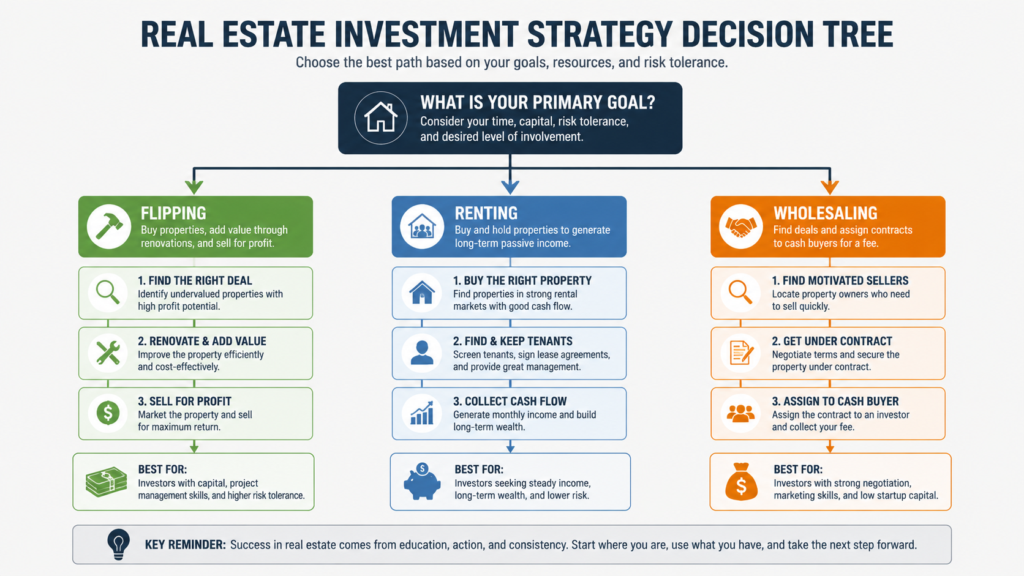
Once you have completed the initial due diligence, work through the decision in this order:
- Can the property be controlled and transferred cleanly? If title, access, or legal problems cannot be resolved within your timeline, renegotiate or reject the deal.
- Do you have the capital and experience to complete the work? If not, determine whether an experienced buyer can still profit after paying your wholesale fee.
- Does the renovated property have strong resale liquidity? If comparable homes sell consistently and the margin supports the full project, a flip may be appropriate.
- Does the property produce acceptable cash flow after realistic expenses? If so, compare the rental’s long-term return with the flip’s immediate profit.
This sequence prevents you from selecting an exit based only on the largest projected headline number.
Compare the Three Outcomes With the Same Assumptions
Assume you can purchase a distressed house for $135,000 and spend $55,000 on repairs.
As a flip, the property may sell for $255,000. After financing, holding, and selling expenses, your projected profit might be $35,000.
As a rental, it may be worth $230,000 after a less expensive renovation and produce $400 per month in stabilized cash flow. You retain the asset but leave substantial capital invested.
As a wholesale deal, another investor may pay enough to provide you with a $12,000 assignment fee. The profit is smaller, but your capital exposure and project duration are much lower.
There is no universally correct answer. The flip offers greater immediate profit, the rental builds longer-term ownership, and the wholesale exit reduces operational exposure.
Match the Exit to Your Experience
A first-time investor should not assume that the most complex strategy will produce the best education. A heavy renovation involving structural work, permits, and multiple trades can become expensive training.
Your existing systems matter. If you have contractors and resale experience, a flip may be efficient. If you already manage rentals and understand tenant demand, holding may be more natural. If your strengths are lead generation, negotiation, and investor relationships, wholesaling may provide a better use of your time.
You can also change the exit when new information appears. A planned flip may become a wholesale assignment after inspection reveals structural damage. A rental may become a resale when insurance or operating costs undermine cash flow. Build flexibility into your contract and financing whenever possible.
Choose the Exit That Survives the Downside
The decision to flip, rent, or wholesale should be made before you buy, then tested again as due diligence produces better information.
Flip when you can control the renovation, support the resale value, and absorb the holding period. Rent when durable demand and realistic operating income justify leaving capital in the property. Wholesale when the opportunity fits another investor’s resources better than your own.
Do not choose the exit with the most attractive optimistic projection. Choose the one that still works when repairs increase, the resale slows, rent comes in below forecast, or financing changes. That is the exit most likely to turn a distressed property into a successful investment.
Wondering Where the Savviest Investors Find Their Best Deals?
Access the largest database of foreclosure properties nationwide and discover below-market deals before other investors. Start your search today!
You might also like:
 House Flipping Market Analysis: How to Choose Profitable Areas
 Flip Property Exit Strategies: Maximizing Profit and Minimizing Risk
 Wholesale Exit Strategy for Flip Properties for Investors
 How House Flipping Deal Analysis Software: How to Run Better Deals
 Best Cities for House Flipping: Top Locations for High ROI in 2025
 Real Estate Investor Mentorship for Portfolio Freedom