
How to Wholesale Distressed Real Estate Deals
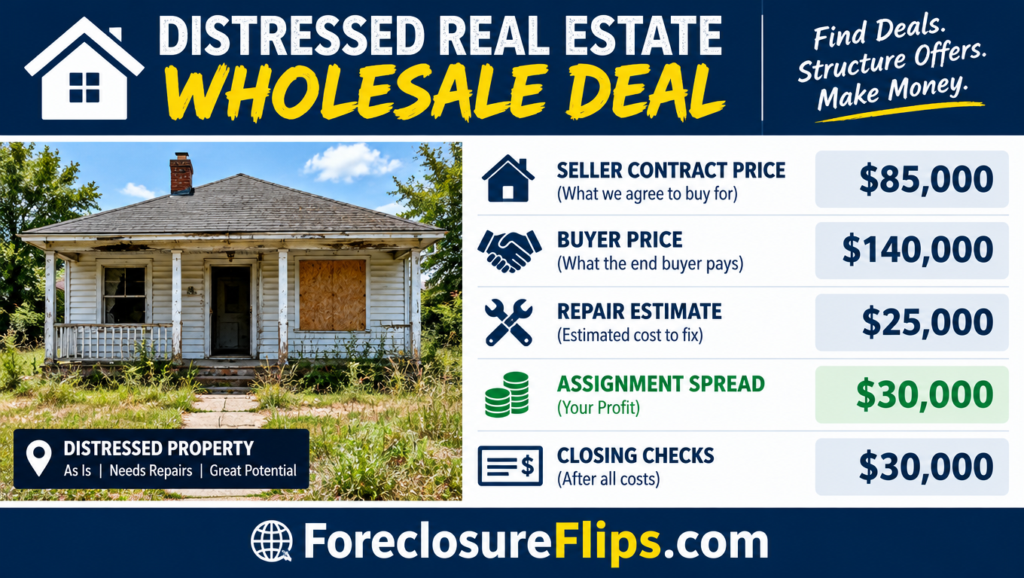
A wholesale deal can show a $20,000 spread and still be a bad deal. The seller may lack enough equity to close, the contract may restrict assignment, or the end buyer may price the repairs higher than you did.
To wholesale distressed real estate, you need more than a discounted contract. You need a seller who can perform, contract rights that support your exit, a real buyer at the proposed price, and a structure that complies with the law where the property sits.
Follow one deal from lead to closing and the weak points become easier to see.
Stay Ahead of the Next Deal
Markets move quickly, and good foreclosure opportunities often require fast analysis. Subscribe to our twice-weekly newsletter for investor-focused tips, tools, and market insights designed to help you make better decisions.
Start With the End Buyer’s Maximum Price
Assume you find a vacant three-bedroom ranch house through a pre-foreclosure lead. The owner wants a quick sale, and the property needs substantial cosmetic work plus an aging roof.
| Deal item | Initial estimate |
|---|---|
| Renovated value | $245,000 |
| Repairs | $42,000 |
| End buyer’s maximum price | $154,000 |
| Proposed seller contract | $137,000 |
| Apparent assignment spread | $17,000 |
That $17,000 is not profit yet. It is the space between two unverified prices.
Start with the end buyer rather than the fee you want to earn. Estimate the buyer’s rehab, financing, holding costs, resale expenses, and required profit, then work backward to a maximum acquisition price.
If you use Foreclosure.com to source distressed leads, use the listing to identify opportunities, then verify ownership, foreclosure status, condition, liens, and sale timing before you build an offer around it.
Recheck Repairs From the Buyer’s Side
Suppose two buyers walk the house. One estimates $48,000 in work and another expects $52,000 because the roof, electrical panel, and sewer line create more risk than your first inspection captured.
The strongest buyer now says the deal works at $149,000, not $154,000. Your possible assignment spread has already fallen from $17,000 to $12,000.
That correction is useful because it happened before you promised yourself a fee the property could not support.
Verify the Seller Can Close at Your Contract Price
A discounted price means little if the seller cannot deliver title for that amount.
Before you treat $137,000 as workable, estimate the mortgage payoff, property taxes, judgments, association balances, and seller-side closing charges that must be paid.
| Seller-side item | Amount |
|---|---|
| First-mortgage payoff | $103,500 |
| Delinquent property taxes | $6,800 |
| Judgment to be cleared | $4,500 |
| Estimated seller closing costs | $4,200 |
| Total required before seller proceeds | $119,000 |
At a $137,000 contract price, roughly $18,000 remains before another title item or negotiated seller proceeds. A previously undiscovered $15,000 lien would change the transaction.
When you wholesale distressed real estate, verify seller equity early enough that a payoff or title surprise does not appear after you have already marketed the contract.
Use a Purchase Contract That Supports the Planned Exit
Your purchase agreement determines the rights you actually control.
Read the assignment provision before signing. Some agreements permit assignment, others require seller consent, and some prohibit it. Seller addenda can also change standard contract language.
Do not assume that adding “and/or assigns” to the buyer name overrides the rest of the agreement or applicable law.
Put Due-Diligence Deadlines on the Same Calendar
Track inspection, title, earnest-money, and closing deadlines before you send the contract to buyers.
If the repair estimate changes or title reveals a problem, you need to know whether the agreement still gives you a contractual response. A wholesale strategy is weak when the only exit depends on finding an assignee before your own obligations become unconditional.
Market the Contract Interest You Actually Hold
After the seller signs, you may hold contractual or equitable rights under the purchase agreement. That does not mean you own the property.
If you are assigning the contract, describe the interest you are offering accurately rather than marketing the house as though title already belongs to you.
Oregon provides a current example of how specific state rules have become. The Oregon Real Estate Agency’s wholesaling rules require residential property wholesalers to register unless they hold a qualifying real estate license, and require specified written disclosures to sellers, buyers, participating brokers, and in advertising.
Those requirements took effect July 1, 2025. Your state may regulate wholesaling differently, so do not build a marketing template before you know what disclosures and licensing rules apply.
Qualify the Buyer Before You Count the Assignment Fee
Return to the ranch house. Your updated buyer ceiling is $149,000 and the seller contract is $137,000.
Before you count a $12,000 spread, confirm that the buyer can close.
Ask for proof of funds or appropriate lender evidence. Track the buyer’s preferred locations, property type, maximum basis, rehab tolerance, and closing speed.
Give the buyer the information you have about condition, occupancy, title concerns, and known repair issues. Understating the rehab may create more initial interest, but it also increases the chance of a retrade or withdrawal near closing.
Check State Wholesaling Law Before You Advertise
There is no single national wholesaling rule that applies to every deal.
Illinois, for example, includes within its statutory definition of broker a person or entity that engages in a pattern of dealing in real estate contracts, including assignable purchase contracts. The Illinois Real Estate License Act definition treats specified activity on two or more occasions within a 12-month period as a pattern of business.
Oklahoma uses a different framework. Its current wholesaler statute requires written disclosure before the homeowner signs that the wholesaler intends to assign or resell the equitable interest for a higher price. It also gives the homeowner a two-business-day cancellation right, bars the wholesaler from presenting themselves as the homeowner’s adviser, and requires specific contract disclosures.
Those three states illustrate why compliance belongs at the front of the transaction. Check current licensing, registration, advertising, disclosure, cancellation, and contract rules where the property sits before outreach or marketing.
Choose Assignment or Double Closing Based on the Actual File
If the agreement is assignable and the law permits the structure, an assignment can transfer your contract rights to the end buyer while the closing agent handles the documented assignment fee.
A double closing uses two separate transactions: you acquire the property, then resell it. That can add funding requirements, closing costs, title coordination, and taxes or fees.
Do not use a double closing as a presumed workaround for a licensing, disclosure, advertising, or contract restriction. The structure still has to comply with the law that applies to the transaction.
Keep Your Role Clear With the Seller
A distressed owner may be behind on payments or facing a foreclosure deadline. That does not make you the seller’s adviser.
If you are purchasing for your own account, describe yourself as the buyer or contracting party. Do not claim to represent the homeowner, guarantee that foreclosure will stop, or create a false deadline to force a signature.
Oklahoma’s current statute expressly prohibits a wholesaler from acting as an adviser or consultant for the homeowner or representing that the wholesaler acts on the homeowner’s behalf.
Ethical seller treatment does not require you to eliminate your profit. It requires accurate terms, required disclosures, and a clear explanation of your role.
Use This Deal Board Before You Send the Property to Buyers
Update each line as documents arrive.
| Deal gate | Evidence you need | Ranch-house status | Your deal |
|---|---|---|---|
| Seller price works | Payoffs, title, closing estimate | Clear at $137,000 | ____ |
| Repairs support buyer price | Walk-through and buyer feedback | Ceiling $149,000 | ____ |
| Contract can transfer | Signed agreement and addenda | Verify before marketing | ____ |
| Buyer can close | Proof of funds or lender evidence | Pending | ____ |
| State rules are satisfied | Current compliance review | Property-specific | ____ |
| Title can transfer | Title report and cure plan | Pending | ____ |
Do not move an unresolved item into the clear column because the projected fee looks attractive.
Recalculate the Spread From the Closing File
Suppose your buyer confirms $149,000 and the seller remains at $137,000. The gross assignment spread is $12,000.
Now reconcile earnest money, assignment documents, charges allocated to you, credits, and title issues before calling $12,000 your net result.
If the seller cannot satisfy a newly discovered lien, the buyer’s higher price does not automatically fix the shortage. The deal may require a revised price, lien resolution, another lawful structure, or termination under the agreements.
Contract Only When the Deal Can Actually Close
The most useful wholesale contract is not the one with the largest theoretical fee. It is the one supported by seller equity, realistic repairs, a workable contract, a qualified buyer, transferable title, and a legal transaction structure.
Before you wholesale distressed real estate, test those items before you market the opportunity.
A clean $8,000 assignment can be more valuable than a projected $25,000 spread attached to a property your buyer will reject or your seller cannot close.
Your fee should come from a transaction in which the seller can perform, the end buyer can close at the assigned basis, and you have the contractual and legal right to complete the structure you are using.
You might also like:
 How to Decide Whether a Distressed Property Should Be Flipped, Rented, or Wholesaled
 Why Wholesaling Disclosure Can No Longer Be Boilerplate
 Real Estate Investor Mentorship for Portfolio Freedom
 Seller Financing for Distressed Property Investors
 How to Track Distressed Sellers Without Chasing Bad Leads
 Motivated Seller Index for Foreclosure Investors