
Zoning Checks Before You Buy a Distressed Property
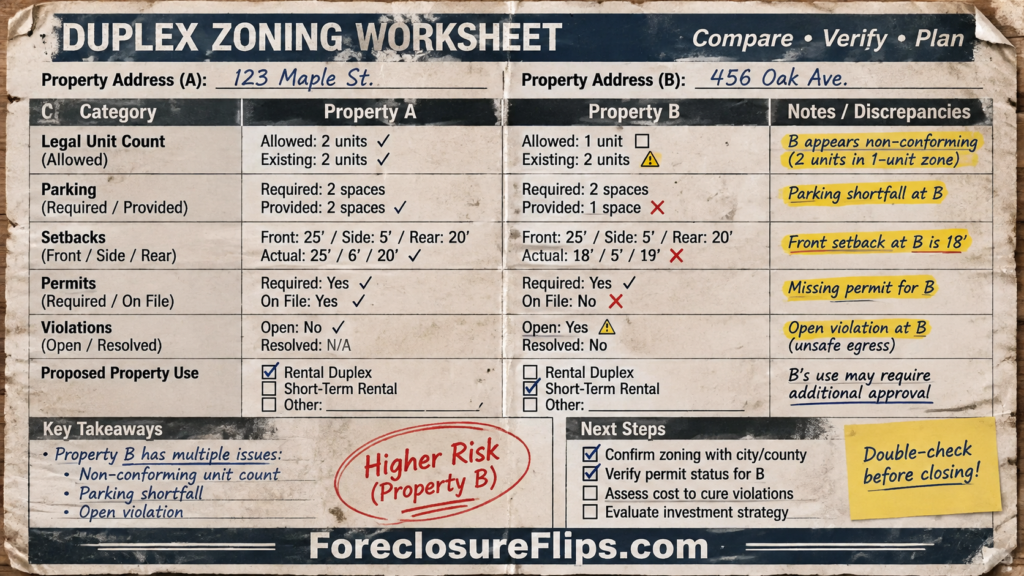
A distressed property can look like a duplex, rent like a duplex, and still be legal for only one dwelling unit. If your offer assumes two rents or a duplex resale, that difference can erase the margin before rehab starts.
A useful foreclosure property zoning review does more than identify the zoning district. It verifies the legal use, unit count, parking, violations, nonconforming status, rebuild rights, and any approvals your plan requires.
The safest offer is based on the use you can document, not the use suggested by two kitchens, two meters, or an old listing.
Get Foreclosure Investing Insights Twice a Week
Subscribe to the Foreclosure Flips newsletter for practical ideas on finding deals, analyzing opportunities, and understanding foreclosure-related investing strategies. We send concise updates twice a week so you can stay informed without adding more noise to your inbox.
Verify the Legal Use Behind the “Duplex” Listing
Assume you are evaluating a distressed property advertised as a duplex for $185,000. The upstairs tenant pays $1,250 per month, the lower unit is vacant, and your rehab model assumes two renovated rents of $1,450.
At first glance, the numbers support a value-add rental or a flip to another investor.
Then the zoning map shows a single-family district.
That finding does not automatically prove the second unit is illegal. The building could have a lawful nonconforming use, a variance, a prior approval, or another legal status that allows two units. It does mean the listing description is no longer enough.
Your next task is to build the property’s land-use history.
Use This Zoning Worksheet Before You Set the Offer
Work through the table as a pre-offer worksheet. Mark each item Verified, Unresolved, or Conflict and attach the record that supports your answer.
| Question | What to verify | Best evidence | Status |
|---|---|---|---|
| What uses are permitted? | Current zoning district and use table | Official zoning map and ordinance | ___ |
| How many units are legal? | Approved dwelling-unit count | Certificate of occupancy, permits, approved plans | ___ |
| Is an older use protected? | Legal nonconforming status | Historic approvals or written zoning determination | ___ |
| Does parking comply? | Required spaces and existing lawful spaces | Zoning code, site plan, survey | ___ |
| Are additions compliant? | Setbacks, lot coverage, height | Permit file, survey, zoning standards | ___ |
| Are violations open? | Zoning, building, or code cases | Municipal enforcement and permit records | ___ |
| Can the property be rebuilt? | Rules after major damage or destruction | Zoning and floodplain provisions | ___ |
| Does your plan change the use? | Rezoning, variance, special approval, or change of occupancy | Planning and building officials | ___ |
A blank status is not a minor paperwork item when your projected rent, ARV, or financing depends on the answer.
Verify the Legal Unit Count in the Building Records
Start with the current zoning district, but do not stop there.
Zoning ordinances identify permitted uses and commonly regulate items such as building height, density, parking, setbacks, and open space. A use may be allowed outright, require additional approval, or be prohibited under the current district.
Now compare the zoning rule with the building record.
Look for the certificate of occupancy, original building permit, conversion permits, approved plans, and later alterations. A tax assessor page that describes a property as a two-family home can help identify what to investigate, but it does not replace the land-use and building approvals.
Two Kitchens Do Not Establish Two Legal Units
The case property has two kitchens and separate electric meters. Neither proves that the municipality approved a second dwelling.
If the permit file shows only one legal unit, your foreclosure property zoning analysis has to answer a new question: was the second unit ever lawfully established under an earlier rule, or was it created without approval?
That difference can decide whether you can keep the rental configuration or must legalize, alter, or remove it.
Document Legal Nonconforming Status Before You Underwrite It
A lawful use can become nonconforming after zoning changes.
Cornell’s nonconforming-use guidance explains that zoning rules can allow a pre-existing use to continue after newer regulations no longer permit that use, while placing limits on expansion, changes, or later reestablishment.
That situation differs from an unpermitted conversion.
If the duplex existed legally before the area changed to single-family zoning, the property may have protected status under local law. You still need evidence. Historic permits, certificates of occupancy, tax records, utility history, prior zoning decisions, and municipal files can help establish the timeline, but the local jurisdiction determines what proof it accepts.
Ask whether the municipality offers a zoning verification letter, nonconforming-use determination, or similar written confirmation.
Check Whether Parking or Site Standards Block the Second Unit
Suppose the planning office confirms that a second unit can potentially be legalized. That does not mean the approval is economically practical.
The parcel has a narrow driveway with space for two cars. Current rules require three spaces for the proposed configuration, and the front setback prevents you from creating another legal stall.
Now the problem is physical, not just documentary.
Review parking, minimum lot area, density, setbacks, height, lot coverage, accessory structures, and any overlay district that applies. A property can satisfy its underlying use designation while failing another dimensional or overlay requirement.
Before you assume a variance will solve the problem, identify the approval required, decision-maker, likely timing, application cost, and whether the requested relief involves discretionary review.
Pull the Permit and Violation File Before You Finalize Rehab
Distressed properties often have alterations that were never closed out.
Search for open permits, expired permits, stop-work orders, unsafe-structure notices, zoning violations, code-enforcement cases, and unresolved inspections. Compare the file with what you see during the property inspection.
On the case property, suppose you find an enclosed rear porch that extends into the required setback and an electrical permit for the lower unit that never received final approval.
Those findings belong in the rehab budget before you offer.
A permit problem can require additional inspections, engineered plans, demolition, corrective work, or a new application. If the municipality requires the lower unit to be removed, your income model changes as well.
Confirm Rebuild Rights When the Property Is Nonconforming or Damaged
An existing building can be legal to occupy today while having limited rights after severe damage.
Local zoning rules may restrict reconstruction or continuation of nonconforming structures and uses. Floodplain requirements can add another layer when the property sits in a Special Flood Hazard Area.
FEMA’s Substantial Damage Quick Guide explains that, in participating communities, a structure in a Special Flood Hazard Area generally must comply with current local floodplain-management standards when repairs equal or exceed 50% of the structure’s market value. A community can adopt a stricter threshold.
That issue deserves attention on fire-damaged, flooded, storm-damaged, or heavily deteriorated foreclosures.
For foreclosure property zoning due diligence, ask what you could legally rebuild if the structure suffered major damage after purchase. A deal that depends on preserving an older nonconforming footprint can carry more downside than the existing layout suggests.
Verify Approvals Before You Model a Change of Use
Do not value a proposed conversion as though it already exists.
If you want to turn an office into apartments, divide a single-family house into three units, add an accessory dwelling unit, or convert a garage into living space, identify every required approval before placing the higher-use value in the model.
Zoning approval may be only one part of the work. A change in building occupancy can trigger additional code requirements. The International Code Council’s 2024 Existing Building Code provisions specifically address alterations and changes of occupancy in existing buildings and can require compliance based on the proposed new occupancy.
Local adoption and amendments control the actual project, so confirm the requirements with the jurisdiction reviewing the permit.
If approval is discretionary, underwrite the existing legal use separately from the proposed use.
Reprice the “Duplex” After the Records Come Back
Return to the $185,000 property.
Your original model assumed two legal units at $1,450 each. The completed zoning review now shows:
- One clearly documented legal dwelling unit
- No permit establishing the lower apartment
- A possible path to legalize a second unit
- A parking deficiency that may require discretionary relief
- An open electrical permit
- A rear addition that needs further setback review
The property may still be a good acquisition. It is no longer a straightforward legal duplex.
Build three numbers instead of forcing one optimistic value:
| Scenario | What you can support | How to use it |
|---|---|---|
| Existing legal use | One dwelling unit | Base acquisition case |
| Legalized second unit | Two units after approvals and work | Upside case |
| Approval denied | One unit plus required corrections | Downside case |
Price the acquisition so the downside does not destroy the project.
Base the Offer on the Legal Use You Can Verify
Zoning due diligence is most valuable before you commit to a rent roll, rehab scope, or ARV that depends on an unverified use.
Confirm the zoning district, legal unit count, nonconforming status, parking, dimensional standards, permit history, open violations, rebuild rights, and approvals required for any planned conversion. Get written confirmation when one unresolved question controls the investment.
A careful foreclosure property zoning review may show that the two-unit bargain really is a legal duplex. It may also show that the lower apartment is an unapproved conversion with no practical path to legalization.
Either answer is useful before you buy. Your offer should reflect the property you are legally positioned to operate and improve, not the version implied by the listing.
You might also like:
 Can You Redevelop That Foreclosure Profitably?
 How to Find City-Owned Foreclosure Property Deals That Work
 Finding Contractors for House Flips: The Investor’s Playbook
 MLS Comps for House Flipping Basics [Free Checklist]
 Cleanout Costs Investors Forget on Foreclosure Flips
 Title 24 Requirements for Home Renovation Before You Flip