
How to Buy Bank-Owned Properties Below Market Value
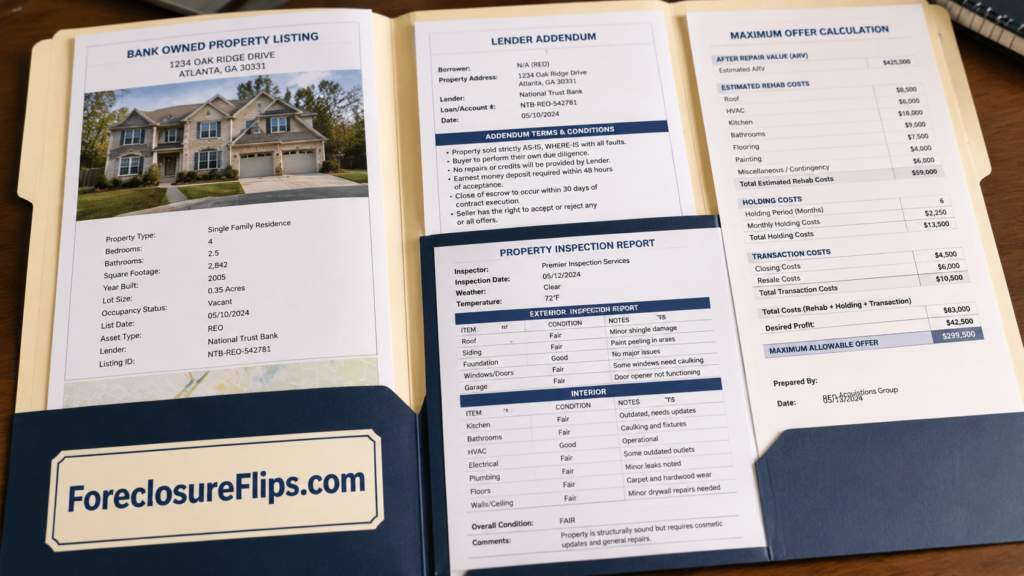
A bank-owned listing can look like the cleanest distressed-property opportunity available. The foreclosure is finished, the previous borrower is no longer negotiating the sale, and an institutional owner has placed the property on the market.
Then the lender addendum arrives.
The seller may reject the standard contract language, limit repair obligations, impose a firm closing date, and require proof that the purchase funds are ready. Meanwhile, the apparent discount may shrink once deferred maintenance, carrying costs, and resale expenses enter the calculation.
Bank-owned properties can sell below market value, but the REO label does not create the discount by itself. The opportunity comes from buying the property below its supportable as-is value while preserving enough margin for repairs, financing, risk, and profit.
Build Your Investing Knowledge One Email at a Time
Foreclosure investing rewards preparation. Join our 2X week newsletter for straightforward guidance on pre-foreclosures, short sales, BRRRR, flipping, and other strategies investors use to evaluate distressed property opportunities.
The Foreclosure Has Ended, but the Process Hasn’t
A property becomes real estate owned, or REO, when the lender or loan owner takes title after foreclosure or accepts a deed in lieu of foreclosure.
At that point, the property is no longer a pre-foreclosure negotiation with a distressed homeowner. It becomes an asset-disposition file managed by a bank department, mortgage investor, government agency, asset manager, or third-party vendor.
That shift changes the conversation.
The seller is generally focused on documented value, net proceeds, contract certainty, and closing performance. Personal appeals about the property’s condition or the amount of work involved tend to carry less weight than comparable sales, contractor estimates, market exposure, and a complete offer package.
Banks also do not always sell properties directly. U.S. Bank’s description of its REO disposition process explains that properties may be marketed through traditional real estate agents, online auctions, or transferred back to the underlying investor. The bank does not accept direct purchase offers on properties marketed through its disposition vendors.
Where Bank-Owned Properties Enter the Market
REOs appear through several channels, and each one reveals something different about the seller’s strategy.
Multiple Listing Service listings
Many bank-owned properties are listed through local real estate brokers and appear on the same MLS feeds as conventional homes.
The listing agent represents the institutional seller and communicates with the asset manager. Offer instructions may require specific forms, document names, file formats, or submission systems. Remarks can also identify owner-occupant priority periods, auction transitions, inspection restrictions, and deadlines for highest-and-best offers.
A local agent with REO experience can be especially useful because the procedural details often matter as much as the offer price.
Lender and mortgage-investor websites
Banks, government agencies, and mortgage investors sometimes maintain searchable property inventories or direct visitors to approved listing agents.
Freddie Mac’s HomeSteps program, for example, markets Freddie Mac-owned homes through local brokers. Other institutions may use third-party asset-management companies rather than maintaining a public inventory under the bank’s name.
Properties can also move between marketing channels. An REO may begin as an MLS listing, later receive a price reduction, and eventually move to an online auction.
Auction platforms
Some lenders use online auctions to increase exposure or dispose of properties that have not sold through a conventional listing.
Auction terms can include buyer’s premiums, bidding deposits, reserve prices, rapid payment deadlines, and separate purchase agreements. A price shown on the bidding screen may therefore be lower than the total acquisition cost.
Distressed-property databases
Services such as Foreclosure.com can help surface lender-owned homes, foreclosure records, and properties moving through different stages of distress.
The initial lead still benefits from confirmation through the MLS, county records, the listing broker, or the seller’s designated platform. Ownership and availability can change before every public database reflects the update.
An REO Offer Has More Than One Price
The dollar amount attracts the most attention, but institutional sellers often evaluate the complete offer rather than one figure in isolation.
| Offer term | What it signals |
|---|---|
| Purchase price | Expected gross recovery |
| Financing evidence | Probability that the buyer can close |
| Earnest money | Financial commitment to the transaction |
| Inspection period | Length of the seller’s continued exposure |
| Closing date | Speed and certainty of disposition |
| Requested concessions | Effect on the seller’s net proceeds |
| Assignment rights | Whether the named buyer will complete the purchase |
| Contingencies | Conditions that could terminate or delay the contract |
A slightly lower cash offer may appear stronger than a higher offer with uncertain financing, a long inspection period, and substantial seller-paid costs. The reverse can also be true when the financed buyer presents solid approval and a materially better net price.
Freddie Mac’s HomeSteps offer process illustrates the documentation expected in an institutional sale. A complete package can include a written contract, preapproval letter or cash proof of funds, certified earnest money, and HomeSteps-specific addenda. Incomplete offers may never reach formal consideration.
Highest and best is not an invitation to guess
Multiple-offer situations often produce a request for each buyer’s highest and best terms.
The phrase can create pressure to raise the price, remove contingencies, or shorten deadlines. Yet the property’s economics remain unchanged. A stronger offer only makes sense while the revised terms still preserve the required margin and protect against the known risks.
Asset managers may also return to the market if the selected buyer fails to close. A rejected offer can become relevant again without increasing the original price.
The Lender Addendum Can Change the Contract
The initial purchase offer may use a familiar state or brokerage form. The bank’s addendum can modify or replace important provisions after acceptance.
Common subjects include:
- As-is condition
- Inspection access
- Earnest-money delivery
- Financing and appraisal deadlines
- Seller repair obligations
- Closing extensions and daily charges
- Title and closing arrangements
- Property damage before settlement
- Personal property left at the home
- Assignment restrictions
- Buyer default
- Seller cancellation rights
The exact language varies by seller and jurisdiction. Two REO listings handled by different asset managers may carry very different contract risks.
“As-is” does not always eliminate inspection rights
An as-is sale generally means the bank is not promising to repair the property or negotiate every defect discovered after contract.
The contract may still provide an inspection period and a right to cancel. In other cases, the buyer receives access but has limited ability to terminate. Auction REOs may offer little or no post-bid inspection protection.
The practical value of an inspection contingency depends on the wording, not the heading.
Closing extensions can become expensive
Institutional sellers often work toward a specific closing date. When a buyer causes the delay, the addendum may permit the seller to charge a daily extension fee, retain earnest money, or terminate the agreement.
That creates friction for financing that depends on unresolved repairs, a slow appraisal, title corrections, or last-minute entity documentation.
Property Access Determines How Much Remains Unknown
REO properties range from move-in ready homes to buildings that have been vacant for years.
Some have been cleaned, secured, and maintained. Others contain roof leaks, frozen plumbing, damaged mechanical systems, vandalism, mold, missing fixtures, or unfinished work left by the previous owner.
The quality of access changes the reliability of the repair budget.
Full access with active utilities
This produces the strongest inspection file. Plumbing, electrical service, heating, cooling, appliances, and fixtures can receive at least a basic operational review.
Hidden defects still remain possible, but the contingency can focus on concealed conditions and estimating error.
Full access with utilities off
The interior may be visible while major systems remain untested.
Winterized plumbing is a common example. Pipes may appear intact even though leaks become apparent only after the system is pressurized. Similar uncertainty applies to electrical panels, wells, septic systems, water heaters, and HVAC equipment.
Partial access
Locked rooms, unsafe basements, boarded additions, occupied units, and inaccessible crawl spaces leave larger gaps in the estimate.
Those gaps deserve their own allowances. A general repair contingency may not be enough when the inaccessible area contains the foundation, plumbing, or primary mechanical equipment.
Financing Has to Match the Property, Not the Listing Price
A bank-owned home can qualify for ordinary financing when its condition meets the lender’s property standards. Severe damage can narrow the options.
Conventional investment-property financing
A conventional loan may fit a property that is habitable and free from major safety or structural concerns.
The appraisal still affects the loan amount, and the bank seller may not automatically lower the price when the property appraises below contract. A failed appraisal can instead reopen negotiations or end the transaction, depending on the contract.
Renovation financing
Renovation loans combine acquisition and improvement costs, but they can introduce contractor documentation, repair reviews, draws, appraisals based on completed condition, and longer closing requirements.
Those moving parts may conflict with an REO seller’s timeline.
Cash, private capital, and bridge financing
Cash and short-term financing can accommodate properties that ordinary mortgage lenders will not accept.
The flexibility comes at a cost. Interest, points, lender fees, appraisal charges, draw fees, and a shorter loan term belong in the same analysis as the purchase price.
A cash offer is not automatically superior when it leaves too little capital for construction and carrying costs.
The Discount Is Usually Payment for a Problem
A popular foreclosure narrative assumes that banks routinely sell REOs at large discounts simply because they want the properties off their books.
The market is less generous.
Recent NAR housing-market data reported that distressed transactions represented only 2% of sales in April 2026. NAR’s chief economist also connected the historically low volume of foreclosure sales with minimal price discounts.
That does not mean below-market REO opportunities have disappeared. It means the discount usually has a reason:
- Significant repairs
- Poor presentation
- Limited financing eligibility
- Incomplete access
- Title or occupancy complications
- A long marketing period
- An unusual property
- A failed prior contract
- Weak demand in the local submarket
The relevant comparison is the property’s current as-is market value—not the retail value of a renovated home.
A discount can disappear inside the deal
Consider an REO with these assumptions:
- Expected after repair value: $340,000
- Bank list price: $185,000
- Renovation: $55,000
- Financing and holding: $24,000
- Resale and closing costs: $32,000
- Contingency: $10,000
- Required profit: $45,000
The maximum total acquisition cost is:
$340,000 − $55,000 − $24,000 − $32,000 − $10,000 − $45,000 = $174,000
If buyer closing costs total $4,000, the maximum offer falls to approximately $170,000.
The $185,000 listing is more than 45% below the projected renovated value, yet it still exceeds the investment limit by $15,000. Comparing the price only with ARV creates the appearance of a bargain that the complete budget does not support.
Below Market Only Counts After Closing
Bank-owned properties remove some of the complications found in pre-foreclosure negotiations. The institutional seller has authority to sell, the emotional side of the transaction is reduced, and the property is generally exposed through an established marketing process.
Different risks take their place.
The offer package has to survive institutional review. The lender addendum may narrow familiar contract protections. Property condition can limit financing, and the bank’s idea of a reasonable price may remain close to as-is market value.
A genuine REO discount survives the whole file: the purchase price, repairs, title, financing, holding period, resale costs, contingencies, and required return.
The bank-owned label identifies the seller. The numbers determine whether the property is actually below market.
You might also like:
 HUD Home Investing When the Numbers Work
 Buying REO Properties: Essential Guide for Investors
 REO Property Negotiation Tips for Real Estate Investors
 Selling REO Properties for Maximum Profit: Investor Guide
 Mobile Home Foreclosures for Investors
 Before You Buy a Tear-Down Foreclosure, Prove the Deal