
Broker Price Opinions in Foreclosure Deals Explained
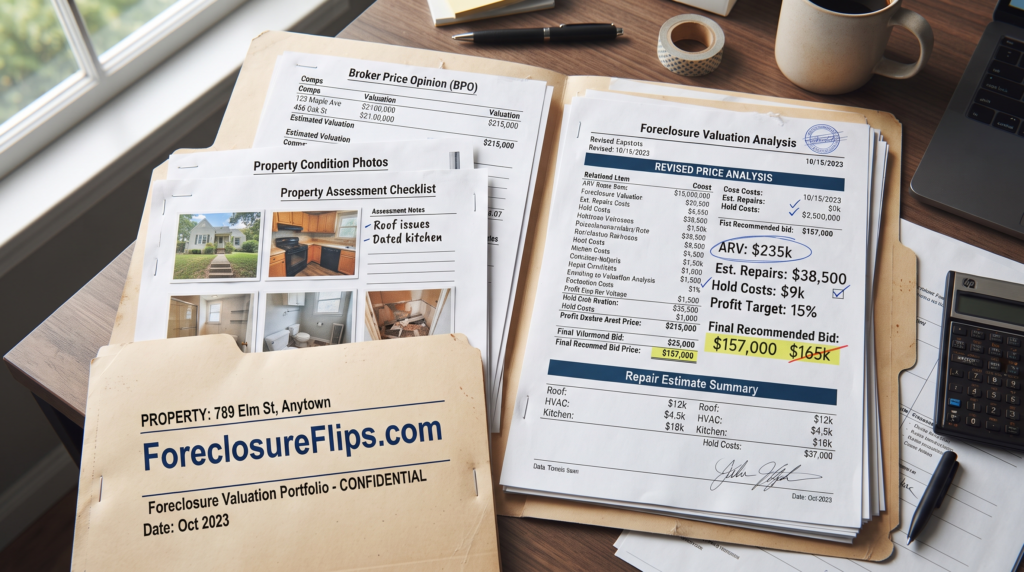
A lender values a distressed property at $315,000. The investor’s comparable sales and repair estimates support something closer to $270,000.
That $45,000 gap can stop a short sale, push an REO asking price above the market, or make a negotiated foreclosure deal appear less attractive than it really is. The disagreement often begins with a broker price opinion rather than a full appraisal.
A broker price opinion foreclosure report can influence the lender’s view of current value, probable sale price, repair exposure, and acceptable proceeds. Understanding what sits behind that number makes it easier to spot weak assumptions and present a stronger valuation argument.
Learn the Strategies Behind Smarter Foreclosure Investing
Get practical foreclosure investing content delivered twice a week, including deal analysis tips, strategy breakdowns, useful tools, and new resources from Foreclosure Flips. Sign up to keep learning and spotting better opportunities.
Why Lenders Use BPOs in Distressed Property Files
A broker price opinion, usually shortened to BPO, is an estimate of probable property value prepared by a licensed real estate broker or agent.
The report typically draws from local comparable sales, active listings, neighborhood trends, visible condition, and the broker’s knowledge of the market. Depending on the assignment, it may include an exterior inspection, an interior inspection, or both.
Freddie Mac’s BPO valuation platform describes reports that include comparable sales, recent transactions, as-is pricing, and estimated value after repairs. That range of information explains why BPOs fit many distressed-property decisions.
A lender or mortgage investor may use a BPO when evaluating:
- A proposed short sale
- A deed in lieu of foreclosure
- Foreclosure strategy
- A potential credit bid
- REO list pricing
- A loan modification or other workout
- Property condition and probable repair needs
- Whether a submitted offer reflects current market value
In a Fannie Mae short sale, for example, the servicer orders a property valuation when the borrower appears eligible and expresses interest in selling. The valuation becomes part of the lender’s review of the proposed transaction and expected proceeds.
The BPO is not always disclosed in full to the buyer or listing agent. Sometimes the only visible result is a counteroffer, a minimum acceptable price, or a statement that the submitted offer falls below the lender’s value.
What a Broker Price Opinion Foreclosure Report Measures
A typical report attempts to answer two related questions:
- What could the property sell for in its present condition?
- What could it sell for after identified repairs or normal market preparation?
Those values can be very different in a distressed-property file.
A vacant house with water damage, a failed roof, and missing mechanical equipment may have an as-is value of $190,000. Renovated sales in the neighborhood may support a future value of $285,000. The $95,000 spread does not represent available profit because repairs, financing, holding expenses, resale costs, risk, and required return still sit between the two figures.
Exterior BPO
An exterior BPO relies on a drive-by inspection, public records, listing data, market information, and exterior observations.
The broker may see:
- Boarded windows
- Roof damage
- Overgrown landscaping
- Fire or storm damage
- Deferred exterior maintenance
- Neighborhood influences
- Obvious vacancy
- Nearby commercial or traffic exposure
Interior condition remains largely unknown. A clean exterior can conceal plumbing leaks, mold, vandalism, missing fixtures, structural damage, or unauthorized construction.
Interior BPO
An interior report includes access to the home and usually provides photographs, room-by-room condition notes, visible repair items, and a more informed comparison with competing properties.
Even an interior BPO is not a home inspection. The broker may not test every system, enter unsafe areas, diagnose structural movement, or identify environmental hazards.
As-is and repaired values
In a broker price opinion foreclosure assignment, the broker may estimate both current value and a probable repaired value.
The reliability of the repaired figure depends on how clearly the finished property is defined. “Average repairs” can mean cosmetic updates to one broker and a complete renovation to another.
An unsupported repaired value can also assume finishes that exceed the neighborhood, a layout improvement that is not part of the actual scope, or a renovation budget that bears little relationship to contractor pricing.
BPO and Appraisal: Similar Numbers, Different Assignments
A BPO and an appraisal can both provide a value conclusion, but they are not interchangeable.
The Consumer Financial Protection Bureau distinguishes a BPO as an estimate prepared by a real estate sales professional, while an appraisal is performed by a licensed appraiser and commonly involves a fuller property inspection and comparable-sale analysis. Different valuations may produce different results because they use different comparables, dates, and intended purposes.
| Valuation issue | Broker price opinion | Appraisal |
|---|---|---|
| Prepared by | Licensed broker or real estate agent | Licensed or certified appraiser |
| Typical emphasis | Probable listing or sale price | Supported opinion of market value |
| Inspection scope | Exterior or interior assignment | Scope established by the appraisal assignment |
| Report detail | Often shorter and market-focused | Usually more formal and extensively documented |
| Common distressed use | Short sales, REO pricing, foreclosure and workout decisions | Lending, litigation, complex valuation, and certain loss-mitigation decisions |
| Repair treatment | May estimate as-is and repaired pricing | May value as-is, subject to repairs, or under another defined condition |
| Primary perspective | Marketability and probable sale outcome | Independent valuation under applicable appraisal standards |
A longer report is not automatically more accurate. A local broker with recent experience in the subdivision may understand buyer behavior that a less-local appraiser misses.
The reverse is also possible. A BPO completed quickly, with limited access and poorly selected comps, can produce a value that looks precise while resting on weak evidence.
Where BPO Values Go Wrong
Most valuation disputes are not really arguments about one final number. They are disagreements about the inputs.
Renovated comps support an as-is property
A distressed home may be compared with sales that received new kitchens, updated bathrooms, roofs, windows, flooring, and mechanical systems.
The report may include a general condition adjustment, but the amount can fall far short of the actual cost and market impact of the deficiencies.
A $20,000 adjustment does not adequately address a property requiring $65,000 in documented work simply because the final value appears more convenient.
The wrong neighborhood defines the market
A comp located one mile away may sit in a different school boundary, subdivision, tax district, flood zone, or buyer market.
Physical distance matters less than competitive similarity. Buyers may not view two nearby areas as substitutes, especially when one has superior access, larger lots, newer construction, or stronger resale demand.
Square footage receives too much weight
Two houses with similar living area can perform very differently.
Layout, bathroom count, garage space, basement utility, lot shape, design, condition, and street influence all affect buyer response. A simple price-per-square-foot calculation can hide those differences.
Stale sales overlook a changing market
A sale from nine months ago may no longer reflect current demand when inventory, mortgage rates, insurance costs, or local employment conditions have shifted.
Older comps can still provide evidence in a thin market, but their relevance depends on what has changed since closing.
Property access was limited
An exterior report may assume typical interior condition even when the property has been vacant, winterized, vandalized, or exposed to water intrusion.
The missing information can push the value too high. It can also push it too low when the exterior appears neglected but the interior remains in better condition.
Distress receives an automatic discount
A foreclosure or short sale is not automatically worth less than every conventional sale.
The discount usually reflects condition, limited financing, reduced market exposure, occupancy, title complications, or pressure to sell. A BPO that lowers the value only because the transaction is distressed can miss the property’s actual competitive position.
Turning a Price Disagreement Into a Valuation Case
When a broker price opinion foreclosure value appears too high, a message stating that the property “isn’t worth that much” adds little to the review.
A credible challenge explains why the original evidence does not support the conclusion.
A comparison table makes the disagreement visible
The strongest alternative comps can be presented beside the BPO assumptions.
| Valuation factor | BPO assumption | Contrary market evidence |
| Condition | Average condition | Roof leak, damaged plumbing, missing HVAC |
| Comparable area | Adjacent subdivision | Subject area sells at a measurable discount |
| Sale quality | Fully renovated comp | Subject requires extensive construction |
| Market timing | Nine-month-old sale | Recent sales show slower demand |
| Living area | Public-record figure | Permit and measurement records show less space |
| Repair estimate | $18,000 | Licensed contractor bids total $54,000 |
The table keeps the argument focused on facts rather than negotiation positions.
Better comps carry more weight than more comps
Ten loosely related sales rarely strengthen the case as much as three or four close matches.
Useful comparables generally share the subject’s:
- Immediate competitive area
- Property type
- Approximate size
- Age and design
- Bedroom and bathroom count
- Lot utility
- Current or expected condition
- Likely buyer pool
Rejected high-value comps can also be addressed. A brief explanation of why a sale is not comparable may prevent it from continuing to anchor the lender’s position.
Condition evidence closes the information gap
Photographs, inspection findings, contractor estimates, code notices, permit records, and specialist reports provide context that listing remarks cannot.
Repair documentation works best when it separates necessary work from optional improvements. A failed electrical panel affects current condition. Premium countertops are an investor finish decision.
Marketing history reveals buyer response
Long days on market, repeated price reductions, failed contracts, limited showing activity, and feedback about condition can challenge a value that assumes normal exposure at a higher price.
An actual arm’s-length offer also provides market evidence, although one low offer does not prove value by itself. The offer becomes more persuasive when it aligns with recent sales, property condition, and documented repair costs.
A BPO Challenge in Numbers
Consider a short-sale property with a lender-supported value of $310,000.
The investor’s offer is $255,000, and the lender counters at $295,000.
The BPO appears to rely on three sales:
- Comp A: $315,000, fully renovated
- Comp B: $305,000, newer roof and HVAC
- Comp C: $298,000, superior subdivision and two-car garage
The subject has:
- Active roof leakage
- One-car carport
- Original kitchen and bathrooms
- Damaged flooring
- Inoperable HVAC
- Approximately $48,000 in contractor-supported repairs
Three closer as-is or partially updated sales closed between $260,000 and $276,000. After reasonable differences for size and condition, the evidence supports a value range of approximately $265,000 to $275,000.
The challenge is not that the lender’s number feels high. The original report appears to have selected superior properties and understated the subject’s condition disadvantage.
A revised offer near the supported range may preserve the lender’s recovery while reflecting the market evidence more accurately.
The BPO Number Is the Start of the Valuation Conversation
A broker price opinion can give a lender a fast, locally informed view of a distressed property. It can also influence whether a short sale moves forward, how an REO is priced, or how a foreclosure strategy is evaluated.
The report’s usefulness depends on the quality of the comparable sales, access to the property, treatment of repairs, and understanding of the local buyer market.
The broker price opinion foreclosure number is only as strong as those assumptions.
When the value appears unsupported, the most effective response is not a lower opinion stated more forcefully. It is a better valuation file—closer comps, clearer photographs, credible repair evidence, accurate property facts, and a direct explanation of where the original analysis lost contact with the market.
You might also like:
 Best Markets for Foreclosure Investing in 2026
 Treasury Yields and Distressed Housing Deals
 REO Property Negotiation Tips for Real Estate Investors
 Foreclosure Investing: How to Buy, Analyze, and Profit From Foreclosed Homes
 Riverside–San Bernardino Foreclosure Market 2026
 Before You Buy a Tear-Down Foreclosure, Prove the Deal