
VineBrook’s $650M Gap Is a Bulk Single-Family Opportunity
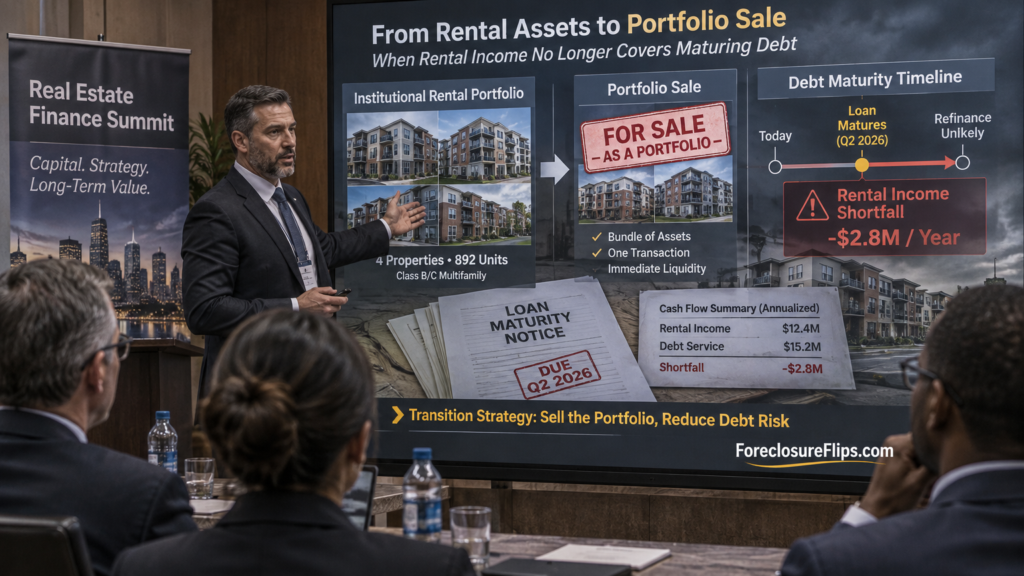
Start with the 2,725 homes VineBrook planned to sell from its namesake portfolio. That figure tells you more about the buying opportunity than the $650.8 million in debt coming due. VineBrook disclosed that its available liquidity was insufficient to cover those maturities. The filing identified several ways to raise the money, including refinancing and selling houses. It did not put a $650 million price tag on a package you could buy.
Your advantage is knowing which houses you can operate together and what it would cost to sell them separately. Before bidding on a bulk single-family rental portfolio, price both exits. In the 20-home example below, a package offered at a 20% discount to retail still costs about $430,000 more than its rental income supports.
Key Takeaways
- Use VineBrook’s sales plan to identify an active seller. Request a dated list of available parcels, the name of the selling entity and permission to bid by market.
- Verify collections, service costs and near-term repairs by address. One occupied house with overdue rent or an unresolved sewer repair can change the price you assign to it.
- Set separate ceilings for a rental hold and individual resales. The retail calculation needs a closing date for each house because every extra month consumes part of the discount.
Stay Ahead of the Next Deal
Markets move quickly, and good foreclosure opportunities often require fast analysis. Subscribe to our twice-weekly newsletter for investor-focused tips, tools, and market insights designed to help you make better decisions.
Which VineBrook homes could reach a buyer?
VineBrook’s November 2026 quarterly filing identified major obligations maturing in March, June, July and August 2027. Management listed partial paydowns, extensions, refinancing and home sales among its options. Those dates give you a reason to check back with a broker. They don’t establish that the owner must sell a particular house by March or accept your price.
Management projected approximately $348 million in net proceeds from selling 2,725 VineBrook homes over the following twelve months. It separately projected about $284 million in proceeds from selling roughly 1,050 homes in the NexPoint Homes portfolio. After quarter-end, 636 VineBrook homes and 54 NexPoint homes were already under contract. Before treating any of those addresses as prospects, confirm which contracts remain in force and whether backup offers are welcome.
The company’s real estate investment disclosures show how selective those sales can be. During the first nine months of 2026, the company sold 2,033 VineBrook homes and 305 NexPoint homes. Over the same period, it acquired 529 homes in build-to-rent communities for the VineBrook portfolio. Ask the broker what the owner intends to keep in your market. If the seller is retaining its newest houses, its portfolio-wide maintenance average may understate the cost of the older homes on offer.
Draw the maintenance route before ordering inspections
Give the broker your counties, maximum purchase price, preferred mix of occupied and vacant homes, and the number of houses you can inspect before your deposit becomes nonrefundable. Ask whether you can bid on a cluster or must take the full package. The answer determines how much territory your property manager needs to cover.
Map the addresses against your manager’s service area. Twelve houses within twenty minutes of the maintenance shop can share vendors, supervision and replacement parts. A dozen houses across four counties may need different contractors after the same storm. Get a quote for the actual addresses. A seller with hundreds of local rentals may pay less per service call than you can obtain on twenty.
Find out whether vacant, sale-ready homes have already been listed individually. The remaining package might suit a landlord who values occupied homes and steady collections. If you intend to resell to owner-occupants, those same leases could leave your capital committed long after the closing date assumed in your offer.
Parcel-level diligence checklist
Keep one line per parcel in your acquisition file. For each item below, record the document reviewed, its date and any dollar adjustment it produces. That last entry turns a document request into a pricing decision.
- Ownership and release. Match the deed, parcel number and selling entity. Have your closing agent identify any lender release needed to deliver that house and flag parcels that could miss the closing date.
- Lease and occupancy. Match the signed lease, amendments, expiration date and deposit to the correct property. Have local counsel confirm the obligations you’ll assume. Use the verified lease term when scheduling access, renovations or a possible resale.
- Rent collected. Tie twelve months of tenant-ledger entries to deposits. Separate current rent, old arrears, concessions and security deposits. Establish who receives outstanding rent collected after closing.
- Physical condition. Review work orders and invoices, then inspect the unresolved items. Three visits for a drain backup warrant the plumber’s diagnosis. A receipt for clearing the line tells you little about the cost of replacing it.
- Expenses under your ownership. Obtain address-specific insurance and management quotes. Ask the local assessor how a transfer could affect property taxes. Replace the seller’s expense allowance wherever your documented cost differs.
- Operational handoff. Confirm who transfers deposits, utility accounts, keys and open work orders. Arrange coverage for the first weekend. A low management quote loses some of its value if emergency calls outside the core service area carry a separate fee.
For example, suppose a house leases for $1,500 a month and the bank received $16,500 during the year. The ledger shows $1,000 of those deposits paid prior-year arrears. Current-year rent collections were therefore $15,500, leaving $2,500 to reconcile against the $18,000 scheduled. A payment received in January, a signed concession and an unpaid balance each call for a different adjustment. Resolve the difference before using that house to estimate collections on the other nineteen.
A four-step workflow for setting your bulk bid
Consider an illustrative package of twenty homes. Nearby sales of comparable vacant, sale-ready houses support a combined retail value of $4 million. The seller asks $3.2 million, or $160,000 per house. Carry the same addresses through all four steps so the two strategies remain comparable.
1. Price the income you can collect
Assume annual rent after vacancy, concessions and collection losses totals $348,000. Taxes, insurance, management, routine repairs and other operating expenses come to $156,000. That leaves $192,000 in net operating income, or NOI, before debt service and capital spending. At the asking price, the going-in capitalization rate is 6%.
Suppose comparable rental sales and your required return support a 6.5% cap rate. Divide $192,000 by 0.065 to get about $2.95 million. The comparable rentals have sound roofs and working HVAC systems. Your houses require $180,000 of immediate replacements outside the operating budget. Deduct that work once to reach a rental purchase ceiling of about $2.77 million before buyer closing costs.
2. Check what it would take to pay the asking price
Buying at $3.2 million and completing $180,000 of immediate work puts $3.38 million into the houses before closing costs. A 6.5% yield on that amount requires $219,700 in annual NOI. That leaves $27,700 a year for your manager to find above the income you verified.
Identify the source of each improvement. A signed maintenance contract may support immediate savings. Higher rents on leases that expire next year belong in a forecast that includes the wait, potential vacancy and cost of turning each house. If the rent increases account for most of the gap, the seller is asking you to pay for income you still have to earn.
3. Work back from individual retail closings
Give each house a feasible sale month based on lease terms, lawful access, contractor capacity and comparable sales. If five similar houses sit in one subdivision where only two comparable homes sold last quarter, check what it took to attract those buyers. A full-price closing with a sizable seller credit can overstate the proceeds you should expect.
Assume the twenty houses eventually produce $4 million in gross proceeds. Allow $240,000 for selling costs, $300,000 for preparation and repairs, $160,000 for financing and carrying costs after interim rent, and $300,000 for target profit. Your resale purchase ceiling is $3 million before buyer closing costs. The $300,000 preparation allowance includes the immediate work needed for resale. Leave the rental scenario’s $180,000 repair deduction out of this calculation.
4. Price a delay before you submit the offer
Suppose selling the final five houses on schedule requires an additional $3,000 concession apiece. That reduces the ceiling by $15,000, to $2.985 million. Delaying those sales four months to preserve their prices costs $18,000 if each house carries at $900 a month after rent. Waiting brings the ceiling down to $2.982 million.
The break-even concession is $3,600 per house. Use that figure when discussing comparable sales with the broker. Under either assumption, the $3.2 million asking price leaves too little room, even though the original retail comps held up.
Questions to settle before you sign
Does VineBrook’s filing confirm a particular package is for sale?
No. Obtain a dated address list and bidding instructions from the authorized representative. Reconfirm availability before ordering inspections, especially if individual buyers can put houses under contract while your bulk offer is under review.
What happens if the seller can deliver only nineteen houses?
Allocate the purchase price by parcel and agree on exclusion terms in advance. Losing the vacant house you planned to sell first could delay the cash needed to renovate the rest. Rework the funding schedule before accepting a flat one-twentieth reduction.
When is a local cluster worth a premium?
A cluster can justify a higher bid when your existing crew produces measurable, sustainable savings. At a 6.5% cap rate, $6,500 of annual expense savings supports $100,000 of additional value before transition costs. Get the vendor commitments that make the savings achievable.
Which ceiling belongs in your offer?
Use the strategy your financing and operating capacity allow, then deduct buyer closing costs and any additional reserve the deal requires. Specify the parcels, inspection rights, release conditions and closing date. A seller with debt coming due may value certainty. Offer a date you can meet at a price the houses can support.
You might also like:
 Real Estate Professional Status: Do Your Hours Qualify?
 BRRRR Investing: How to Buy, Rehab, Rent, Refinance, and Repeat
 Rental Property Tax Deductions When a Flip Becomes a Hold
 How Passive Activity Rules Trap Real Estate Investor Losses
 How Debt to Income Ratio Affects Property Investors
 Cash-on-Cash Return for Distressed Property Deals