
How to Build a Foreclosure Investing System That Scales
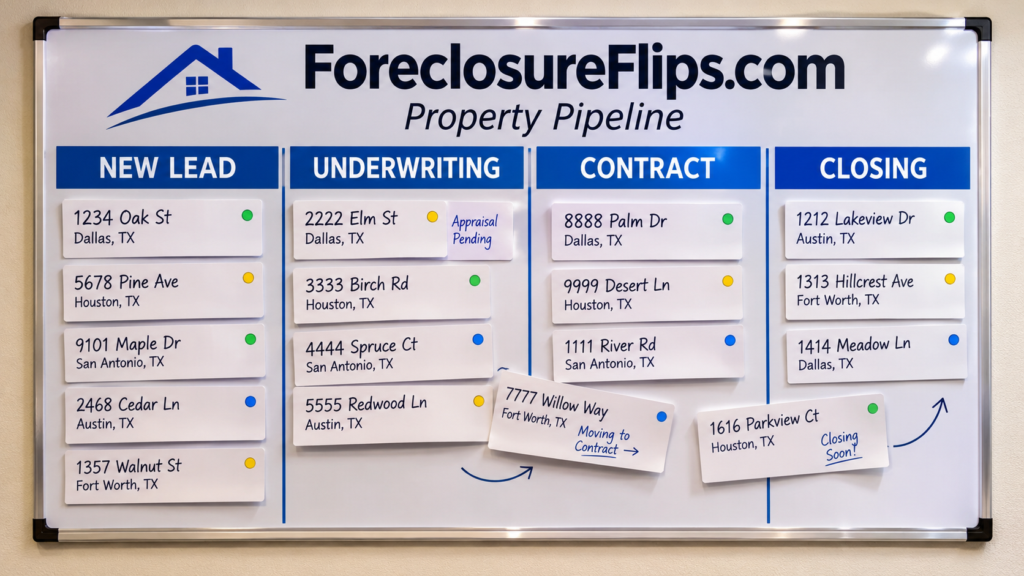
Two investors can work the same county, see many of the same distressed properties, and finish the year with very different results. One works whatever deal happens to be in front of them. The other knows how many leads enter the pipeline each week, which properties deserve full underwriting, when every follow-up is due, and how much capital is available for the next closing.
That is what a foreclosure investing system changes. It replaces deal-by-deal improvisation with a repeatable process for finding, screening, pursuing, financing, and closing distressed properties.
The goal is not to automate judgment. It is to prevent missed follow-ups, inconsistent underwriting, stale leads, and an empty pipeline whenever one transaction becomes demanding.
Learn the Strategies Behind Smarter Foreclosure Investing
Get practical foreclosure investing content delivered twice a week, including deal analysis tips, strategy breakdowns, useful tools, and new resources from Foreclosure Flips. Sign up to keep learning and spotting better opportunities.
Start With One Pipeline Before You Add More Leads
Assume two investors each receive 50 new distressed-property leads on Monday.
Investor One opens listings as they arrive, saves interesting addresses, calls a few owners, researches one auction, and spends two hours estimating repairs on a house that later has almost no usable equity.
By contrast, Investor Two moves all 50 through the same first-pass process. Ownership and foreclosure status get verified. Location or property-type mismatches are removed. Estimated value, debt, sale timing, and next action are recorded.
By Friday, 38 properties may be rejected, eight may remain on follow-up, three may deserve full underwriting, and one may justify an offer.
The second investor did not find more deals. Instead, the system prevented weak leads from consuming the time needed to find the one that could close.
HubSpot’s lead qualification framework makes a similar operating point: qualification helps teams focus on stronger prospects while routing weaker or premature leads elsewhere.
Give Every Property One Stage and One Next Action
A working pipeline can use:
New lead → Verified → Initial screen → Contact or auction review → Full underwriting → Offer or bid → Contract / winning bid → Due diligence → Closing → Rehab / hold / resale
Every active property should have one current stage and one next action.
A lead marked “pre-foreclosure” without a next step is not being managed. Better entries say: verify junior liens, call owner Friday, inspect Tuesday, recheck auction status November 24, or remove because equity is insufficient.
Define Exit Rules for Weak Leads
Write down what removes a property from active work: insufficient equity, an unacceptable location, seller pricing above your maximum, repairs outside your capability, an auction bid above your ceiling, or a title problem that cannot be resolved within the deal.
This keeps the pipeline from becoming storage for addresses you are unlikely to buy.
Feed Fresh Distressed Leads Into the Pipeline Every Week
Deal flow becomes fragile when lead generation stops whenever you are busy.
Recurring sources can include pre-foreclosure filings, auction calendars, REO properties, failed listings, tax delinquency, code issues, probate, agent relationships, referrals, and direct seller outreach.
You can also use Foreclosure.com as a recurring source for pre-foreclosure, auction, bank-owned, and other distressed-property leads. Treat the listing as the start of research, then verify ownership, foreclosure status, liens, sale dates, and property facts before advancing the lead.
Set a sourcing cadence. Review new leads on fixed days instead of waiting until the pipeline looks empty.
The pipeline should keep creating future opportunities while current deals demand attention.
Reject Weak Properties in the First Screen
Full underwriting every new lead wastes time.
Create a five- to ten-minute screen that answers only what you need to decide whether deeper work is justified:
- Is the property inside your target geography?
- Does the property type fit your strategy?
- What is the rough as-is value?
- Is there likely enough equity or auction spread?
- What foreclosure stage or sale date applies?
- Is there an obvious occupancy, title, zoning, or condition problem?
If a property fails a non-negotiable rule, stop. Fast rejection preserves time for the smaller number of properties where detailed analysis can create an advantage.
Standardize the Full Underwriting File
Once a lead survives screening, use the same core inputs each time: comparable sales, as-is value, repairs, title, mortgage payoffs when available, taxes, liens, occupancy, financing, carrying costs, closing expenses, and exit assumptions.
Your underwriting should produce a maximum purchase price or bid ceiling.
Another investor bidding higher does not improve your ARV. A seller wanting another $15,000 does not reduce repairs. Recalculate the ceiling when the facts change, not when negotiating pressure increases.
Put Every Follow-Up on a Specific Date
Many distressed-property leads are timing problems rather than immediate opportunities.
A homeowner may want another month before deciding whether to sell. An REO can be repriced later. A foreclosure sale can be postponed.
Replace “follow up later” with a date and reason: call November 20, recheck the auction December 4, or review the REO after 30 days on market.
Consistent follow-up lets older leads compete with new leads for your attention instead of disappearing into the database.
Confirm Capital Before the Offer or Bid Becomes Binding
For each serious deal, record the financing source, cash requirement, deposit, closing deadline, rehab funding, and backup path.
Keep lender requirements current. Private and hard-money lenders can change leverage, rate, appraisal, insurance, or property-condition requirements, while auction funding may run on a much shorter clock.
The financing problem should surface before the offer becomes difficult or expensive to exit.
Use This Weekly Foreclosure Investing Checklist
The exact days can change. The important point is that sourcing, underwriting, follow-up, offers, and financing all have protected time.
Monday — Refill and Clean the Pipeline
☐ Import new distressed-property leads
☐ Remove duplicates and stale records
☐ Verify priority properties and sale dates
☐ Assign every new lead a stage and next action
Tuesday — Screen and Underwrite
☐ Complete first-pass screens
☐ Move qualified properties into full underwriting
☐ Update values, repairs, liens, and title assumptions
☐ Set maximum offer and bid amounts
Wednesday — Contact and Follow Up
☐ Make scheduled seller calls
☐ Follow up with agents, trustees, asset managers, or wholesalers
☐ Revisit older leads reaching their follow-up date
☐ Record each result and next action
Thursday — Prepare Offers and Capital
☐ Prepare offers or auction bid plans
☐ Confirm deposits, financing, and available cash
☐ Resolve open due-diligence questions
☐ Remove deals that no longer qualify
Friday — Measure the Pipeline
☐ Count new leads, qualified leads, offers, contracts, and closings
☐ Review stalled deals
☐ Identify the stage creating the largest delay
☐ Schedule next week’s sourcing and follow-up
Keep the checklist short enough to use every week. Put detailed instructions in separate SOPs.
Track Conversion From Lead to Closing
Track movement through the pipeline:
New leads → qualified leads → full underwriting → offers or bids → contracts → closings
Suppose 400 new leads produce 80 initial screens, 20 full underwriting files, eight offers, three contracts, and two closings.
If 400 leads produce only five initial screens, intake may be too slow. Twenty fully underwritten deals producing one offer may point to sourcing or buy criteria that need adjustment. When signed contracts frequently fail, due diligence, title, financing, or seller qualification may be the bottleneck.
A repeatable foreclosure investing system lets you see where deals disappear instead of assuming you simply need more leads.
Write the Process Down Before You Hire
Document repeatable tasks first: importing leads, verifying records, preparing comp sets, ordering title, scheduling follow-up, updating the CRM, assembling offer files, and managing closing checklists.
SCORE’s current guidance on reducing owner dependency recommends identifying tasks that depend on the owner, documenting procedures, training someone else to perform them, and handing off responsibility in stages.
Short checklists often work better than long manuals. A trained team member should be able to follow the procedure without reconstructing how you personally do the task.
Scale the Bottleneck Instead of the Entire Business
If leads wait for screening, add screening capacity before buying more lead data. If qualified sellers wait days for a callback, repair follow-up before expanding marketing. When contracts pile up in due diligence, strengthen title, inspection, and closing coordination.
Capital can become the constraint too. Finding five viable acquisitions per month creates little value if financing supports only one.
Scale the stage preventing more qualified deals from reaching closing.
Review Closed and Lost Deals for Different Lessons
After each closing, compare estimated repairs with actual repairs, projected ARV with the eventual value, planned holding time with actual days held, and expected financing cost with the real number.
Lost properties deserve a separate review. Did slow follow-up cost the deal? Was your value estimate wrong? Did title fail late? Perhaps another buyer simply accepted a lower return.
Turn repeated findings into changes to screening rules, underwriting files, follow-up schedules, or SOPs.
Protect Lead Generation While You Are Closing Properties
A demanding closing can make sourcing feel optional. That is how the pipeline becomes empty a month later.
Protect recurring lead generation and follow-up even during busy transaction weeks. Delegate administrative work as volume grows, but keep the acquisition cadence running.
Scaling begins when the same process reliably moves a property from lead to decision without requiring you to reinvent the workflow.
The strongest foreclosure investing system gives you steady deal flow, faster rejection of weak opportunities, consistent follow-up, predictable funding preparation, and enough operating data to see what should improve next.
That is the difference between chasing foreclosure deals and building an acquisition business that can grow.
You might also like:
 Buying REO Properties: Essential Guide for Investors
 REO Property Negotiation Tips for Real Estate Investors
 Condo Foreclosures for Investors
 Before You Buy a Tear-Down Foreclosure, Prove the Deal
 Foreclosure Environmental Due Diligence Before You Buy
 Why Tax Benefits of Foreclosure Investing Depend on Your Exit