Upset Bid Rules After a Foreclosure Sale
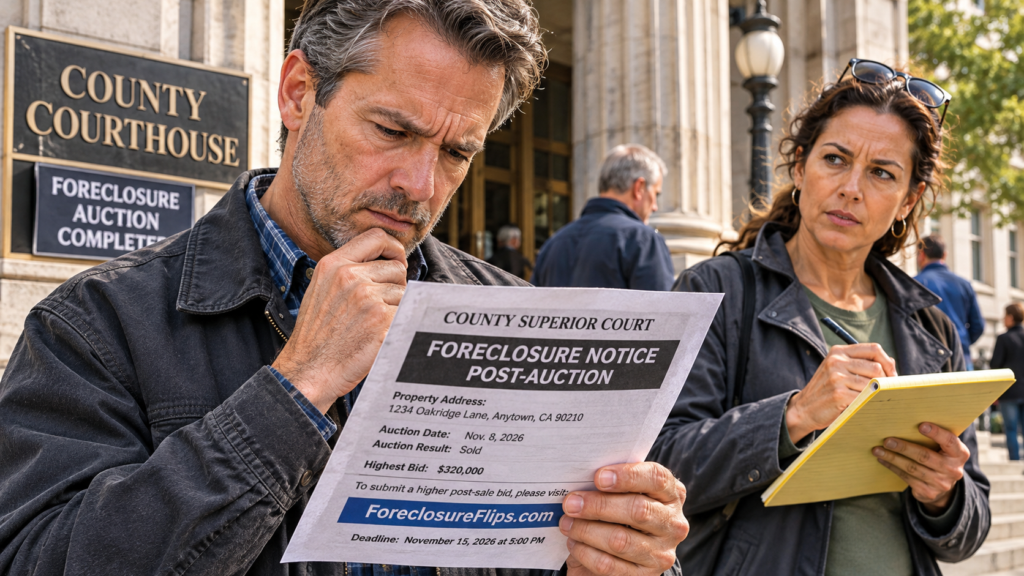
A $190,000 winning foreclosure bid can mean very different things depending on where the property sits. South Carolina keeps some judicial sales open to higher bids for 30 days; North Carolina lets a qualifying upset bid restart a 10-day period; Ohio can end the auction while court confirmation still stands between the sale and the deed.
That is why an upset bid foreclosure cannot be underwritten from the auction price alone.
Before you bid, identify the rule that can change the price, tie up your deposit, delay closing, or postpone the point when you can rely on the acquisition.
Get Foreclosure Investing Insights Twice a Week
Subscribe to the Foreclosure Flips newsletter for practical ideas on finding deals, analyzing opportunities, and understanding foreclosure-related investing strategies. We send concise updates twice a week so you can stay informed without adding more noise to your inbox.
Check the Post-Sale Procedure Before You Set Your Maximum Bid
Assume you are tracking three distressed single-family homes, each likely to sell near $190,000:
- A South Carolina judicial foreclosure.
- A North Carolina power-of-sale foreclosure.
- An Ohio sheriff sale.
The same high bid creates three different post-sale timelines.
Use this comparison before committing capital:
| Post-sale question | South Carolina example | North Carolina example | Ohio example | Your property |
|---|---|---|---|---|
| Can a later bid replace the auction high bid? | Yes, in covered judicial sales | Yes | Not through the statute | ____ |
| How long can bidding remain open? | Up to 30 days in covered sales | 10 days after each qualifying upset bid | Auction rules govern bidding | ____ |
| Can a new bid restart the period? | No; the statutory period runs to its closing point | Yes | Not applicable | ____ |
| What deposit rule affects a later bid? | Up to 5% under the statute | At least 5%, minimum $750 | Sale terms govern deposit | ____ |
| What post-sale step can delay certainty? | Open bidding period | Repeated upset-bid periods | Court confirms | ____ |
South Carolina Can Keep Some Judicial Sales Open for 30 Days
South Carolina law provides a post-sale bidding period for certain judicial foreclosure sales. Under South Carolina Code § 15-39-720, bidding in covered sales remains open until the thirtieth day after the sale, excluding the sale date. During that period, qualifying bidders can raise the current bid after complying with the sale terms and making any required deposit.
Suppose the South Carolina property receives a $190,000 high bid on sale day. You cannot treat that number as final merely because no one bid higher at the courthouse. Another eligible bidder can raise the price during the open period.
Confirm That the 30-Day Rule Applies to This Foreclosure
The South Carolina procedure does not apply to every foreclosure case.
Section 15-39-760 excludes specified foreclosure suits when, among other circumstances, the complaint states that no personal or deficiency judgment is demanded and the right to such a judgment is expressly waived. In those cases, the sale advertisement must state that bidding will not remain open after the sale.
Read the foreclosure judgment and sale advertisement before you assume another 30 days of bid exposure.
South Carolina Deposit Rules Can Reserve Cash During the Open Period
South Carolina Code § 15-39-740 permits a required good-faith deposit at the conclusion of bidding, and from a person who later raises the bid, of 5% of the bid or a lower percentage. When another bidder validly raises the bid, § 15-39-750 requires return of the prior high bidder’s deposit and ends that bidder’s interest in the sale.
If the sale requires 5%, a $200,000 bid can require $10,000 of deposit capital. A $215,000 bid raises that amount to $10,750.
Treat the deposit as committed until the procedure releases it.
North Carolina Restarts the 10-Day Period After Each Upset Bid
North Carolina uses a different post-sale mechanism.
Under North Carolina General Statutes § 45-21.27, an upset bid must exceed the reported sale price or previous upset bid by at least 5%, with a minimum increase of $750. The bidder must also deliver a deposit of at least 5% of the upset bid, subject to the same $750 minimum. Each timely qualifying upset bid starts another 10-day period for a further bid.
At a $190,000 current bid:
5% of $190,000 = $9,500
The next minimum bid is:
$199,500
The 5% deposit on that bid is:
$9,975
Calculate the Next Minimum Bid Before You Decide to Continue
Assume your hard acquisition ceiling is $218,000.
The bidding can move from $190,000 to $199,500 and then to $209,475. Another 5% increase produces a minimum next bid of $219,948.75.
That number exceeds your ceiling.
The slower pace of an upset bid foreclosure can make each increase feel like a separate negotiation. It is still competitive bidding. Unless new facts change value, repairs, financing, or your required return, keep the ceiling you established before the competition intensified.
Ohio Can Require Court Confirmation After the Auction Ends
Ohio illustrates a different post-sale risk: bidding can finish while the judicial sale still needs confirmation.
Under Ohio Revised Code § 2329.31, the court of common pleas examines the sale proceedings after the writ is returned. If the court finds that the sale complied with the applicable statutes, it directs the clerk to enter confirmation. The statute also allows the court to stay confirmation in specified circumstances and requires the purchaser to pay the balance due within 30 days after confirmation.
Record the auction date, confirmation date, payment deadline, and deed transfer separately.
Confirmation also changes your cash timetable. A bidder may know the auction price while still waiting for the court to complete its review. If your lender needs a fixed closing date, make sure its funding window can accommodate that step instead of assuming the balance comes due immediately after the auction.
Separate Four Dates in Every Foreclosure-Sale File
The phrase “I won the auction” can obscure the dates that actually control your exposure.
Track these four events:
Sale date: when bidding occurs.
Post-sale bid deadline: when applicable upset or raised-bid rights expire.
Confirmation or finality date: when the governing procedure fixes the sale or the court confirms it, if required.
Payment and deed date: when you must fund the remaining price and when title transfers under the applicable process.
South Carolina emphasizes the open-bid period. North Carolina can repeatedly move the bid deadline. Ohio adds a court-confirmation step.
Keep Deposits, Closing Funds, and Rehab Reserves in Separate Buckets
Post-sale procedures can create a liquidity problem even when the purchase price still works.
Keep three amounts separate:
Bid deposits: money committed to active bids.
Closing funds: cash or financing required when the sale reaches the payment stage.
Property reserves: money for insurance, security, utilities, taxes, cleanup, and renovation after acquisition.
Suppose you have $80,000 of available liquidity. A $10,000 deposit supporting an unresolved South Carolina bid cannot also serve as the cash required for a North Carolina upset bid or an Ohio closing.
Use a Five-Line Bid Card Before You Raise Any Post-Sale Bid
For every property, write down:
- Current legal high bid: $__________
- Next qualifying bid or required post-sale step: __________
- Deposit or funds currently committed: $__________
- Next statutory or court deadline: __________
- Hard acquisition ceiling: $__________
For an upset bid foreclosure, update the card whenever a qualifying bid changes the price or deadline. For a confirmation-state sale, replace the next-bid entry with the confirmation event and payment deadline.
Read the Sale File Before You Transfer Funds
State law establishes the framework, but the property-specific documents supply critical details.
Review the judgment or order, notice of sale, bidder instructions, deposit requirements, payment deadline, title provisions, and any stated post-sale procedure.
That review is especially important in South Carolina because some foreclosure sales do not use the 30-day open-bid procedure. In North Carolina, the notice of sale remains relevant to the terms governing the purchase. Ohio bidders also need the court-sale terms alongside the confirmation statute.
Stop Bidding When the Post-Sale Price Breaks the Deal
Geography changes what a foreclosure high bid actually buys you on sale day.
A covered South Carolina judicial sale can remain open to higher bids for 30 days. North Carolina can restart a 10-day period every time a qualifying upset bid arrives. Ohio can require court confirmation after bidding ends before the purchaser reaches the later payment and deed stages.
Those procedures can delay certainty and keep capital unavailable even when your underwriting remains unchanged.
Before entering an upset bid foreclosure, calculate the next legal bid, reserve the required deposit, identify the event that makes the sale final, and preserve enough liquidity to close.
The goal is not to win the last round. It is to acquire the property at a price and on a timeline that still support the return you calculated before the bidding started.
You might also like:
 Foreclosure Investing: How to Buy, Analyze, and Profit From Foreclosed Homes
 How Bankruptcy Can Delay an Investment Foreclosure Deal
 New York City Metro Foreclosure Market 2026
 Buffalo Foreclosure Market 2026
 How to Prepare for a Sheriff Sale Without Overbidding
 What a Property Deed Reveals in Foreclosure Deals