
The Pig Through the Python: Where Foreclosure Supply Lands
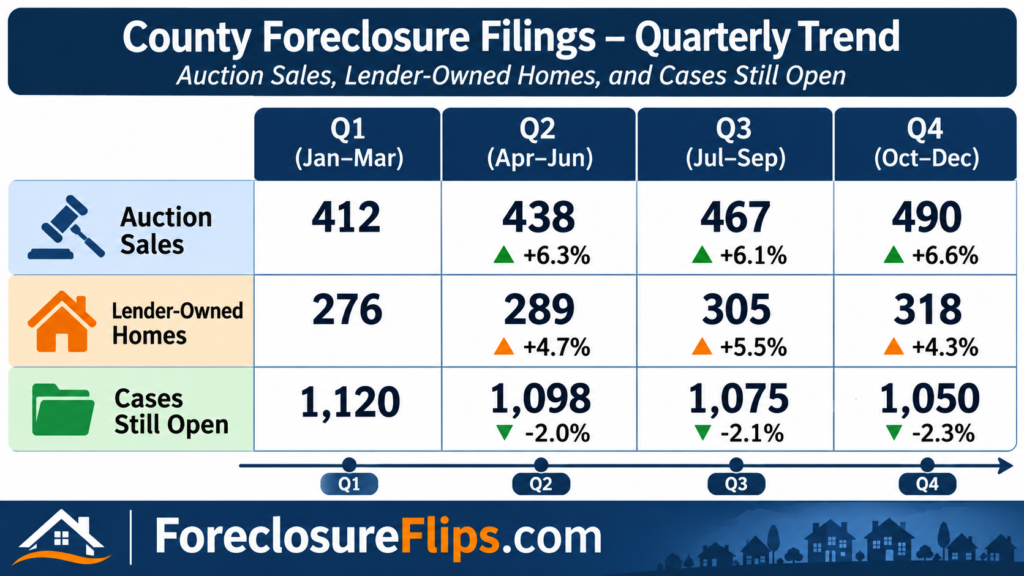
To decide which quarter to bid in, work backward from auctions that actually happened in your county. Find the first public filing for each property, then measure how much time passed before the sale. A jump in missed payments tells you where to start watching. The local foreclosure pipeline tells you when to have money ready.
Suppose a county records 40 new foreclosure cases in March. If you set aside your acquisition budget for June, you could pass on a good spring deal and still have nothing to bid on until October. The question worth asking is how many of those 40 properties will reach your kind of sale, and when.
Key Takeaways
- Follow the same properties from filing to outcome. A March complaint and an October auction notice can describe one house.
- Use older local cases to estimate a bidding quarter. Update that estimate when a trustee or sheriff publishes an actual sale date.
- Track auction purchases and lender-owned listings separately. Each gives you a different point at which you can make an offer.
Get Foreclosure Investing Insights Twice a Week
Subscribe to the Foreclosure Flips newsletter for practical ideas on finding deals, analyzing opportunities, and understanding foreclosure-related investing strategies. We send concise updates twice a week so you can stay informed without adding more noise to your inbox.
What happens between a missed payment and a public filing?
The mortgage servicer collects payments and handles the account when the homeowner falls behind. Early on, the work happens between those two parties. The owner might catch up after a missed paycheck, agree to a repayment plan or apply to change the loan terms. You generally can’t see those discussions in county records.
For many residential mortgages, the CFPB’s mortgage servicing rule generally requires the servicer to wait until the borrower is more than 120 days delinquent before making the first foreclosure notice or filing required by law. Exceptions apply. Even when that threshold passes, the servicer may still be reviewing a complete application for help. A timely application can also restrict when a sale may proceed.
That gap explains the pig in the python. A group of borrowers can miss payments in the same month, then spend very different lengths of time working through default. Some keep their homes. Others sell and pay off the mortgage. By the time you see the first public filings, you’re looking at a smaller group, and the owners still have options.
Which county record puts a house on your bidding calendar?
A complaint or default notice starts your watchlist
In a judicial foreclosure, the lender takes the case to court. The New York court process shows how far a residential complaint can sit from an auction. A case may go through several settlement conferences over months. If the parties settle, it can end there. If the lender obtains a judgment of foreclosure and sale, look for the auction notice next.
In a nonjudicial foreclosure, a trustee can conduct a sale under the deed of trust. For example, the California foreclosure process uses a recorded notice of default. A later notice of sale supplies a proposed auction date. If your data feed labels both documents “foreclosure activity,” open the underlying record before assigning the property to a quarter.
At this stage, save the parcel number, case or trustee reference, first filing date and source. A quick look at nearby sales can tell you whether the neighborhood fits your buying criteria. You can leave a detailed repair budget until there’s evidence the property will reach a sale you can enter.
A sale notice gives you a date to verify
Once a sale appears on the official calendar, record the date and who runs the auction. Read the sale terms while there’s still time to arrange the deposit and investigate title. Check the status again before moving money or traveling. A postponement from September 29 to October 6 shifts the opportunity into the next quarter, even though the delay is only a week.
Keep the original date alongside the revised one. Overwriting September makes your past forecast look more accurate than it was. Counting October as another property makes supply look larger than it is. One parcel can have several dates and only one completed sale in that proceeding.
Where does the property go after auction?
A third-party purchase closes the auction opportunity for you if someone else wins. If the lender takes the property back, follow the transfer into real estate owned, or REO. That gives you another possible route to buy. It still leaves an interval between the lender acquiring title and a listing agent accepting offers.
For an auction purchase, record the result and verify the deed when it becomes available. For an REO purchase, add two dates to your sheet: the lender’s acquisition and the first active listing. An updated deed tells you who owns the house. The listing tells you whom to contact, what the seller is asking and whether you can arrange a showing.
The distinction changes your budget. Say a lender takes back a house on September 25 and lists it on November 12. An auction buyer had a September decision. As a buyer who needs interior access and financing, your first realistic opportunity may be November. Counting both events as fresh houses would double the apparent supply on that street.
Turn last year’s filings into this year’s bidding quarters
Start with one county and one filing type. Pick a group of older filings with a full year of follow-up. Match each parcel and proceeding to the posted sale result, deed or dismissal. Include the cases that never reached auction. Starting with completed sales alone can tell you how long successful cases took, but it can’t tell you how many new filings you should expect to reach a sale.
Suppose you track 40 first filings from one March through the following March. Here’s an illustrative result for that group.
| Outcome by the following March | Properties | What you could have bid on |
|---|---|---|
| Auction held in April–June | 2 | Two second-quarter auctions |
| Auction held in July–September | 6 | Six third-quarter auctions |
| Auction held in October–December | 10 | Ten fourth-quarter auctions |
| Auction held the following January–March | 2 | Two first-quarter auctions the next year |
| Case closed without an auction | 12 | No auction in that proceeding |
| Still open at the cutoff | 8 | Timing unresolved |
Of the 40 filings, 20 reached an auction within a year. Ten reached one in the fourth quarter, or 25% of the original group. Suppose the next March brings 32 comparable filings. Applying that local history gives you a rough fourth-quarter workload of eight auctions: 32 multiplied by 25%. That’s eight sales to research before you screen for price, title, condition or competition.
The denominator makes a difference. Half of the completed auctions happened in the fourth quarter. Apply that 50% to all 32 fresh filings and you’ll plan for 16 sales, twice what your sample supports. The eight open cases also deserve a later check. Treating them as permanently closed would hide the part of the foreclosure pipeline that takes longest to surface.
When should you commit time and cash?
Give early filings a monthly review. As dates appear, move the properties that meet your criteria onto a weekly auction calendar. For each one, write down the next decision and its deadline. “Confirm deposit instructions by Thursday” gives you something to do. “Likely Q4” is enough for a forecast, but too vague for an auction next week.
Before you bid, confirm the current sale terms with the official auction administrator. Have a local real estate attorney or qualified title professional review the specific lien being foreclosed, potential surviving claims and any applicable redemption rights. If a postponement pushes the sale into another quarter, refresh your comparable sales, financing terms and maximum bid before committing funds.
Foreclosure pipeline FAQ
Can you forecast sales from a rise in 90-day delinquencies?
Use it as an early signal to start following county filings. A delinquency count includes borrowers who may catch up or sell voluntarily. Without local evidence of how many comparable loans reach auction and how long that takes, there’s little basis for choosing a bid month.
What if the auction date passes with no posted result?
Leave the outcome unconfirmed. Check with the trustee, referee or sheriff named in the notice, then look for a recorded deed. A calendar entry that disappears doesn’t tell you whether bidding took place or who acquired the property.
How many quarters of county data should you use?
Start with several filing quarters old enough to have the same follow-up period. Keep their results separate at first. If a large share of one group is still open after a year, extend your observation period before relying on that county’s one-year estimate.
Which date should an REO buyer use to plan an offer?
Use the first active listing date to measure when past lender-owned homes became available. For a specific house you’re watching now, verify that the seller is accepting offers and check the eligibility terms. A lender deed recorded today is a reason to monitor the address, even if your bidding quarter is still ahead.
You might also like:
 Foreclosure Investing for Beginners: Complete Step-by-Step Guide
 Foreclosure Investing: How to Buy, Analyze, and Profit From Foreclosed Homes
 How Bankruptcy Can Delay an Investment Foreclosure Deal
 New York City Metro Foreclosure Market 2026
 Buffalo Foreclosure Market 2026
 Rochester Foreclosure Market 2026