
Investors Default First: How to Front-Run the County Recorder
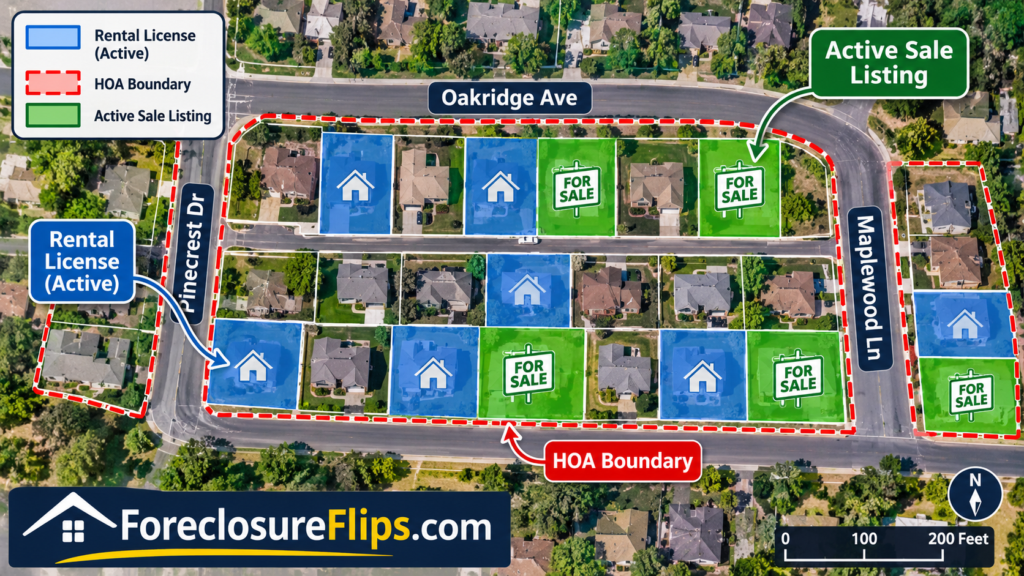
You can find a landlord willing to sell before a foreclosure notice appears. Start with a subdivision where several investors own the same floor plan. Check what those houses actually rent for, what changed in the cost of owning one, and which owners have already taken a step toward selling. A rental listing replaced by an as-is sale listing tells you more about where to spend Friday afternoon than a spreadsheet full of absentee owners.
“Investors default first” is a hypothesis you can test locally. A landlord can sell a losing rental without moving the family, and a flipper can sell an unfinished project to free up cash. Either one may sell while every payment is current. If you’re researching investor-owned property foreclosure, that voluntary sale is the opportunity you’d miss by waiting for the recorder.
Key Takeaways
- Map investor ownership one subdivision at a time. Match deeds and parcel records to rental licenses, then remove duplicate addresses and separate confirmed rentals from guesses.
- Use HOA budgets, assessments and leasing rules to calculate what changed for an owner. A membership roster tells you who owns a unit. It tells you little about the loan.
- Give priority to a property when you can verify both a financial reason to consider selling and a practical way to make an offer.
Stay Ahead of the Next Deal
Markets move quickly, and good foreclosure opportunities often require fast analysis. Subscribe to our twice-weekly newsletter for investor-focused tips, tools, and market insights designed to help you make better decisions.
Why a landlord or flipper might sell before missing a payment
Consider two owners facing a $9,000 roof bill. One lives in the house and needs somewhere to live after a sale. The other owns an identical rental that clears $200 a month. That roof consumes 45 months of the rental’s surplus. Both owners may have ample savings. Only the landlord can sell the house, put the proceeds elsewhere and sleep in the same bed that night.
A flipper faces a different decision. Suppose an unfinished house costs $2,400 a month in interest, insurance, taxes and utilities. A three-month delay adds $7,200 before the contractor does another hour of work. An as-is offer can make sense if it saves enough time and leaves the owner cash for the next project.
The National Private Lenders Association’s October 2026 lending report tracks loans for renovation projects separately from loans underwritten against rental income. That distinction is worth carrying into your search. A delayed inspection can change a flipper’s exit date. A new monthly assessment can change a landlord’s return for years. Neither event establishes that an investor stopped paying before an owner-occupant did.
Find the subdivision where you can price the next house
Start with a recorded subdivision or condo phase whose boundaries you can identify on the assessor’s map. Export or copy one row per parcel. Keep the site address, unit number, deeded owner, tax mailing address and most recent transfer date. A ZIP code is usually too broad for this exercise. Two developments across the street from each other can have different dues, leasing restrictions and resale prices.
Look for recurring deeded owners and match parcels to local rental records. A different mailing address gives you a reason to check further. It can also belong to someone with a second home. Several LLCs sharing the address of a registered agent may have entirely different owners. Leave uncertain properties in a separate column so your investor count remains defensible.
Calculate the rental share on your block
Try this with a 100-home subdivision. You find active rental licenses on 24 distinct parcels and 18 parcels with recent rental listings. Ten appear in both groups. How many homes have at least one piece of rental evidence?
The answer is 32. Add 24 and 18, then subtract the ten duplicates. You have evidence of rental use or marketing on 32% of the parcels. You still need to check dates, ownership transfers and whether a license covers an entire home or a unit in an owner-occupied building. Repeat the exercise in a nearby development using the same criteria before deciding where to spend your time.
Read the HOA roll alongside the budget
If you have authorized access to an HOA membership roll, match unit numbers and owner names to the parcel list. One owner holding six comparable townhouses is worth researching differently from six unrelated owners. If that owner lists one house, the asking price and condition give you a starting point for valuing the other five. The listing alone gives you no reason to assume the whole portfolio is for sale.
Access depends on the jurisdiction and the document. For example, Florida’s 2026 HOA records statute gives parcel owners inspection rights and protects certain information. An outside buyer can start with recorded declarations and amendments, then ask a listing agent for documents the seller can share. For a particular property, confirm the applicable rules with the association or a local real estate attorney.
The budget may be more valuable to you than the roster. Suppose approved dues rise from $185 to $285 a month on each of those six townhouses. At unchanged rents, the owner’s combined annual cash flow falls by $7,200. Check the effective date and whether the increase recurs. A proposed assessment in meeting minutes and an adopted increase payable next month belong on different lines of your worksheet.
Use rental permits to check what changed at one address
Search the local licensing system by street address and unit. Philadelphia’s property research tools illustrate how to do this. OpenMaps includes rental licenses, while Atlas brings together property ownership, deed information, permits and licenses. Use the equivalent city or county sources for your market and check which rentals the local program covers.
Record the license status, expiration date and the date you looked it up. If a license appears to have lapsed, search for a replacement under the same parcel or a slightly different unit number. A transfer, renewal in progress or address mismatch can explain the apparent gap. An empty search result tells you very little in a jurisdiction that licenses only certain rental types.
Next, compare the license history with public listings. A current license and a fresh rental advertisement suggest the owner is still seeking a tenant. An expired advertisement followed by a broker’s listing offering the same unit for sale gives you someone to call. For a flip, substitute the building permit and inspection history. Ask the agent which work remains and whether the contractor’s estimate includes closing out the permit.
Which owner would you approach this week?
You buy townhouses you can inspect and have time to price one deal. These three illustrative properties sit in the same development and face the same dues increase. Pick one before reading the assessment.
| Property | What you can verify |
|---|---|
| Alder Court | The tax bill goes out of state. A current rental ad offers a twelve-month lease, and the owner recently renewed the rental license. |
| Briar Lane | The rental ad came down. The owner’s broker now offers the unit as-is, allows inspections and will provide the adopted assessment schedule. |
| Cedar Place | A renovation permit remains open. The last inspection was two months ago. You found no listing and have no estimate for the remaining work. |
Briar Lane earns the inspection slot. You can verify the seller’s intent, inspect the unit and calculate the assessment’s effect on your own return. Alder Court belongs on a rental-comparison sheet. Cedar Place deserves another permit check if a sale listing appears or the owner invites an offer.
For Briar Lane, ask for the current lease if occupied, the dues statement, assessment installments and any rental restrictions affecting a buyer. Confirm lease obligations and access arrangements with the seller and your local closing professional. Run your price using the rent you can support and the expenses you’ll inherit. A $100 monthly dues increase costs you the same $1,200 a year it cost the seller.
For an off-market property that otherwise fits, a brief inquiry to the verified owner can settle the question. “I’m looking to buy a townhouse in this development. Would you consider an as-is offer for yours?” Use a contact method permitted locally, route listed properties through the agent and honor a request for no further contact. There’s no need to speculate about debt or involve a tenant in the owner’s decision.
Questions about finding investor-owned property before foreclosure
How do you test whether investors default first in your county?
Group comparable financed homes by verified occupancy, purchase period and loan type where available. Track the first public foreclosure filing for each group over the same period and use the number of financed homes in each group as the denominator. This measures the rate and timing of public filings. To establish who missed payments first, you’d need dated loan-performance data that the recorder generally doesn’t provide.
Where do you check for an investor-owned property foreclosure filing?
Identify the official source for the jurisdiction. That may mean the court docket for a foreclosure lawsuit or the recorder’s index for a notice of default or trustee sale. Search by parcel and owner, confirm the document type and save the search date. A filing involving HOA dues can concern a different obligation from the mortgage.
Can you find a small landlord who owns rentals in their own name?
Yes. Match a rental license or a recent whole-home rental listing to the current deed and unit number. An LLC-only search would skip those owners. Verify the dwelling type, especially for duplexes where the owner may occupy one unit and rent the other.
What should you count as a successful lead?
Track verified owners willing to discuss a sale, inspections obtained, offers made and purchases closed. Keep eventual foreclosure filings in a separate column. If a landlord accepts a fair offer, pays off the loan and never appears on a foreclosure list, your search found exactly the deal you set out to buy.
You might also like:
 Skip Tracer for Real Estate: Who Can Actually Sell?
 How to Buy Pre-Foreclosure Properties Directly
 Don’t Wait for Q1: Start Building Your Deal Pipeline Today
 Seller Financing for Distressed Property Investors
 How to Build a Distressed Property Buy Box
 Distressed Seller Bankruptcy Signals Investors Should Understand