
How to Estimate Seller Equity in Pre-Foreclosure
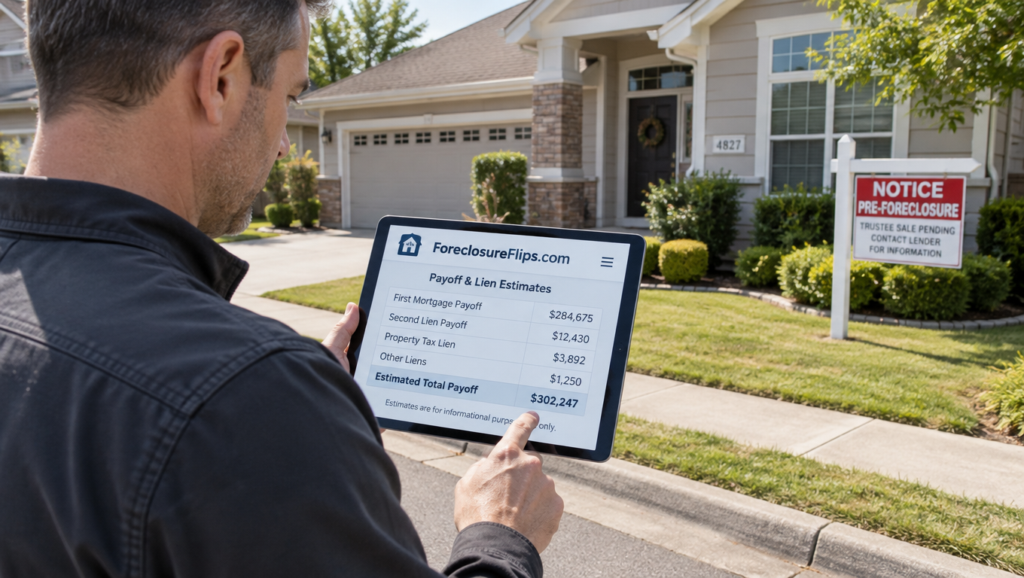
A house can appear to have $125,000 of equity and still leave the owner with less than $30,000 at your offer price. The missing dollars usually sit in places a quick property search does not show: the current payoff, junior debt, delinquent taxes, recorded liens, and closing expenses.
That is why pre-foreclosure equity should be estimated from the seller’s likely closing statement backward, not from market value minus an old mortgage balance.
The useful number is what remains after the obligations that must be cleared to transfer title—and whether that remainder works for both your acquisition price and the seller’s required proceeds.
Get Foreclosure Investing Insights Twice a Week
Subscribe to the Foreclosure Flips newsletter for practical ideas on finding deals, analyzing opportunities, and understanding foreclosure-related investing strategies. We send concise updates twice a week so you can stay informed without adding more noise to your inbox.
Begin With the Property’s Current As-Is Value
Assume you identify a three-bedroom ranch in pre-foreclosure. Renovated comparable sales suggest a possible after-repair value of $395,000, but the property needs updates and deferred maintenance. Current-condition comparables support an as-is value closer to $340,000.
Use $340,000 for the seller-equity calculation.
ARV belongs in your investment underwriting because it helps estimate the value after renovation. It does not describe how much value the seller can convert into cash today.
Build the as-is estimate from recent comparable sales that reflect the property’s current condition and location. If interior access is unavailable, widen the condition allowance rather than assuming renovated condition.
You can use pre-foreclosure listings to identify properties for research, but treat each listing as the start of the file. Verify ownership, foreclosure status, value, debt, and sale timing before relying on the apparent equity.
For the ranch:
As-is market value: $340,000
Estimated first-mortgage balance: $215,000
Apparent gross equity: $125,000
That $125,000 is a screening number. It is not yet money the seller can receive.
Replace the Mortgage Balance With a Dated Payoff
Recorded mortgage amounts and data-provider balances can help you screen leads, but they do not show exactly what must be paid to release the loan at closing.
The CFPB explains that a mortgage payoff amount differs from the current principal balance because it includes interest through the payoff date and can include unpaid fees or other charges. CFPB payoff guidance
Suppose the ranch shows an estimated $215,000 principal balance, but the dated payoff comes back at $224,800.
The first adjustment is immediate:
$340,000 − $224,800 = $115,200
Nearly $10,000 of the apparent equity disappears before you look at any other claim.
Keep Reinstatement and Payoff Numbers Separate
A pre-foreclosure file may also show an estimated amount needed to reinstate the loan. Do not automatically subtract that figure in addition to the verified payoff.
Reinstatement generally addresses the amount required to cure the default and resume the loan. A payoff addresses the amount required to satisfy the loan through a specified date.
If the $224,800 payoff already includes unpaid interest, late charges, advances, and other amounts required to satisfy the mortgage, subtracting a separate $9,800 arrears estimate could count some debt twice.
Keep both fields in your file when they are available:
Estimated reinstatement amount: $__________
Verified payoff through: __________
Verified payoff amount: $__________
For an acquisition, the payoff is the figure that belongs in the seller-net calculation.
Add HELOCs, Junior Mortgages, Taxes, and Liens
Now title research reveals three additional claims:
HELOC: $31,000
Delinquent property taxes: $6,400
HOA lien: $3,200
Subtract them from the $115,200 remaining after the first-mortgage payoff:
$115,200 − $31,000 − $6,400 − $3,200 = $74,600
Other properties can carry judgments, municipal liens, special assessments, contractor claims, or federal tax liens. Their priority and treatment can vary, so use title professionals or counsel where needed.
The IRS states that a federal tax lien is normally paid from sale proceeds when sufficient equity exists; if proceeds cannot satisfy the lien, a discharge may be required to complete the sale.
An online first-mortgage estimate does not establish total property debt.
Build an Equity Waterfall for Every Serious Lead
Once a property survives your first screen, run the numbers in this order:
Estimated as-is market value …………… $__________
minus verified first-mortgage payoff ……. $__________
minus HELOC / junior mortgage payoff ……. $__________
minus delinquent property taxes ………… $__________
minus HOA / municipal / judgment liens ….. $__________
minus other payoff-required claims ……… $__________
= equity before selling costs ………….. $__________
minus seller closing costs at expected sale price … $__________
= estimated seller net ………………… $__________
For the ranch, assume a conventional $340,000 sale would carry approximately $18,000 of seller-side transaction costs for this illustration:
$340,000 sale price
− $224,800 first-mortgage payoff
− $31,000 HELOC
− $6,400 delinquent taxes
− $3,200 HOA lien
− $18,000 estimated seller costs
= $56,600 estimated seller net
Freddie Mac notes that seller closing costs can include commissions, taxes, and fees and that these costs come out of sale proceeds.
The property that appeared to contain $125,000 of equity now produces an estimated $56,600 to the seller at a $340,000 sale price.
Recalculate the Waterfall at Your Offer Price
Your offer changes the seller’s proceeds.
Suppose your underwriting supports a $300,000 direct purchase. Because the transaction is not the same as a conventional retail listing, assume seller-side costs of $6,500 for this example.
Run the waterfall again:
$300,000 offer
− $224,800 first-mortgage payoff
− $31,000 HELOC
− $6,400 delinquent taxes
− $3,200 HOA lien
− $6,500 seller closing costs
= $28,100 estimated seller proceeds
This is where pre-foreclosure equity becomes useful in negotiation. The homeowner may appear to have six figures of gross equity, yet your actual offer may leave less than $30,000 after required payoffs and costs.
A deal can work for your acquisition model and still fail because the seller’s net does not solve the seller’s problem.
Ask What the Seller Needs From the Closing
Assume the owner says $25,000 of net proceeds would cover moving expenses, a rental deposit, and immediate financial needs.
At the illustrative $300,000 offer, the current calculation leaves about $28,100. A $292,000 offer would reduce the estimated proceeds to roughly $20,100 if every other number stayed unchanged.
Now you have a meaningful boundary.
The seller may have better alternatives, including a conventional listing or another buyer. Your calculation tells you whether your proposed transaction can satisfy the known claims and the seller’s stated objective.
Keep Three Equity Numbers in the Deal File
Do not collapse every equity estimate into one figure.
Gross equity is the current property value minus mortgage debt. Use it for fast lead screening.
Usable equity subtracts junior debt, taxes, liens, and other claims that must be cleared.
Seller net starts with the actual offer or sale price and subtracts required payoffs plus transaction costs.
Early research may justify estimates. Serious negotiations call for current payoffs, title information, and transaction-specific closing costs.
Keeping the three figures separate prevents you from calling $100,000 of gross equity available seller proceeds.
Refresh the Numbers as the Foreclosure Advances
A pre-foreclosure file changes while it sits in your pipeline.
Interest, allowable fees, taxes, junior-lien balances, and property deterioration can reduce the seller’s net over time. Value can change too.
A property showing $60,000 of usable equity in September may look very different several months later.
If you track pre-foreclosure properties over time, refresh the payoff, title information, value, and sale date when the foreclosure status changes or the owner becomes ready to discuss an actual transaction.
Never carry an old equity estimate into a current offer without checking the inputs.
When Payoffs Exceed Sale Proceeds, Check Short-Sale and Lien Options
Suppose total required payoffs and transaction costs reach $318,000, but the property is worth only $310,000 as-is.
A conventional investor purchase below market value cannot satisfy everything from the proceeds.
The file may point toward a short sale, lien settlement, disputed balance, or another resolution that requires lender or lienholder involvement. It may also be a lead you remove from the pipeline.
Thin or negative pre-foreclosure equity does not automatically make a property worthless. It changes the transaction you would need to complete.
Identify the shortage before negotiating a price that cannot clear title.
Use Equity to Qualify the Property, Not Judge the Owner
Equity tells you whether a sale may be financially possible; it does not explain why the owner missed payments or which option the owner should choose.
Rely on public records and lawful data for initial screening. When an owner engages, verify the figures needed for the proposed acquisition and explain your offer clearly.
Keep the analysis focused on what you can verify: value, payoffs, liens, costs, timing, and your offer economics.
Make Seller Net the Number That Controls the Offer
The fastest screen remains value minus estimated debt. That is useful when hundreds of leads need sorting.
Before you contract, go further.
Use current as-is value. Replace estimated mortgage balances with dated payoffs. Add junior debt, taxes, liens, and title claims. Estimate transaction costs at your actual purchase price, then calculate the dollars the seller is likely to receive.
Strong pre-foreclosure equity analysis tells you whether the property can close at your price and whether the proposed sale can leave the seller with realistic proceeds after the required claims are paid.
That is the number worth negotiating from.
You might also like:
 How to Find More Deals From One Property Owner
 Seller Financing for Distressed Property Investors
 How to Create a Distressed Property Lead Scorecard
 How to Track Distressed Sellers Without Chasing Bad Leads
 Skip Tracer for Real Estate: Who Can Actually Sell?
 Mortgage Default Stages and Investor Lead Timing