
Learn to Read Foreclosure Listings and Verify the Deal
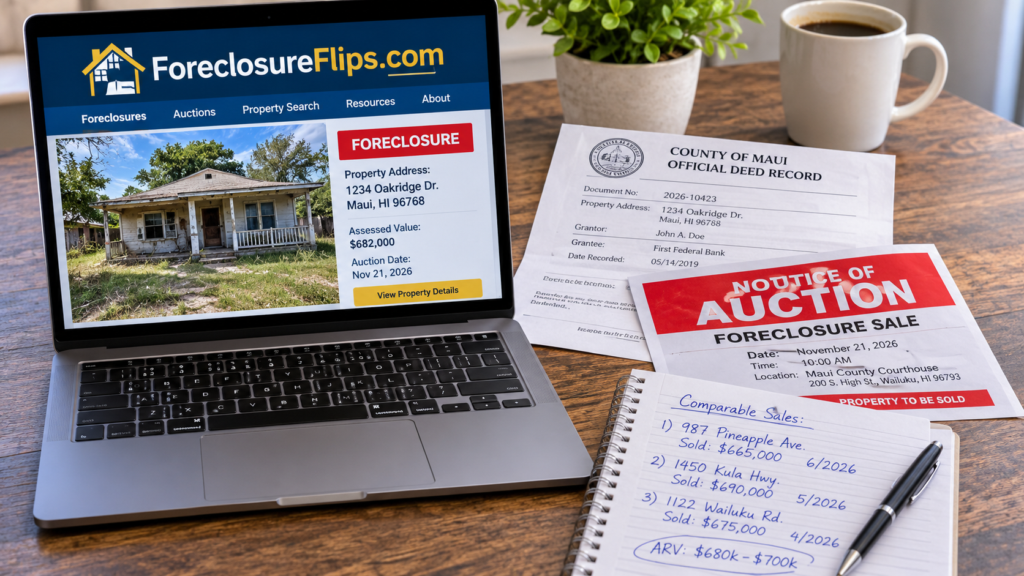
Three records for the same house can make one property look like three opportunities. One shows a scheduled auction, another still labels the property pre-foreclosure, and a third carries an estimated value that seems to leave a wide profit margin.
That is the danger of treating foreclosure listings as finished due diligence. They are lead records assembled from sources that can update on different schedules.
Use the listing to find the property. Before you price the deal, establish the current stage, confirm the sale date, rebuild the value estimate, reconcile duplicate records, and verify the facts that can change your bid or prevent a closing.
Build Your Investing Knowledge One Email at a Time
Foreclosure investing rewards preparation. Join our 2X week newsletter for straightforward guidance on pre-foreclosures, short sales, BRRRR, flipping, and other strategies investors use to evaluate distressed property opportunities.
Determine the Property’s Current Foreclosure Stage First
You find a three-bedroom ranch with three records attached to the address.
One record says “pre-foreclosure.” Another shows an auction scheduled for December 8. A third has an older event date and wording that could suggest the lender acquired the property.
Do not average those records into a conclusion. Identify which event happened last and which public or transaction source controls the current status.
Foreclosure procedure depends on state law. Cornell Law School’s foreclosure overview explains that judicial foreclosure uses a court process, while nonjudicial foreclosure can proceed under a power of sale without a court order when state law permits it.
That difference tells you where to verify the file. Judicial cases may require a court docket and sheriff or court sale record; nonjudicial cases may point you toward a trustee, foreclosure attorney, recorder, or official auction source.
Treat the Listing Stage as a Label, Not a Legal Conclusion
Labels such as pre-foreclosure, auction, bank-owned, and REO help you sort inventory. They do not replace the underlying foreclosure record.
Ask one question before deeper underwriting: What is the most recent independently verified event for this property?
Record that event and the date you verified it.
Build Your Own Deal File From the Listing
You can search current foreclosure inventory to identify addresses worth investigating. Once a property survives your first look, move the useful fields into your own file rather than relying on the listing page as the permanent record.
For the ranch, record:
Address and parcel number
Owner of record
Foreclosure case or instrument number
Current foreclosure stage
Scheduled sale date and source
Estimated as-is value
Known mortgages and liens
Taxes and assessments
Occupancy status
Last verification date
Put a source beside each important field so an old status or value does not survive unnoticed after newer information appears.
Verify the Auction Date With the Source Controlling the Sale
The ranch still shows December 8.
Do not arrange funds, travel to the auction, or set your acquisition calendar around that date until you verify it with the source closest to the sale.
Foreclosure auctions can be postponed or canceled. Auction.com’s current foreclosure auction guidance advises buyers to check the sheriff, court, foreclosure attorney, county, or trustee when Auction.com is not conducting the sale. It also notes that loss mitigation, bankruptcy, and other resolutions can change a scheduled sale.
Check again near the event. A valid date when the data was collected may no longer be current.
Investigate a Past Auction Date Instead of Assuming the Sale Occurred
An expired auction date creates a research question.
Did the property sell to a third party? Perhaps the lender took it back, or the sale was postponed or canceled.
Look for the next event: sale result, continuance, cancellation, deed, court confirmation where applicable, or a new auction date. That answer determines whether you pursue the owner, prepare for a future auction, or wait for an REO disposition.
Rebuild the Value From Current-Condition Comparables
The listing shows an estimated value of $410,000.
Treat that number as a screening clue, not your bid ceiling.
Automated valuation models depend on available data. Zillow describes its Zestimate as an estimate based on public records, MLS data, and other inputs, not an appraisal. Reported error rates also differ between on-market and off-market homes, illustrating how results depend on available data.
Your acquisition value should reflect the house you can actually buy.
Pull recent comparable sales, adjust for location and physical differences, and separate current as-is value from after-repair value. If you cannot inspect the interior, increase the condition allowance rather than assuming an automated estimate captures deferred maintenance.
A $410,000 screen estimate might become a $355,000 as-is value after condition and micro-location adjustments—enough to eliminate an auction margin.
Use This Foreclosure Listing Verification Matrix
Complete the final column before a property reaches a serious offer or auction bid. A blank beside a price-changing fact shows you what still needs verification.
| Listing field | What can be wrong or incomplete | Best verification source | Verified? |
|---|---|---|---|
| Foreclosure stage | Status may lag the legal process | Court, trustee, sheriff, recorder, foreclosure attorney | ______ |
| Owner | A deed or foreclosure transfer may have occurred | County land records / recorder | ______ |
| Auction date | Sale may be postponed, canceled, or continued | Official sale source | ______ |
| Case / instrument number | Duplicate or old proceeding may be shown | Court docket or recorder | ______ |
| Estimated value | Model may miss condition or comp differences | Current comps, inspection, BPO/appraisal when warranted | ______ |
| Mortgage information | Balance may be estimated or stale | Payoff when authorized; recorded loan documents for screening | ______ |
| Junior liens | First-mortgage data may hide total leverage | Title search / recorded instruments | ______ |
| Property taxes | Delinquency can change after data collection | County tax authority | ______ |
| Occupancy | Mailing address or old photos can mislead | Lawful field verification; seller/agent information | ______ |
| Property facts | Beds, baths, use, or square footage can conflict | Assessor, permits, MLS history, inspection | ______ |
| Sale terms | Deposit, payment, and bidder rules vary | Official auction terms | ______ |
Use the matrix to expose unknowns that can change your decision. A new lead does not require the same verification depth as a property you are preparing to bid on.
Reconcile Duplicate Records Before Counting Another Deal
Your ranch appears twice in the pipeline.
Do not delete one record just because the street address matches. Compare the parcel number, owner, lender or plaintiff, case number, instrument number, recording date, sale date, and current stage.
Two records may describe the same event from different feeds, or they may represent a postponed sale, second lien, older case, or later default. Merge them only after you know what each represents.
This also keeps your pipeline statistics honest. Forty records are not forty potential acquisitions when several addresses appear more than once.
Confirm the Owner Before Choosing the Acquisition Path
The current owner determines whom you can buy from.
Before a completed sale, the borrower may still hold title. Afterward, title may move to a third-party bidder or lender according to state procedure. Check the latest deed together with the current foreclosure record.
If the ranch has become lender-owned, seller outreach to the former owner no longer creates a purchase path. Your attention shifts to the lender, asset manager, broker, or authorized disposition channel.
Keep Market Value, Debt, Opening Bid, and Asking Price Separate
A listing can display several large dollar figures that answer different questions.
Estimated market value is a valuation opinion.
Mortgage or judgment debt reflects an obligation and can change as interest, fees, advances, or costs accrue.
Opening or credit bid comes from the foreclosure sale process and does not establish market value.
REO asking price reflects the lender-owner’s current marketing decision.
At auction, build your maximum bid from as-is value, unknown repair exposure, title and tax risk, occupancy, sale terms, financing, holding costs, and required return. REO and direct pre-foreclosure purchases require different contract, payoff, and seller-net analysis.
Refresh the File Whenever the Property Changes Stage
A status change should trigger more than an edit to one field.
If the property moves from pre-foreclosure to scheduled auction, refresh the sale date, foreclosure record, ownership, taxes, value, and prior title work. A later REO appearance means rebuilding the file around the new seller, asking price, access, and contract terms.
A second foreclosure property search can alert you to a listing change, but pair that update with the official record controlling the current event.
This is where foreclosure listings become useful monitoring tools: they can flag a change that deserves independent verification.
Increase Verification as More Capital Goes at Risk
For an initial screen, confirm that the address, rough stage, property type, geography, and estimated value fit your strategy.
When the lead survives, verify ownership, current foreclosure status, sale date, stronger comps, taxes, and obvious lien or title concerns.
Before an offer, nonrefundable deposit, or auction bid, resolve every unknown that can materially change price, title, closing ability, required cash, or exit.
That sequence lets you investigate many leads without performing full due diligence on every address.
Make the Bid From the Verified File
Useful foreclosure listings can compress a large amount of distressed-property data into one search. That makes them effective for finding opportunities and tracking changes, but they cannot do the final investor work for you.
Verify the foreclosure stage from the legal or transaction record. Confirm ownership before choosing whom to pursue. Check auction dates near the sale. Replace automated values with current-condition analysis, reconcile duplicate records, and refresh the file when the process advances.
The ranch that looked simple on the first screen may become a strong acquisition, a postponed sale, an overpriced auction, a future REO, or a property you reject.
Your verified file tells you which one it is.
You might also like:
 Foreclosure Investing for Beginners: Complete Step-by-Step Guide
 Foreclosure Investing: How to Buy, Analyze, and Profit From Foreclosed Homes
 New York City Metro Foreclosure Market 2026
 Buffalo Foreclosure Market 2026
 Rochester Foreclosure Market 2026
 What a Property Deed Reveals in Foreclosure Deals