
The First 30 Minutes of Foreclosure Deal Analysis
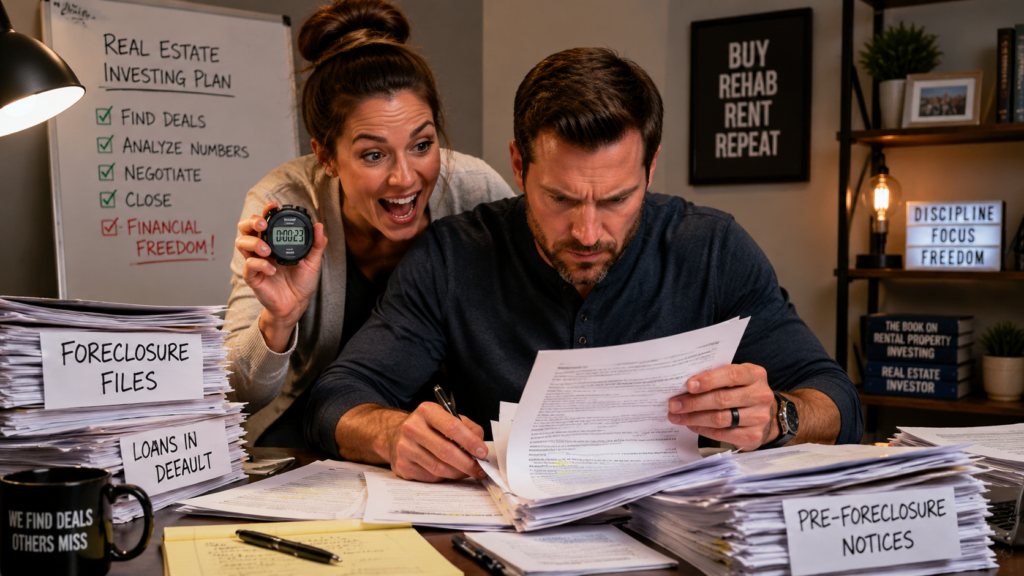
A good foreclosure deal analysis workflow does not begin with a detailed spreadsheet. It begins with elimination.
Your first objective is to determine whether a property deserves more time, not to prove that it is a deal. In 30 minutes, you usually cannot confirm clear title, calculate an exact renovation budget, or predict the final resale price. You can, however, identify weak margins, unsuitable locations, severe property risks, and transaction problems before paying for deeper due diligence.
Use the first half hour to classify the opportunity as a pass, a rejection, or a property that needs one specific question answered.
Learn the Strategies Behind Smarter Foreclosure Investing
Get practical foreclosure investing content delivered twice a week, including deal analysis tips, strategy breakdowns, useful tools, and new resources from Foreclosure Flips. Sign up to keep learning and spotting better opportunities.
Minutes 0–5: Identify the Property and Sale Stage
Start by confirming the address, parcel number, property type, legal owner, and foreclosure stage.
A pre-foreclosure lead, scheduled auction, bank-owned listing, and government-owned property follow different timelines. They also provide different access, financing, inspection, and contract rights. Foreclosure datasets commonly distinguish notices of default, lis pendens filings, auction notices, completed foreclosures, and REO inventory, as reflected in foreclosure filing data.
Record the scheduled sale date, listing status, opening bid or asking price, occupancy information, and the party controlling the transaction. Check whether the property has been postponed, relisted, withdrawn, or offered at several previous auctions.
Stop immediately if the property type falls outside your buy box. A rural manufactured home, occupied condominium, mixed-use building, or fire-damaged structure may require financing and expertise you do not have.
Minutes 5–10: Establish a Conservative Value Range
Do not spend ten minutes searching for the highest comparable sale. You need a credible range.
Find three to five recent sales with similar location, size, age, construction, bedroom count, and property type. Give the greatest weight to nearby transactions that reflect the condition you expect after renovation.
Separate current-condition value from after-repair value. If distressed homes sell around $165,000 and renovated homes sell between $245,000 and $265,000, do not automatically underwrite the property at $265,000. Use the lower or middle portion of the range until the property’s layout and repair potential are confirmed.
Also review active listings. Closed sales show what buyers previously paid, while active competition shows what your finished property may face when it reaches the market.
Reject the opportunity if the projected spread only works with the highest sale, future appreciation, or a finished price well above neighborhood norms.
Minutes 10–15: Create a Repair Risk Band
At this stage, you are not developing a contractor-ready scope. You are assigning the property to a repair category.
A light project may need paint, flooring, fixtures, appliances, landscaping, and minor carpentry. A moderate renovation may include kitchens, bathrooms, windows, HVAC, roofing, or partial system replacement. A heavy project may involve structural work, extensive water damage, fire damage, complete mechanical replacement, layout changes, or code correction.
Use listing photographs, exterior observations, property age, permit history, prior listings, and vacancy indicators. Missing interior photos should increase your estimate rather than reduce it.
For example, you might place the property in a preliminary range of $25,000–$40,000 rather than recording a false-precision estimate of $31,750. Add a separate uncertainty reserve when access is limited.
If the deal fails at the upper end of the preliminary repair range, it does not deserve a paid inspection yet. This is also where assessing vandalism risk should come into play.
Minutes 15–20: Screen Title, Taxes, and Association Exposure
Search the county recorder, clerk, tax collector, assessor, and court records available online. You are not completing a title examination. You are looking for obvious reasons the acquisition may cost more or take longer than expected.
Confirm the owner’s name and review recorded mortgages, foreclosure filings, tax delinquency, judgments, probate matters, bankruptcy references, municipal liens, and unusual transfers. For condos or planned communities, identify the association and look for unpaid assessments or litigation.
The importance of prior claims is reflected in the purpose of owner’s title insurance, which can protect against certain ownership claims arising before the purchase. Your initial record search should therefore lead to a question for the title professional, not a conclusion that title is clear.
At an auction, determine which lien is being foreclosed and whether senior obligations may remain. For an REO or listed property, confirm whether the seller expects to provide insurable title.
Move the property to “pending” if the numbers work but one title issue needs clarification. Reject it if your potential margin cannot support legal or curative work.
Minutes 20–25: Test Location and Exit Liquidity
A profitable renovation is not enough. You need an exit market.
Check recent sales volume, days on market, price reductions, rental demand, school or employment access, property taxes, insurance concerns, and nearby conditions that could limit demand. Look for highway noise, industrial uses, high-voltage lines, difficult access, abandoned buildings, or an unusual concentration of distressed properties.
Run the address through the official FEMA Flood Map Service Center and note whether flood exposure could affect insurance, financing, renovation, or resale. Flood-zone status does not automatically disqualify a property, but it changes the cost and buyer pool.
Then identify the likely exit. A conventional three-bedroom house may appeal to retail buyers, landlords, and other investors. An oversized renovation, unusual conversion, or remote property may have only one practical buyer type.
Reduce your expected value or increase holding time when resale liquidity is weak.
Minutes 25–28: Calculate a Rough Maximum Price
Now combine the information into a preliminary ceiling:
Conservative after-repair value
– repair range
– acquisition and closing costs
– financing and holding costs
– selling costs
– title, occupancy, and unknown-condition allowances
– required profit
= preliminary maximum purchase price
Assume a conservative after-repair value of $260,000. Repairs are estimated at $55,000, with a $10,000 uncertainty reserve. Financing, holding, acquisition, and selling expenses total $45,000, and you require a $35,000 profit.
Your preliminary maximum price is $115,000.
If the asking price is $145,000, do not spend the next week trying to justify it. The property needs a major price reduction or a materially better fact—such as verified minor repairs—to reenter consideration.
Minutes 28–30: Assign the Next Action
End the workflow with a decision rather than another research tab.
Use one of three outcomes:
- Reject: The margin, location, condition, or transaction structure does not fit.
- Investigate: The deal may work, but one material unknown needs resolution.
- Advance: The preliminary margin supports title work, an inspection, contractor input, or a site visit.
For an “investigate” result, write down the exact question. Examples include whether a senior lien survives, whether the property is occupied, or whether an addition was permitted. Do not continue broad research without knowing what fact could change your decision.
The Investor Takeaway
The first 30 minutes of a foreclosure deal analysis workflow should protect your time and due-diligence budget.
Confirm the sale stage, establish a conservative value range, classify the repair exposure, screen public records, evaluate the location, and calculate a rough maximum price. Then decide whether to reject, investigate, or advance the opportunity.
You will sometimes eliminate a property that could have produced a profit. That is acceptable. Your goal is not to pursue every possible deal. It is to reserve detailed analysis, professional fees, and acquisition capital for properties with enough preliminary margin to justify them.
Looking For Foreclosure Deals In Your Area To Analyze?
Learn how to find deeply discounted properties. Get instant access to pre-foreclosures, REOs, and short sales updated daily!
You might also like:
 How Code Violations Affect Foreclosure Deals
 Zombie Foreclosures What Investors Need to Know
 As-Is Foreclosure Deals How to Price the Risk
 When a Foreclosure Listing Is Not Really a Deal
 Title Search for Foreclosure Properties: Investor Essentials
 Foreclosure Insurance Problems Investors Should Plan For