
How Multifamily Refinancing Stress Can Force a Sale

An apartment property can be full, collect rent every month, and still face a forced decision when its loan matures.
The problem often appears when the owner asks for replacement financing. A higher interest rate, lower appraisal, or tighter lender standards can reduce the size of the new loan below the balance that has to be repaid.
That is where multifamily refinancing stress can turn into deal flow. Operations may still look healthy while the capital stack forces the owner to add cash, bring in a new partner, negotiate with the lender, or sell.
Learn the Strategies Behind Smarter Foreclosure Investing
Get practical foreclosure investing content delivered twice a week, including deal analysis tips, strategy breakdowns, useful tools, and new resources from Foreclosure Flips. Sign up to keep learning and spotting better opportunities.
Start With the Refinance Gap
Assume an apartment owner has a $15 million loan coming due.
The property produces $1 million of annual net operating income. Several years ago, the building supported the original debt under lower borrowing costs and stronger valuation assumptions.
At refinance, the lender values the property at $18 million and caps the new loan at 65% of value.
That produces maximum proceeds of $11.7 million.
The owner now has to solve a $3.3 million gap before the existing $15 million loan can be paid off.
Nothing about occupancy had to collapse. Rent collections could remain steady. The financial pressure comes from the difference between the debt that must be repaid and the debt the property can support today.
For investors, that gap can be more useful than a delinquency notice because it can create seller motivation before payment default appears.
Why 2026 Has So Many Refinancing Decisions
The Mortgage Bankers Association estimates that $875 billion of the roughly $5 trillion in outstanding commercial and multifamily mortgage debt is scheduled to mature during 2026.
About 13% of mortgages backed by multifamily properties mature this year.
A maturity creates a deadline. The owner has to repay the existing lender through refinancing, fresh equity, a sale, or another negotiated solution.
MBA also reports that some loans originally scheduled to mature earlier were extended or modified, pushing additional balances into later maturity years. Higher borrowing costs during the post-pandemic period helped create that backlog.
For an investor, maturity volume tells you where financing pressure may surface. The property-level numbers determine whether that pressure creates a sale.
The Same NOI Can Support a Much Lower Value
Refinancing pressure becomes sharper when capitalization rates rise.
Suppose an apartment property produces $1 million of annual NOI.
At a 4.5% cap rate, that income implies a value of about $22.2 million.
Raise the cap rate to 6%, and the same NOI implies a value of about $16.7 million.
Income stayed flat. Implied value fell by roughly $5.5 million.
That decline can cut refinance proceeds even before operating performance weakens.
Recent Trepp multifamily analysis has shown higher appraisal cap rates across securitized apartment properties since 2022, illustrating how repricing can reduce collateral values even while buildings continue generating income.
For a buyer, this changes the way you should read a seller’s asking price. A property acquired or refinanced at a lower cap rate may carry a debt balance that today’s valuation struggles to support.
Debt Service Can Create a Second Squeeze
Value is only one side of the refinance.
The replacement loan also has to work against the property’s cash flow.
Assume a building produces $600,000 of annual NOI. The current loan requires $400,000 of annual debt service, producing a 1.50 debt-service coverage ratio.
A new loan at a higher rate requires $550,000 per year.
Debt-service coverage falls to about 1.09.
A lender seeking a stronger coverage ratio may reduce proceeds even further.
Now the owner faces two constraints at once: lower value limits loan-to-value proceeds, while higher debt service limits the amount supported by income.
That combination can turn a property with stable occupancy into a capital problem.
The Owner Has Four Ways to Fill the Gap
Once the refinance comes in short, the choices become fairly concrete.
The owner can contribute cash. Existing investors can inject more equity. A new partner can recapitalize the deal. The lender can agree to an extension or modification.
A sale becomes another path when those choices produce an unattractive return or require more capital than ownership wants to commit.
This is where multifamily refinancing stress becomes useful for acquisition sourcing.
A seller may have spent years operating the property successfully and still decide that writing a $2 million or $3 million check into the deal makes little sense.
That motivation differs from a residential foreclosure. The property can remain occupied, maintained, and cash-flowing while the balance sheet pushes ownership toward an exit.
Current Delinquency Data Shows Uneven Pressure
Across commercial mortgages, conditions vary sharply by lender and loan structure.
Freddie Mac reported a 0.51% multifamily delinquency rate for the second quarter of 2026, up from 0.43% in the first quarter and 0.47% a year earlier. In its second-quarter multifamily results, Freddie Mac attributed much of the increase to elevated interest rates and stress in small-balance loans.
Agency multifamily performance remains far stronger than heavily stressed segments of commercial mortgage-backed securities. Trepp has also reported higher CMBS delinquency, including newly delinquent multifamily loans, showing how refinancing pressure can appear sooner in more aggressively financed parts of the market.
The split tells you where to look.
A conservatively financed property with long-term agency debt can face a very different outcome from an acquisition funded with short-term bridge debt, aggressive leverage, or a business plan that depended on rapid rent growth.
Debt structure should sit beside occupancy, rents, and expenses in your first-pass review.
Small Apartment Properties Can Feel the Squeeze Faster
Freddie Mac’s reference to small-balance loan stress deserves attention from individual investors.
Smaller multifamily properties often operate with less room for error. A rise in insurance premiums, property taxes, payroll, repairs, or utilities can consume a larger share of available cash flow.
Rent growth can also slow before expenses do.
A five-, ten-, or twenty-unit building may look stable from the street while its refinance proceeds shrink enough to derail the owner’s plan.
Ask for the existing debt terms early in your analysis.
You want the current balance, maturity date, interest rate, amortization, prepayment terms, and any extension options. Pair those figures with trailing NOI and a realistic estimate of what a lender would finance today.
The seller’s debt can reveal motivation that listing remarks may omit.
Find the Capital Problem Before the Listing Looks Distressed
A refinancing problem often appears in the numbers before it appears in the property.
Start with five figures:
- Current loan balance
- Maturity date
- Trailing NOI
- Likely refinance proceeds
- Current market value
Then calculate the capital gap.
Suppose the owner owes $8 million and current income and value support only $6.8 million of replacement debt.
The $1.2 million difference becomes part of every ownership decision.
An investor with abundant liquidity may fill it. Another owner may prefer to preserve capital for other properties or avoid adding money to an investment with weaker projected returns.
That second owner can become a motivated seller while occupancy is still strong.
Refinance Pressure Can Change Your Offer Strategy
When debt creates the motivation, the seller’s decision may revolve around proceeds rather than headline price.
An owner facing a $3 million refinance gap may accept a lower price if a sale removes the need for a large cash contribution and produces a cleaner exit.
Your underwriting still has to begin with the real estate.
Verify current rents, concessions, vacancy, payroll, repairs, insurance, property taxes, utilities, and capital expenditures. Rebuild NOI before applying a market cap rate.
Then underwrite the debt you could obtain after acquisition.
A purchase price that looks attractive under the seller’s old financing can fail under your new loan terms.
Use the Foreclosure Flips free real estate investor calculators to test debt service, cash flow, renovation costs, and exit assumptions before deciding how much capital the property can support.
Underwrite the Refinance Before Counting on the Upside
Many apartment acquisitions are sold on future rent growth, renovations, or operational improvements.
Run the refinance case before giving those gains full credit.
Estimate stabilized NOI using rents and expenses you can support from current market evidence. Apply a cap rate that reflects today’s transaction environment. Calculate replacement debt using realistic loan-to-value and debt-service coverage constraints.
Then compare the projected proceeds with the balance you expect at refinance.
A deal that requires falling rates, rapid rent growth, and a richer valuation leaves little room for error.
By contrast, a property that works under current financing conditions gives you a stronger base for any upside the business plan eventually produces.
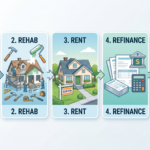
For BRRRR investors, this step directly affects capital recycling. Lower refinance proceeds can trap more cash in the property and slow the next acquisition.
The Deal May Appear Before the Default
Multifamily refinancing stress can create a sale while the building still looks healthy.
The owner reaches maturity, discovers that replacement debt falls short, and has to choose where the missing capital comes from.
Some owners will fund the gap. Others will restructure. A portion will sell.
That is the opportunity to look for.
Study maturities alongside NOI, value, and debt-service coverage. A building can have paying tenants and stable operations while its financing reaches a point that changes the owner’s willingness to hold.
The strongest lead may be the property with a healthy rent roll and a loan that no longer fits it.
You might also like:
 Rental Property Cash Flow Analysis: Calculating True Returns + Free Template
 Calculating Cash Flow for Rental Properties: Step-by-Step Template
 Expenses to Include in Cash Flow Analysis for BRRRR Properties
 BRRRR Investing: How to Buy, Rehab, Rent, Refinance, and Repeat
 Assumable Mortgages for Real Estate Investors
 Rental Property Tax Deductions When a Flip Becomes a Hold