Savannah Foreclosure Market 2026
The Savannah foreclosure market should be researched differently from Atlanta or Macon. Savannah is smaller than Atlanta, more tourism-sensitive than Macon, and more exposed to coastal insurance, flood, historic-district, and short-term rental considerations than most inland Georgia markets.
That makes Savannah useful for investors, but only when the strategy is specific. A foreclosure near downtown Savannah, a rental house in Pooler, a property in Garden City, a coastal-adjacent asset on the islands, and a workforce-housing opportunity near logistics employment are not interchangeable deals.
The main investor question is whether the foreclosure discount is large enough to cover the real local costs: title work, taxes, insurance, flood exposure, roof and moisture issues, renovation limitations, tenant demand, resale timing, and any short-term rental restrictions that affect the exit plan.
Get Foreclosure Investing Insights Twice a Week
Subscribe to the Foreclosure Flips newsletter for practical ideas on finding deals, analyzing opportunities, and understanding foreclosure-related investing strategies. We send concise updates twice a week so you can stay informed without adding more noise to your inbox.
What the 2026 Foreclosure Data Suggests for Savannah Investors
Georgia remains one of the more active foreclosure-start states in the country. ATTOM’s Q1 2026 U.S. Foreclosure Market Report reported 118,727 U.S. properties with foreclosure filings during the quarter, up 26% from the prior year.
The state of Georgia recorded 4,356 foreclosure starts in Q1 2026, putting it among the top states by foreclosure-start volume.
Savannah is not a volume market in the same way Atlanta is. The opportunity is narrower.
Investors should treat Savannah as a targeted research market where individual property selection matters more than broad lead volume.
| 2026 Signal | Current Reading | Investor Use |
|---|---|---|
| Georgia foreclosure starts | 4,356 in Q1 2026 | Statewide pipeline is meaningful |
| National foreclosure filings | Up 26% year over year in Q1 2026 | Distress is increasing from prior-year levels |
| National REOs | Up 45% year over year in Q1 2026 | Bank-owned inventory deserves monitoring |
| Savannah profile | Smaller coastal metro | More selective deal flow than Atlanta |
| Main thesis | Local risk-adjusted basis | Best deals depend on submarket, insurance, and exit control |
ATTOM’s April 2026 foreclosure update showed the national trend continuing, with foreclosure filings up 18% year over year and completed foreclosures up 42%. That supports monitoring Georgia markets, including Savannah, but it does not imply that every distressed property is mispriced.
Savannah investors should be especially careful about the difference between a low price and a clean investment basis. A property can look inexpensive and still be a weak deal if insurance, flood history, code work, historic renovation limits, or rental restrictions reduce the exit value.
Savannah’s Housing Market Requires Exit Discipline
Savannah’s housing market has enough demand to support investor exits, but the market is not uniform. Downtown, Midtown, the islands, West Chatham, Pooler, Port Wentworth, Garden City, Thunderbolt, and Southside Savannah all need separate pricing assumptions.
Realtor.com’s Savannah housing market data showed a median listing price near $398,900, about 2,100 homes for sale, and a typical market time of roughly 62 days. That points to a market with active inventory and enough transaction depth for investors to compare deals, but not one where every resale exit should be treated as immediate.
Redfin’s Savannah housing market data showed a softer sale-price picture over the three months ending April 2026, with prices down 6.7% year over year and a median sale price near $330,000. Homes sold after an average of 81 days on market, compared with 61 days a year earlier.
That gap between list-price context and sale-price behavior is important. Sellers may still ask for strong prices, but closed sales and time on market suggest buyers are more selective.
A foreclosure investor should not underwrite from optimistic listings. Use closed comps, current competing inventory, days on market, price reductions, and likely buyer concessions.
| Savannah Resale Signal | Recent Reading | Investor Use |
|---|---|---|
| Median listing price | About $398,900 | Useful for broad market positioning |
| Median sale price | About $330,000 | Better starting point for exit realism |
| Average days on market | About 81 days in Redfin data | Longer hold periods may be needed |
| Price trend | Sale prices down year over year | Avoid aggressive ARV assumptions |
| Market structure | Tourism, port, military, logistics, and local demand | Match the property to the correct buyer or tenant pool |
The key point is not that Savannah is weak. It is that exit strategy must be chosen carefully. A downtown-adjacent rehab, a long-term rental near employment corridors, and a short-term rental candidate near visitor demand require different assumptions.
Chatham County Research Should Come Before the Deal Model

Most Savannah foreclosure research starts with Chatham County. Before estimating profit, investors should confirm the property’s ownership history, recorded security deeds, liens, tax status, sale notices, zoning limitations, and physical risk profile.
The Chatham County Superior Court Clerk’s Real Estate Division records deeds, liens, plats, UCC filings, and other real estate documents. That matters because a foreclosure opportunity should not be analyzed only from a listing, auction notice, or drive-by inspection. Recorded documents often decide whether the apparent discount is real.
Chatham’s tax resources also matter. The county tax site provides access to property records and tax information, which investors should review before making offers or bidding. Delinquent taxes, assessment changes, city-versus-county tax exposure, and ownership records can affect holding costs and closing risk.
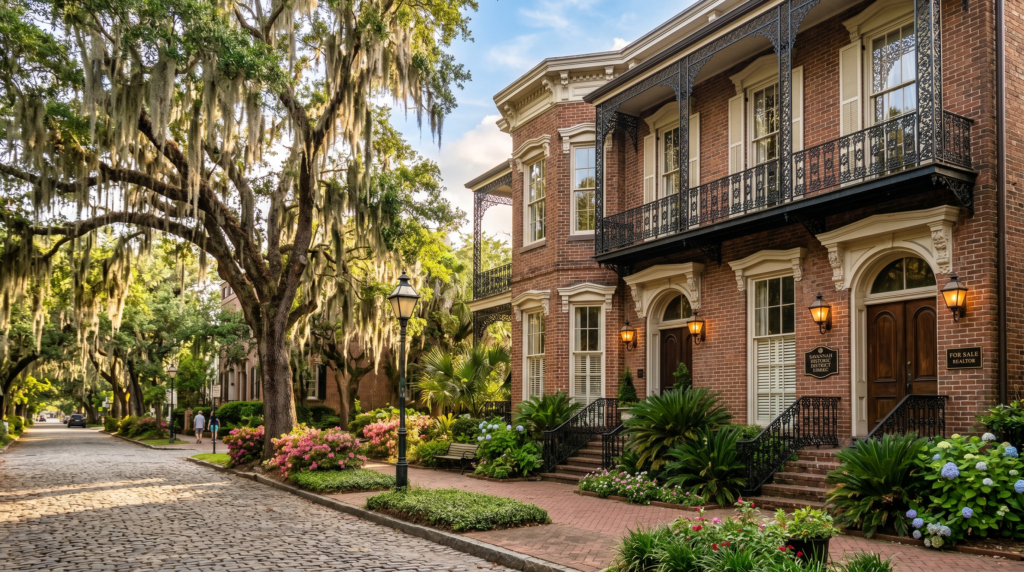
Historic Savannah and Downtown
Historic Savannah can attract strong buyer and visitor demand, but foreclosure investors need to be careful with renovation assumptions.
Older buildings may involve roof, foundation, moisture, termite, plaster, window, electrical, plumbing, and structural issues. Some properties may also face historic-district design review or permitting requirements.
A downtown or historic-area foreclosure may work when the acquisition price reflects the full restoration burden. It may fail when the investor prices the rehab like a standard suburban renovation.
Midtown and Southside Savannah
Midtown and Southside Savannah can offer more conventional single-family and rental opportunities. These areas may be better suited for investors seeking long-term rentals, moderate rehabs, or resale to local buyers.
The main issue is neighborhood-level pricing. Investors should compare only nearby closed sales with similar age, condition, layout, and buyer profile. A broad Savannah average is too imprecise for underwriting.
Pooler, Port Wentworth, and West Chatham
West Chatham has been shaped by logistics, port-related employment, industrial growth, and suburban expansion. Pooler and Port Wentworth may attract tenants and buyers tied to employment access, newer housing, and affordability relative to more central Savannah locations.
Foreclosure investors should watch new-construction competition, HOA rules, commute patterns, tax exposure, and whether the property’s condition matches what local buyers expect. A dated foreclosure competing against newer homes needs a larger discount.
Islands and Coastal-Adjacent Areas
Whitemarsh Island, Wilmington Island, Tybee Island, and other coastal-adjacent locations require extra review. Insurance, flood zones, elevation, wind exposure, roof age, moisture, storm history, and buyer financing can all affect value.
A coastal foreclosure can look attractive because the location is appealing. The underwriting should begin with insurability and flood exposure before moving to ARV.
| Area | Possible Investor Angle | Main Item to Verify |
|---|---|---|
| Historic / Downtown Savannah | Renovation, resale, hospitality-adjacent demand | Historic constraints, structural repairs, permitting |
| Midtown / Southside | Long-term rentals, moderate rehabs, local resale | Neighborhood comps and repair scope |
| Pooler / Port Wentworth | Workforce housing, logistics-linked demand | New-build competition and HOA costs |
| Garden City / Port areas | Lower-basis rentals and industrial-adjacent demand | Tenant quality, condition, resale depth |
| Islands / coastal areas | Premium resale or rental demand | Flood, wind, insurance, roof, moisture |
Georgia’s Auction Calendar Leaves Little Room for Slow Diligence
Georgia foreclosure sales are typically handled through a nonjudicial process when the security deed contains a power of sale.
The Georgia Attorney General’s mortgage foreclosure guidance states that auctions take place on the first Tuesday of each month, or the first Wednesday if the first Tuesday is a holiday, between 10:00 a.m. and 4:00 p.m. on the county courthouse steps.
For Savannah investors, that monthly cycle creates a hard deadline. The property should be researched before auction day, not after the opening bid looks attractive.
That research should include recorded documents, taxes, title, lien position, occupancy, insurance, flood zone, repair scope, neighborhood comps, and resale or rental assumptions. If those items cannot be reviewed in time, the safer choice is usually to skip the auction and look for a better-controlled acquisition channel.
Investors should also distinguish mortgage foreclosure sales from tax sales. Chatham County’s tax sale page describes scheduled tax sales and ex-officio sheriff’s deed sales. Tax-sale investing is a separate risk category from mortgage foreclosure investing, with different title, redemption, payment, and due diligence considerations.
Build Your Investing Knowledge One Email at a Time
Foreclosure investing rewards preparation. Join our 2X week newsletter for straightforward guidance on pre-foreclosures, short sales, BRRRR, flipping, and other strategies investors use to evaluate distressed property opportunities.
Acquisition Strategies That Fit Savannah
Pre-Foreclosures
Pre-foreclosures can be useful in Savannah because the investor may have time to inspect, negotiate, review title, and close through a more controlled process than an auction purchase.
The best candidates are not simply owners in default. They are owners with a solvable problem and enough equity or lender flexibility to support a transaction. Common situations may include deferred maintenance, inherited property, relocation, divorce, tax pressure, storm-related repairs, rental underperformance, or a house that needs more work than a retail buyer wants to take on.
For Savannah, pre-foreclosure research should add two local filters: flood or insurance exposure and regulatory fit. A property intended for short-term rental use, for example, should not be valued that way until the rules are verified.
Foreclosure Auctions
Savannah auction opportunities require strict price discipline. The auction may give access to a property, but it does not guarantee clean title, vacant possession, accurate repair estimates, or a simple resale.
Set the maximum bid from the exit backward. Use recent closed comps from the immediate area, not citywide averages. Then subtract repairs, taxes, title risk, possession costs, insurance, flood-related costs, utilities, holding time, selling costs, and required profit.
If the remaining number is not comfortably below likely auction competition, the deal is not strong enough.
REO Properties
REO properties may be useful for investors who want to avoid some auction uncertainty. Because the lender has already taken title, REOs can sometimes allow more conventional inspection, negotiation, and closing procedures.
In Savannah, better REO candidates may include properties with poor marketing, stale pricing, correctable cosmetic issues, or repair problems that discourage retail buyers. Less attractive REOs are those priced close to finished retail value while still requiring roof, moisture, termite, structural, or systems work.
Short Sales and Discounted Owner Sales
Short sales may appear when debt and property condition exceed value, but discounted owner sales may be more common. In Savannah, a seller may have equity but still be motivated because of vacancy, estate issues, insurance problems, storm repairs, tenant issues, or inability to finance required repairs.
These deals can be more practical than auctions because the investor can inspect and negotiate. The key is to avoid paying for a future use that is not legally or economically viable.
Rentals, BRRRR, and Short-Term Rental Assumptions
Savannah can support rental strategies, but the type of rental matters. Long-term rentals, workforce housing, student-related demand, military-adjacent demand, and short-term vacation rentals are different businesses.
The City of Savannah defines a short-term vacation rental as the rental of an entire dwelling unit for 30 days or less and requires operators to complete an application process and obtain an STVR certificate. The city’s short-term vacation rental rules should be reviewed before using short-term rental revenue in an acquisition model.
A foreclosure deal should not be justified by Airbnb-style income unless zoning, certificate eligibility, operating rules, parking, HOA restrictions, insurance, and realistic occupancy have all been reviewed.
Local Risks That Can Change the Deal
Savannah has several risks that do not show up clearly in a foreclosure notice.
| Risk | Why It Matters | Investor Response |
|---|---|---|
| Flood and wind exposure | Insurance and financing can change the economics | Check flood zone, elevation, wind coverage, roof age, and claims risk |
| Historic property repairs | Older homes may need specialized work | Budget for structure, moisture, termites, windows, and permitting |
| STVR restrictions | Short-term rental income may not be available | Verify zoning, certificate eligibility, caps, HOA rules, and operating limits |
| Tax and title issues | Older ownership or delinquent taxes can complicate acquisition | Search deeds, liens, tax records, and court filings early |
| Moisture and termite damage | Coastal humidity can conceal expensive repairs | Inspect crawlspaces, framing, subfloors, drainage, and ventilation |
| Slower resale pockets | Some areas do not have deep buyer demand | Use hyperlocal closed sales and current competing inventory |
Savannah’s largest trap is underwriting a property for the wrong exit. A house may not be suitable for short-term rental. A historic rehab may need more capital than a standard flip. A lower-basis rental may attract tenants but deliver weak returns after repairs and turnover. The acquisition price must reflect the actual use case.
How to Research Savannah Foreclosure Deals
A strong Savannah research process should begin with location, property type, and intended exit.
For pre-foreclosures, verify ownership, recorded documents, security deeds, tax status, lien position, occupancy, flood exposure, insurance feasibility, and condition. Then compare the property against immediate-area as-is and renovated sales.
For courthouse sales, review the legal notice, title chain, taxes, liens, security deed, occupancy, insurance, flood zone, and repair scope before auction day. Do not bid from assessed value. Do not bid from a broad Savannah average. Bid only from a property-specific model.
For REO properties, compare the bank’s price against closed comps, active competition, condition, market time, and required repairs. A lender-owned property is only useful if the price reflects the actual work and risk.
For rentals, decide first whether the plan is long-term rental, mid-term rental, student/military/workforce rental, or short-term vacation rental. Each has different rules, tenant profiles, operating costs, and income assumptions.
Where Savannah Fits in the Georgia Foreclosure Strategy
Savannah should be treated as Georgia’s coastal, tourism-sensitive foreclosure research market. It does not offer Atlanta’s scale. It does not behave like Macon’s lower-basis inland market. Its appeal is more specialized: port and logistics employment, tourism demand, historic housing, coastal-adjacent assets, and selective rental opportunities.
Compared with Atlanta, Savannah has less foreclosure volume but more location-specific risk. Compared with Macon, Savannah may provide stronger tourism and coastal-demand angles, but it also has higher insurance, flood, and regulatory complexity. Compared with smaller coastal Georgia markets, Savannah offers more buyer and tenant depth, but also more competition and stricter property-level diligence.
Investors comparing Savannah with other parts of the state should use the broader Georgia foreclosure market page as the statewide reference point. For national context, the hub on states with the most foreclosure opportunities can help compare Georgia against other foreclosure-heavy states.
If you are actively screening inventory, you can compare active foreclosure listings. For rehab-heavy properties, run the numbers carefully before committing capital.
FAQ
Can a Savannah foreclosure be underwritten as a short-term rental?
Only after the property’s legal eligibility is verified. Savannah requires STVR certification, and not every residential property can be operated as a short-term rental. Investors should confirm zoning, certificate availability, HOA restrictions, parking requirements, insurance, and realistic occupancy before using short-term rental income in the model.
What extra due diligence is needed for historic Savannah properties?
Historic or older properties need a deeper repair review. Investors should inspect roof structure, foundation, crawlspace moisture, termites, windows, exterior materials, electrical, plumbing, and permitting constraints. Renovation costs may be higher if repairs must preserve historic features or meet design-review requirements.
How should investors compare downtown Savannah with Pooler or Port Wentworth?
Downtown Savannah is more tied to historic character, tourism, walkability, and specialized renovation risk. Pooler and Port Wentworth are more tied to suburban growth, logistics employment, commuting, and newer housing competition. The same foreclosure discount should not be valued the same way in both areas.
What records should be checked before bidding on a Chatham County foreclosure?
Investors should review Chatham County deed records, liens, tax status, ownership history, security deeds, legal notices, and any available court filings. Tax records and recorded documents should be checked before setting a bid limit because unpaid taxes, liens, or title issues can change the true acquisition cost.
What is the difference between a mortgage foreclosure sale and a Chatham County tax sale?
A mortgage foreclosure sale is generally tied to a lender enforcing a security deed after borrower default. A tax sale is tied to unpaid property taxes and has different payment, title, and redemption considerations. Investors should not treat the two auction types as interchangeable.
Which Savannah foreclosure properties are most likely to produce hidden repair costs?
Older homes, vacant properties, coastal-adjacent houses, crawlspace homes, and properties with visible moisture problems deserve extra caution. In Savannah, humidity, termites, roof leaks, drainage issues, and deferred maintenance can create repair costs that are not obvious from exterior photos.
Looking for deeply discounted properties in Savannah others don’t know about?
Don’t miss out on the next great investment opportunity! Search millions of foreclosure listings and get daily alerts for new properties in your target market.