
Treasury Yields and Distressed Housing Deals
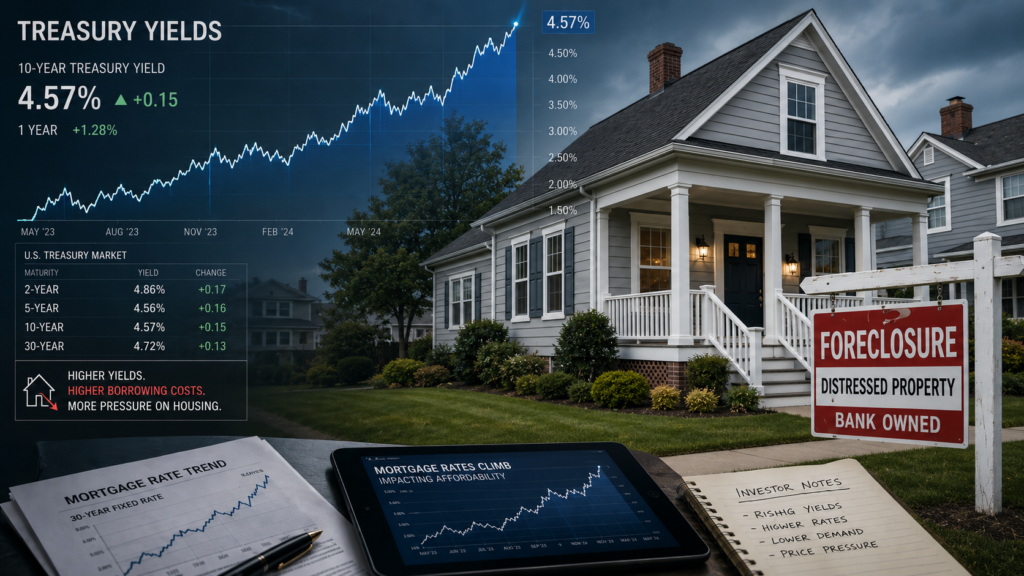
Treasury yields are not usually the first thing foreclosure investors watch. Most investors focus on local foreclosure filings, auction lists, seller equity, repair costs, resale values, and financing terms. Those items matter most at the deal level.
But in 2026, Treasury yields deserve a place in the distressed housing conversation. They influence mortgage rates, investor financing costs, buyer affordability, and the ability of distressed owners to sell before foreclosure. When yields rise, the effect can move through the housing market quickly.
The issue is not simply whether the Federal Reserve cuts or raises short-term rates. Mortgage rates tend to follow longer-term bond yields more closely, especially the 10-year Treasury. When global investors demand higher yields to hold U.S. debt, the cost of mortgage credit can rise even if the Fed has not made a new policy move.
That matters for foreclosure, pre-foreclosure, short sale, and REO investors because distressed opportunities often appear when affordability stress meets weak exit liquidity. A property owner may be current today but vulnerable tomorrow if payments rise, insurance costs increase, taxes reset, or a sale becomes harder because buyers cannot qualify at current rates.
Get Foreclosure Investing Insights Twice a Week
Subscribe to the Foreclosure Flips newsletter for practical ideas on finding deals, analyzing opportunities, and understanding foreclosure-related investing strategies. We send concise updates twice a week so you can stay informed without adding more noise to your inbox.
Why Treasury Yields Matter to Housing Investors
U.S. Treasury securities are the benchmark for much of the credit market. Mortgage-backed securities, corporate debt, municipal bonds, and private lending costs are all priced against a broader rate environment. When Treasury yields move higher, mortgage rates usually face upward pressure.
That relationship matters because housing is extremely payment-sensitive. A buyer does not shop only by purchase price. The buyer shops by monthly payment, down payment, taxes, insurance, and available credit. If rates rise while home prices remain elevated, fewer buyers can qualify for the same property.
For distressed housing investors, that can create two opposing effects.
First, higher rates can reduce competition from traditional buyers. Homes needing repairs, title work, delayed closings, or cash-heavy offers may become less attractive to owner-occupants. That can create more room for investors who can solve problems quickly.
Second, higher rates can weaken investor exits. A foreclosure flip, short sale, or REO acquisition still needs a buyer, tenant, refinance, or resale channel. If the end buyer’s mortgage payment becomes too expensive, the investor’s resale price may need to adjust.
The mistake is assuming that more distress automatically means better deals. A higher-rate market can create opportunities, but it can also shrink margins.
Foreign Treasury Selling Adds Pressure to the Rate Picture
Foreign demand for U.S. Treasuries is part of the broader rate environment. When major foreign holders reduce Treasury positions, it can contribute to upward pressure on yields, especially if investors are already concerned about inflation, federal deficits, geopolitical risk, or currency exposure.
Recent U.S. Treasury data shows movement among major foreign holders. Japan’s Treasury holdings declined from $1.239 trillion in February 2026 to $1.192 trillion in March 2026. Mainland China’s holdings declined from $693.3 billion to $652.3 billion over the same period, according to the U.S. Treasury’s Major Foreign Holders of Treasury Securities table.
This does not mean foreign selling alone determines mortgage rates. Treasury yields reflect many variables, including inflation expectations, Federal Reserve policy expectations, federal borrowing needs, recession risk, and global capital flows. But reduced foreign appetite for Treasuries can matter at the margin because the U.S. government must keep financing large debt issuance.
For housing investors, the practical takeaway is simple: do not treat mortgage rates as isolated from global capital markets. A foreclosure investor underwriting a deal in 2026 should be watching the 10-year Treasury, mortgage-rate spreads, and buyer affordability just as closely as comparable sales.
Stay Ahead of the Next Deal
Markets move quickly, and good foreclosure opportunities often require fast analysis. Subscribe to our twice-weekly newsletter for investor-focused tips, tools, and market insights designed to help you make better decisions.
Mortgage Rates Are Still the Transmission Mechanism
The housing market does not react directly to a foreign Treasury report. It reacts through mortgage rates, buyer demand, monthly payments, and seller flexibility.
In mid-May 2026, Reuters reported that the average 30-year fixed mortgage rate rose to 6.56% for the week ended May 15, based on Mortgage Bankers Association data. Mortgage applications also fell 2.3% from the prior week. Reuters noted that mortgage rates follow the 10-year Treasury yield more closely than the Fed’s short-term policy rate, and that a global bond selloff had pushed longer-term Treasury yields higher. (Reuters)
That is the key connection for distressed housing.
Higher mortgage rates reduce affordability. Lower affordability can weaken demand. Weaker demand can increase days on market, increase concessions, and force some sellers to adjust price expectations. In distressed situations, time is often the enemy. A seller facing missed payments, tax liens, code violations, probate issues, or a pending auction may not have months to wait for the perfect buyer.
This is where disciplined investors can find opportunities. The opportunity is not “rates are high, therefore buy everything.” The opportunity is that some sellers will need certainty more than top-dollar pricing.
Housing Inventory Is Improving, But Still Uneven
A distressed housing strategy should not be built on national headlines alone. Local inventory matters. The same rate shock can produce different outcomes in Austin, Chicago, Tampa, Cleveland, Charlotte, Las Vegas, or Philadelphia.
Realtor.com’s April 2026 housing report showed a more buyer-friendly spring market. National active listings were up 4.6% year over year, median list prices were down 1.4% year over year, and 11 of the top 50 metros were buyer’s markets heading into spring. Realtor.com also reported that national active listings reached just over 1 million, while median days on market increased by two days from the prior year. (Realtor.com Research)
That does not mean the entire market has shifted in favor of buyers. Inventory remains below pre-pandemic levels nationally, and some metros still have tight supply. But the direction matters. More listings, softer list prices, and longer marketing times can reduce the urgency that supported sellers during the low-inventory years.
For distressed investors, that creates a more selective market. In stronger supply-constrained metros, distressed properties may still attract heavy competition. In softer markets with rising inventory, higher insurance costs, flat rents, or weak population growth, sellers may need to discount more aggressively.
Foreclosure Activity Is Rising, But This Is Not 2008
Foreclosure activity is moving higher, but investors should avoid assuming a nationwide foreclosure wave.
ATTOM reported that U.S. foreclosure activity in April 2026 declined from March but remained above year-earlier levels. The report counted 42,430 properties with foreclosure filings, down 8% from March but up 18% from April 2025. Foreclosure starts were up 12% year over year, while completed REOs were up 42% year over year. ATTOM also identified Delaware, South Carolina, Florida, Indiana, and Illinois as the states with the worst foreclosure rates for the month. (ATTOM)
That is a meaningful signal, but it should be interpreted correctly.
Foreclosures are rising from a low base. Many homeowners still have significant equity. Lending standards after the financial crisis were generally tighter than during the mid-2000s bubble. There is also still enough housing demand in many markets to help distressed owners sell before foreclosure.
The result is not a broad collapse. It is a fragmented distressed market. Some owners will sell before auction. Some will have enough equity for a traditional sale. Some will need short sale assistance. Some will lose the property to foreclosure. Some REO inventory will return to lenders, especially where properties have condition, title, or pricing issues.
The best investor opportunities will likely come from local mispricing, not national panic.
Where Distressed Opportunities May Appear First
Higher Treasury yields and mortgage rates are most likely to create distressed opportunities in markets where affordability is already stretched and inventory is already rising.
Investors should pay close attention to metros with several overlapping conditions:
- High payment-to-income pressure
- Rising active listings
- Longer days on market
- Elevated price reductions
- Flat or falling rents
- Rising foreclosure starts
- Higher insurance or tax burdens
- Large gaps between asking prices and investor exit values
The strongest distressed opportunities may not be the markets with the highest foreclosure counts. Large states naturally produce more filings because they have more housing units. A better screen is foreclosure rate, local inventory growth, affordability pressure, and investor exit liquidity.
For example, a market with a modest number of foreclosure filings but weak resale demand may create better negotiated acquisitions than a larger market where every distressed property receives multiple cash offers.
The Bottom Line for 2026
Rising Treasury yields do not automatically create a foreclosure wave. But they do tighten the housing market’s pressure points.
When foreign demand for Treasuries weakens, global bond markets sell off, or investors demand higher yields, mortgage rates can remain elevated. Elevated mortgage rates reduce affordability. Lower affordability can slow resale demand, pressure sellers, and make it harder for distressed homeowners to exit cleanly.
That is where distressed housing opportunities may expand.
The best investors will not chase headlines. They will track Treasury yields, mortgage rates, local inventory, foreclosure starts, price reductions, and realistic resale values. They will focus on deals where the seller’s problem is specific, the discount is measurable, and the exit strategy works under today’s financing conditions.
In 2026, the opportunity is not simply buying distressed properties. The opportunity is buying them with enough margin to survive a higher-rate, slower-moving housing market.
Wondering Where the Savviest Investors Find Their Best Deals?
Access the largest database of foreclosure properties nationwide and discover below-market deals before other investors. Start your search today!
You might also like:
 Foreclosure Investing: How to Buy, Analyze, and Profit From Foreclosed Homes
 Best Markets for Foreclosure Investing in 2026
 Foreclosure Investing for Beginners: Complete Step-by-Step Guide
 Buying REO Properties: Essential Guide for Investors
 REO Property Negotiation Tips for Real Estate Investors
 Housing Affordability Crisis and Foreclosure Investing