
How To Build Real Wealth With a New Construction Rental Portfolio
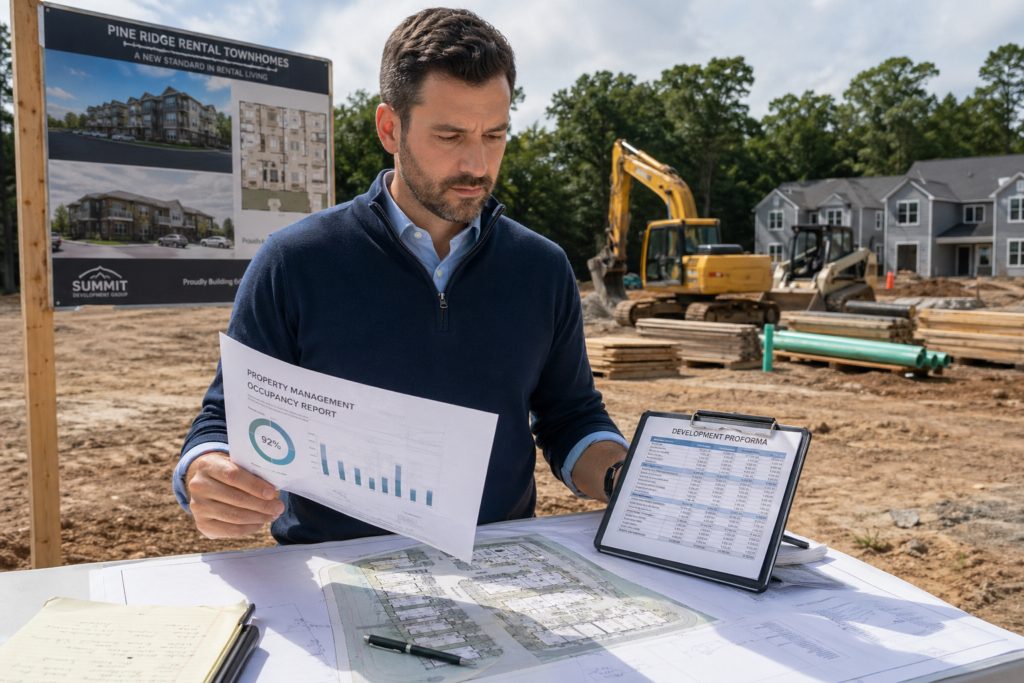
If all work stopped tomorrow, would the income keep coming?
That is one of the most important questions in real estate investing.
Not gross revenue. Not assignment fees. Not one-time profit from a flip. Not the size of the next deal. The deeper question is whether there is enough durable monthly income to support a household, preserve capital, and create long-term financial independence.
For many investors, the honest answer is no.
That does not mean wholesaling or flipping are bad strategies. Both can create useful income. Both can teach deal sourcing, negotiation, valuation, and execution. But they are still transactional. When the activity stops, the income usually stops too.
Ownership is different.
A well-built rental portfolio can produce income whether the investor is actively working that day or not. That is why many of the people who build real long-term wealth in real estate eventually become owners, developers, or both.
The Difference Between Income and Wealth
Wholesaling and flipping can create income. Ownership can create wealth.
That distinction matters.
A wholesaler earns money by finding a deal, controlling the contract, and assigning or double-closing the opportunity. A flipper earns money by buying, improving, and reselling a property. Both strategies depend on repeatedly completing new transactions.
A rental owner builds an asset base. The property can produce monthly income, amortize debt, benefit from long-term appreciation, and create tax and refinancing opportunities. The investor is not only getting paid for activity. The investor is building an income-producing balance sheet.
The IRS recognizes rental real estate as a distinct income category with its own reporting and deduction rules. Rental income generally must be reported, while ordinary and necessary expenses associated with the property may generally be deducted from rental income. That tax framework is one reason rental-property ownership should be treated as a serious operating business, not a casual side activity. IRS rental real estate guidance is a useful starting point for understanding the need for organized income, expense, and recordkeeping systems.
Why Transactional Strategies Have a Ceiling
Wholesaling and flipping can be valuable entry points into real estate. They can help investors build capital, learn markets, and develop negotiation skills.
But both models have an obvious weakness: they require constant replacement.
A wholesaler who closes a large assignment still needs the next lead. A flipper who sells a profitable rehab still needs the next acquisition. If marketing slows, deal flow slows. If lending tightens, buyers become cautious. If construction costs rise, margins compress. If the investor stops working, income can drop quickly.
That is why some investors feel busy but not free.
They may have large gross revenue, but no permanent income base. They may be closing deals, but not accumulating enough assets. They may be working harder each year without creating income that continues without constant daily involvement.
The goal is not necessarily to avoid transactional income. The stronger goal is to convert active income into ownership.
Why Owners Play a Different Game
Owners are paid differently.
A rental owner can collect income month after month. Over time, tenants may help pay down debt through rent. Property values may rise. Rents may increase. Equity may build. The investor may refinance, recapitalize, or use the property as collateral for the next project.
That does not make ownership passive in the casual sense. Rental property still requires management, maintenance, bookkeeping, financing discipline, legal compliance, and capital reserves. But it is a different economic model from flipping houses one at a time.
The owner is building a machine.
A single property may not create financial independence. But a portfolio can. When monthly income becomes large enough and stable enough, the investor’s relationship with work changes. Work becomes a choice, a growth strategy, or a way to build more assets—not the only thing keeping the lights on.
Why Development Changes the Equation
Ownership is powerful. Development can make ownership even more powerful.
When an investor buys an existing rental property, the income stream already exists. That can be useful, but the price often reflects that income. In competitive markets, stabilized rental assets may trade at prices that leave limited upside.
Development allows the investor to create the asset instead of simply buying it.
That might mean building duplexes, small multifamily properties, ADUs, townhomes, or other new construction rentals. It might mean replacing one obsolete structure with multiple income-producing units. It might mean using an oversized lot, side yard, or teardown opportunity to create housing that did not previously exist.
This is where many investors underestimate what is possible. Development sounds institutional, but small-scale development can be approachable if the investor learns the process.
New Construction Rentals and Durable Cash Flow
New construction rentals can be attractive because the investor controls the design, unit mix, layout, finishes, systems, and long-term operating profile from the beginning.
Older properties can be profitable, but they often come with hidden issues: outdated plumbing, old electrical systems, inefficient layouts, deferred maintenance, roof problems, HVAC problems, and unknown prior repairs. New construction does not eliminate risk, but it can reduce certain categories of near-term maintenance uncertainty.
New units may also appeal to tenants who want modern layouts, energy-efficient systems, better parking, in-unit laundry, durable finishes, and updated kitchens and bathrooms.
For financing, rental income documentation matters. Fannie Mae’s Selling Guide provides detailed rules for how rental income may be considered in mortgage underwriting, including documentation and eligibility standards. Investors do not need to treat those rules as an investment plan, but they are a reminder that rental income becomes more useful when it is documented, stable, and supportable. Fannie Mae’s rental income guidance helps show how lenders think about rental income in a formal underwriting context.
The $50,000 Per Month Question
A useful thought exercise is simple: what amount of monthly income would make work optional?
For some households, the number might be $10,000 per month. For others, it might be $25,000, $50,000, or more. The exact figure depends on lifestyle, debt, family obligations, tax position, location, and risk tolerance.
But the principle is the same.
If the goal is $50,000 per month in net rental income, the investor has to reverse-engineer the portfolio.
How many units are needed? What does each unit rent for? What are the operating expenses? What debt service is required? What vacancy assumption is realistic? What capital reserves are needed? What property management structure is required? How much equity must remain in the portfolio? What markets can support the plan?
This is not fantasy math. It is portfolio design.
A new construction rental portfolio gives the investor a way to think in terms of unit count, yield on cost, operating efficiency, and long-term income rather than one-off transaction profit.
Developers Create the Inventory
One reason developers build wealth is that they create inventory.
Most investors compete for existing assets. Developers create new ones.
That difference is important in supply-constrained markets. If quality rental units are scarce, the developer who can deliver them may create value at the development spread: the difference between what it costs to produce the property and what the completed asset is worth.
This does not happen automatically. Bad development deals can destroy capital. Costs can run over. Approvals can take longer than expected. Interest rates can move. Rents can miss projections. Contractors can fail. The exit value can disappoint.
But when done correctly, development can give the investor something wholesalers and flippers usually do not get: long-term ownership of the finished asset.
Why Development Is More Approachable Than It Looks
Development seems intimidating because people associate it with large apartment complexes, institutional capital, cranes, and massive construction sites.
But development can start smaller.
A duplex on a subdivided lot is development. A pair of ADUs can be development. A fourplex replacing an obsolete single-family house can be development. A small build-to-rent cluster can be development. A side-yard infill project can be development.
The investor does not need to begin with a $50 million project. The better path is often to learn the blueprint through smaller, repeatable projects.
That blueprint includes site selection, zoning review, feasibility analysis, acquisition, design, budgeting, financing, permitting, construction management, lease-up, stabilization, and refinance or long-term hold planning.
A tool such as Rehab Valuator can help investors organize the financial side of that blueprint, including deal analysis, project budgeting, funding presentations, and projected returns.
The Blueprint Matters More Than Motivation
Motivation is not enough to become a developer.
A motivated investor can still overpay for land, underestimate site work, misunderstand zoning, miss utility costs, rely on weak rent assumptions, underbudget construction, or build a project that does not match the market.
What matters is process.
Before committing to a project, an investor should be able to answer several questions. What is the land basis per unit? What does zoning allow? What approvals are required? What is the construction budget? What contingency is included? What are realistic rents? What will the property be worth when stabilized? What financing is available? What happens if costs rise? What happens if lease-up takes longer?
This is why education and structure matter. For investors who want a more guided path into real estate development, funding strategy, and deal execution, the Inner Circle Mentorship may be worth reviewing.
Building Wealth Requires Keeping the Asset
A common mistake is selling every good project.
There are times when selling makes sense. A flip can generate capital. A sale can reduce risk. A disposition can free cash for better opportunities.
But if the investor sells every strong asset, the portfolio never compounds.
Owners think differently. They ask whether the property should be held, refinanced, improved, or used as a platform for future acquisitions. They evaluate not only the immediate profit, but also the future income stream.
A new construction rental that produces reliable cash flow can become part of a long-term wealth engine. Over time, a portfolio of these assets may do more for financial independence than repeatedly chasing the next transaction.
Housing Supply Creates Opportunity
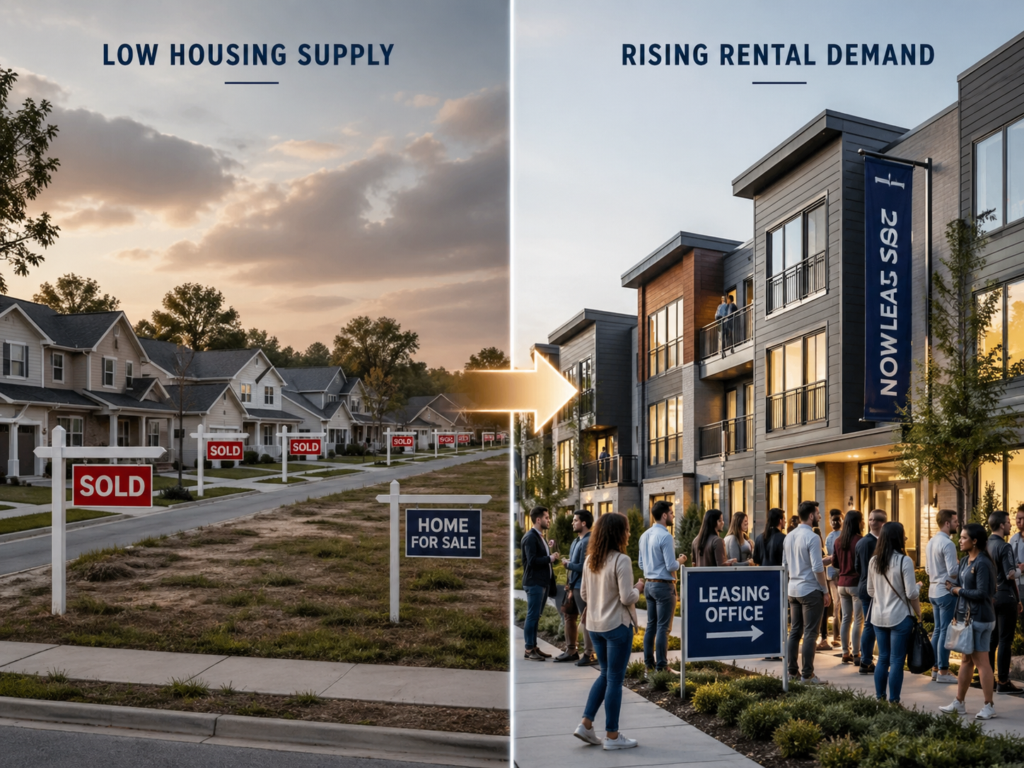
New construction rentals also matter because many markets need more housing.
HUD’s HOME program materials state that program funds may be used for acquisition, new construction, or rehabilitation of affordable rental housing. While private investors are not necessarily building under HOME program rules, the broader point is clear: new rental housing supply is an important part of the housing system. HUD Exchange’s HOME rental housing overview provides federal context on rental housing development and rehabilitation.
Small developers can play a practical role here. Duplexes, ADUs, small multifamily buildings, and build-to-rent units can add needed housing without requiring every project to be a large apartment complex.
The best projects can serve both goals: investor returns and useful housing supply.
How to Start Thinking Like an Owner
An investor who wants durable rental income should begin shifting the analysis.
Instead of asking only, “How much can I make if I sell this?” the investor should also ask, “What happens if I keep it?”
That means modeling rent, vacancy, expenses, management, repairs, reserves, debt service, taxes, insurance, refinancing options, and long-term cash flow.
It also means tracking actual results after the project is complete. The investor should compare projected rent to actual rent, projected expenses to actual expenses, and projected cash flow to real cash flow.
For investors who want to test a more structured approach to budgeting, project analysis, and reporting, the 14-Day $1 Trial of Rehab Valuator Premium can be a practical way to start organizing the numbers.
The Bottom Line
The people building real wealth in real estate are usually not just chasing checks. They are building ownership.
Wholesaling and flipping can create active income. But ownership creates durable income. Development can go a step further by allowing investors to create the assets they want to own.
A portfolio of new construction rentals can produce income whether the investor is working that day or not. It can support a family, build equity, create options, and reduce dependence on the next transaction.
Development is not risk-free, and it is not automatic. But it is more approachable than many investors think when there is a blueprint, a disciplined process, and the right tools.
The goal is not simply to do more deals.
The goal is to build assets that keep paying long after the deal is done.
You might also like:
 Rental Property Cash Flow Analysis: Calculating True Returns
 Tenant Screening for BRRRR Investors: Finding Quality Renters
 BRRRR Investing: How to Buy, Rehab, Rent, Refinance, and Repeat
 Why Missing Middle Housing Is Missing
 Top BRRRR Markets for 2026
 BRRRR Method Explained: Building Wealth Through Real Estate