Rockford Foreclosure Market 2026
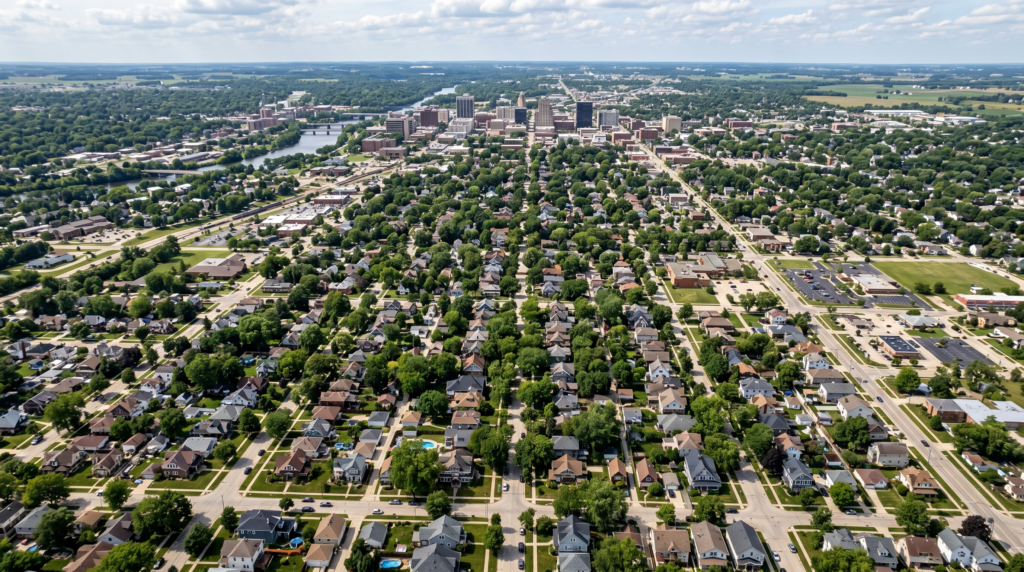
The Rockford foreclosure market gives Illinois investors a very different opportunity set than Chicago. The entry prices are lower, the buyer pool is smaller, and individual property condition carries more weight.
A foreclosure that looks inexpensive on paper can still be a poor acquisition if taxes, title issues, code problems, old mechanical systems, or slow resale demand consume the margin.
Rockford is worth researching because it sits in a state with elevated foreclosure activity while offering a lower acquisition basis than the Chicago metro. But the market has to be handled carefully. In a lower-price city, a $20,000 repair miss can matter as much as a $75,000 miss in a higher-value market.
The useful investor angle is not “cheap houses.” It is whether a foreclosure property in Rockford can be bought at a basis that leaves room for repair risk, holding time, judicial-sale timing, tax exposure, and a realistic resale or rental exit.
Get Foreclosure Investing Insights Twice a Week
Subscribe to the Foreclosure Flips newsletter for practical ideas on finding deals, analyzing opportunities, and understanding foreclosure-related investing strategies. We send concise updates twice a week so you can stay informed without adding more noise to your inbox.
The 2026 Foreclosure Signal for Rockford Investors
Illinois remains one of the more foreclosure-active states in 2026. ATTOM’s Q1 2026 U.S. Foreclosure Market Report reported 118,727 U.S. properties with foreclosure filings during the quarter, up 26% from the prior year.
The state ranked fifth-worst nationally by foreclosure rate, with one filing for every 833 housing units, and reported 6,551 properties with foreclosure filings during Q1.
That statewide pressure matters for Rockford because smaller Illinois metros may not produce the same volume as Chicago, but they can still provide investable leads when prices, condition, and exit demand line up.
| 2026 Signal | Current Reading | Investor Use |
|---|---|---|
| Illinois foreclosure rate | 1 in every 833 housing units in Q1 2026 | Statewide distress is elevated |
| Illinois foreclosure filings | 6,551 properties in Q1 2026 | Enough activity to justify monitoring |
| National foreclosure filings | Up 26% year over year in Q1 2026 | Pipeline is rising from prior-year levels |
| National REOs | Up 45% year over year in Q1 2026 | Bank-owned inventory should be watched |
| Rockford thesis | Lower basis plus condition sensitivity | Better for investors who can control repairs and taxes |
ATTOM’s April 2026 foreclosure update showed the broader trend continuing, with U.S. foreclosure filings up 18% from April 2025 and completed foreclosures up 42% year over year.
For Rockford investors, the key takeaway is that foreclosure activity is not isolated. The statewide and national pipeline is active enough to monitor, but local execution matters more than broad statistics.
Rockford’s Housing Market Can Move Quickly at the Right Price
Rockford’s affordability has been a major part of its housing-market appeal. Lower prices can help investors enter with less capital, but they also reduce the room for mistakes.
Redfin’s Rockford housing market data showed Rockford home prices up 10.3% year over year over the three months ending April 2026, with a median sale price near $170,000. Homes sold after an average of 14 days on market, while April sales volume declined to 359 homes from 406 a year earlier.
That is a specific and important signal. Properly priced homes may move quickly, but fewer closed sales means investors should not assume unlimited buyer depth. A finished foreclosure still has to match what local buyers can finance, afford, and accept in terms of condition.
Realtor.com’s Rockford market data also shows major neighborhood-level differences. Recent neighborhood readings included median listing prices of about $225,000 in Northeast Rockford, $170,000 in Southeast Rockford, $139,950 in Northwest Rockford, and $92,450 in Southwest Rockford.
That spread is central to underwriting. A repair budget that is reasonable in Northeast Rockford may be excessive in Southwest Rockford. A rental strategy that works near one employment or retail corridor may fail a few miles away if tenant demand and property condition do not support the basis.
| Rockford Market Signal | Recent Reading | Investor Use |
|---|---|---|
| Median sale price | About $170,000 | Lower-basis market than Chicago |
| Year-over-year sale-price change | Up 10.3% | Demand exists for properly priced homes |
| Average days on market | About 14 days | Good properties can sell quickly |
| April sales volume | Down year over year | Buyer depth still needs testing |
| Neighborhood pricing range | Wide variation by area | Underwrite by submarket, not city average |
Winnebago County Records Should Shape the Shortlist

Most Rockford foreclosure research starts with Winnebago County. Investors should treat the county record search, tax file, and court process as part of the acquisition model, not as administrative cleanup after a deal is found.
The Winnebago County Recorder explains that its office maintains land records including deeds, mortgages, liens, plats, UCC filings, and other recorded documents.
The county’s Recorder’s Office is a core resource because recorded-document research can reveal ownership history, mortgage position, liens, releases, and title issues that are not visible from a listing photo.
The Winnebago County Treasurer’s parcel tax inquiry lets users view current and historical parcel tax information. For foreclosure investors, that matters because delinquent taxes, prior-year balances, assessment changes, and special charges can change the all-in basis.
Northeast Rockford
Northeast Rockford may offer stronger resale potential in selected pockets, but cleaner homes can attract more owner-occupant competition. A foreclosure in this part of the city may need to be underwritten around resale quality, school or neighborhood demand, and the risk of paying too much for a house that still needs substantial systems work.
Northwest Rockford
Northwest Rockford may provide a mix of lower-basis single-family homes and rental candidates. Investors should be careful with property condition, block-level demand, tenant quality, and whether the finished product fits the local price ceiling.
Southeast and Southwest Rockford
Lower acquisition prices may appear more frequently in Southeast and Southwest Rockford, but lower basis does not remove risk. Investors should focus on roof age, mechanical systems, foundation, security, occupancy, resale depth, and rent collectability.
A house bought cheaply in a weaker pocket can still become expensive if it needs major capital and the exit market is thin.
Loves Park, Machesney Park, and Boone County Spillover
Investors researching Rockford may also compare Loves Park, Machesney Park, Cherry Valley, South Beloit, and nearby Boone County communities. These areas can offer different buyer pools, school demand, commute patterns, and property-tax profiles.
The useful comparison is not which area is “better.” The useful comparison is where the acquisition basis, repair scope, rent or resale demand, and holding risk line up most clearly.
| Area | Possible Investor Angle | Main Item to Verify |
|---|---|---|
| Northeast Rockford | Resale-oriented rehabs and stronger owner demand | Thin discounts and buyer expectations |
| Northwest Rockford | Rentals, moderate rehabs, affordability plays | Tenant depth and block-level comps |
| Southeast Rockford | Lower-basis acquisitions and selected rentals | Repair scope and resale ceiling |
| Southwest Rockford | Deep-discount candidates and rental testing | Security, vacancy, and financing depth |
| Loves Park / Machesney Park | Suburban rental and resale alternatives | Taxes, school demand, and inventory competition |
| Boone County spillover | Lower-density or commuter-related plays | Liquidity and property-specific demand |
Illinois Judicial Foreclosure Requires Case-Level Patience
Illinois foreclosure investing is court-driven. That gives investors more public information than many nonjudicial states, but it also means the process can take longer and involve more procedural steps.
The Illinois foreclosure process generally requires a court judgment, sale, report of sale, and confirmation before title transfer is finalized. Illinois Legal Aid explains that after the judicial sale, the plaintiff files a motion asking the court to confirm the sale, and the court confirms unless specific legal problems are found.
Its mortgage foreclosure process overview is homeowner-facing, but the sale-confirmation step is relevant to investors because the winning bidder does not simply walk away with immediate marketable control.
The Winnebago County Sheriff’s Office Civil Process Section manages evictions, foreclosures, summonses, subpoenas, and related sales and foreclosure functions within the county. Its civil process page also notes that the sheriff’s office does not provide a foreclosure-sale listing online and directs foreclosure-sale inquiries to Civil Process.
For investors, this is practical. Rockford foreclosure research may require more direct county-level tracking rather than relying only on a single online list.
Acquisition Strategies That Fit Rockford
Court-Stage Opportunities
Because Illinois foreclosures move through court, investors may be able to monitor cases before sale and identify owners, lienholders, or properties that could be approached before the sheriff-sale stage.
The better leads are properties with enough equity, understandable title, manageable repairs, and an owner problem that can be solved before the sale process advances. The worst leads are properties where the apparent discount disappears after taxes, liens, or repair scope are reviewed.
Sheriff Sales
Sheriff sales can produce opportunities, but Rockford investors should not bid from the opening amount or the assessed value. The bid ceiling should be built from realistic resale or rental value, then reduced for repairs, taxes, title risk, occupancy, legal timing, utilities, insurance, carrying costs, selling costs, and required profit.
Because Rockford’s price points are lower than Chicago’s, investors should use larger percentage contingencies. A modest dollar mistake can become a large percentage of the total deal.
REO Properties
REO properties may offer a cleaner acquisition path than sheriff sales because the lender has already taken title. That can give investors more room for inspection, negotiation, and closing review.
In Rockford, the better REO opportunities are often properties with poor presentation, dated interiors, manageable systems work, or stale pricing. The weaker candidates are properties needing major capital while priced close to local retail value.
Discounted Owner Sales
Some Rockford opportunities may come from owners who are not fully underwater but cannot fund repairs, carry a vacant home, resolve probate, manage tenants, or deal with code or tax issues.
These transactions can be more controllable than auction purchases because the investor can inspect, negotiate, and close through a standard title process. The key is to avoid paying for a property as if it is stabilized before the real work has been priced.
Rentals and BRRRR
Rockford’s lower acquisition basis can make rentals and BRRRR strategies worth reviewing, but rent ceilings matter. A property that is inexpensive to buy can still fail if turnover, maintenance, taxes, insurance, and management consume cash flow.
The best rental candidates are usually simple, functional homes with durable tenant demand, manageable repairs, and a basis low enough to survive conservative rent and refinance assumptions.
Build Your Investing Knowledge One Email at a Time
Foreclosure investing rewards preparation. Join our 2X week newsletter for straightforward guidance on pre-foreclosures, short sales, BRRRR, flipping, and other strategies investors use to evaluate distressed property opportunities.
Rockford Risks That Can Distort the Numbers
Rockford investors should focus less on headline discount and more on what happens after closing.
| Risk | Why It Matters | Investor Response |
|---|---|---|
| Low-value repair shock | A major system repair can erase a small deal’s spread | Use line-item budgets and larger contingencies |
| Property taxes | Tax exposure can reduce rental returns | Check current and historical parcel taxes |
| Judicial-sale timing | Sale confirmation affects control and timing | Track case status and confirmation steps |
| Older housing systems | Roof, HVAC, plumbing, electrical, and foundation issues can be costly | Inspect systems before setting bid or offer limits |
| Thin resale pockets | Some areas have limited buyer depth | Use neighborhood-level sold comps and days-on-market data |
| Vacancy and security | Empty homes can deteriorate quickly | Budget for securing, utilities, winterization, and holding costs |
Rockford’s biggest underwriting trap is treating low price as protection. A low purchase price helps only when the property has a realistic path to occupancy, resale, or rental performance.
How to Research Rockford Foreclosure Deals
For court-stage opportunities, review the foreclosure case, recorded documents, ownership history, mortgage position, taxes, liens, and likely sale timeline. Then decide whether a negotiated purchase is possible before the case reaches sale.
For sheriff-sale candidates, verify the case status, title chain, taxes, liens, occupancy, insurance, repair scope, and immediate-area comps before setting a bid. Use conservative ARV or rent assumptions. Do not rely on county assessed value as your investment anchor.
For REO properties, compare the lender’s asking price to closed sales, competing listings, repair needs, and time on market. Look for pricing gaps caused by poor presentation or fixable condition problems.
For rentals, underwrite the property as a small operating business. Include vacancy, management, turnover, repairs, taxes, insurance, utilities during vacancy, and capital reserves. The numbers should work without assuming unusually high rent growth.
Where Rockford Fits in the Illinois Foreclosure Strategy
Rockford should be treated as a lower-basis Illinois foreclosure market with meaningful execution risk. It does not have Chicago’s scale, liquidity, or public-record depth, but it may offer more approachable acquisition prices and less competition for certain value-add properties.
Compared with Chicago, Rockford gives investors lower purchase prices but less buyer depth and smaller margins for repair mistakes.
Compared with Peoria, Rockford may offer stronger recent pricing momentum, but each neighborhood still needs separate resale and rental analysis.
Compared with smaller Illinois markets, Rockford offers more inventory and regional demand, but not enough liquidity to ignore property-level risk.
Investors comparing Rockford with other parts of the state should use the broader Illinois foreclosure market page as the statewide reference point. For national context, the hub on states with the most foreclosure opportunities can help compare Illinois against other foreclosure-heavy states.
If you are actively screening inventory, you can compare active foreclosure listings. For rehab-heavy properties, run the numbers carefully before committing capital.
FAQ
Where should a Rockford investor start checking property records?
Start with Winnebago County land records and parcel tax data. The Recorder’s Office is used for deeds, mortgages, liens, plats, and related recorded documents, while the Treasurer’s parcel inquiry helps verify current and historical property taxes.
Why do repair contingencies matter more in Rockford than in higher-priced metros?
Because the finished values are lower. A $20,000 surprise repair can consume a large share of the profit on a $170,000 resale. Rockford foreclosure models should use system-level repair estimates for roof, HVAC, plumbing, electrical, foundation, and water damage before the bid is finalized.
How should investors compare Northeast Rockford with Southwest Rockford?
Northeast Rockford may offer stronger resale demand in selected pockets but often with less discount. Southwest Rockford may show lower entry prices, but investors need closer review of buyer depth, tenant demand, security, vacancy, and property condition. The same rehab budget should not be applied to both areas.
Does Winnebago County publish a simple online sheriff-sale list?
The Winnebago County Sheriff’s Civil Process page states that the sheriff’s office does not provide a foreclosure-sale listing online and directs foreclosure-sale inquiries to Civil Process. Investors should be prepared to track cases, notices, and county resources rather than relying on one public list.
What tax issue should Rockford foreclosure investors check first?
Verify whether current and prior-year property taxes are paid, then estimate whether the post-acquisition tax burden still supports the exit. For rentals, taxes can materially change cash flow. For flips, unpaid taxes and special charges can affect the true acquisition cost.
Are Rockford foreclosures better suited for rentals or flips?
The property decides. A simple house with durable tenant demand and manageable repairs may fit a rental strategy. A well-located property with strong nearby sold comps may fit a flip. A low-priced house with heavy systems work and weak buyer depth may fit neither.
Looking for deeply discounted properties in Rockford others don’t know about?
Don’t miss out on the next great investment opportunity! Search millions of foreclosure listings and get daily alerts for new properties in your target market.