
Pre-Foreclosure Investing: How to Find, Analyze, and Buy Pre-Foreclosures
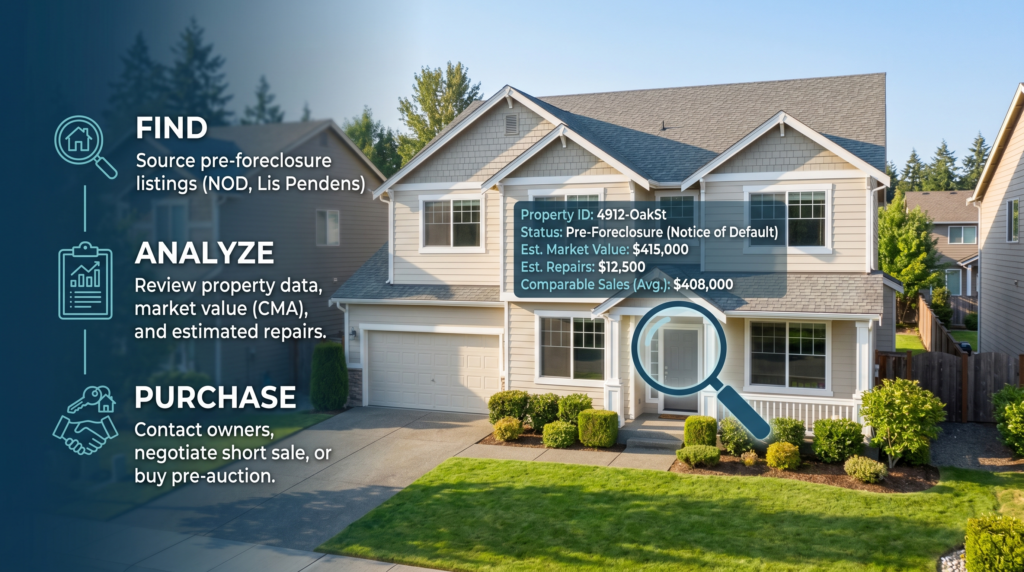
Pre-foreclosure investing is one of the earliest ways to identify distressed real estate opportunities before a property reaches auction, becomes bank-owned, or appears more broadly in foreclosure listings.
At this stage, the homeowner is typically behind on mortgage payments and the lender has started some part of the default process. But the property has not yet been sold through foreclosure. That creates a narrow window where the owner may still have time to sell, refinance, reinstate the loan, pursue a short sale, or work out another solution before losing the property.
For investors, this can create real opportunity. Pre-foreclosure properties may not be fully exposed to the market yet. The owner may be motivated to sell. There may be enough equity in the property to structure a transaction that helps the owner avoid foreclosure while still allowing the investor to make a reasonable return.
But pre-foreclosure investing is not a shortcut. It requires careful research, professional communication, legal awareness, and disciplined deal analysis. Investors who approach these situations carelessly can underestimate liens, misread foreclosure deadlines, overpay for repairs, violate local rules, or damage their reputation by treating distressed homeowners as targets rather than people facing a serious financial problem.
This guide explains how pre-foreclosure investing works from start to finish, including how to find leads, evaluate deals, contact homeowners, manage risk, and decide whether this strategy fits your investing goals.
Get Foreclosure Investing Insights Twice a Week
Subscribe to the Foreclosure Flips newsletter for practical ideas on finding deals, analyzing opportunities, and understanding foreclosure-related investing strategies. We send concise updates twice a week so you can stay informed without adding more noise to your inbox.
What Is Pre-Foreclosure?
Pre-foreclosure is the stage before a property is sold through foreclosure. The homeowner still owns the property, but the mortgage loan is in default or moving toward default resolution.
In practical terms, pre-foreclosure usually begins after the borrower has missed payments and the lender has taken formal action, such as issuing a notice of default, filing a lis pendens, or scheduling a trustee sale or sheriff sale. The exact terminology depends on the state and whether the foreclosure process is judicial or non-judicial.
The most important point is simple: a pre-foreclosure property has not yet been foreclosed on.
That means the homeowner may still have several options. They may be able to catch up on payments, negotiate with the lender, sell the property, refinance, file bankruptcy, pursue a loan modification, or complete a short sale if the property is worth less than the debt owed.
For investors, this matters because the negotiation is usually with the homeowner, not the bank. The investor is not buying a bank-owned property. The investor is trying to purchase the property before the foreclosure process reaches the sale stage.
That distinction changes almost everything: the seller, the timeline, the paperwork, the risks, and the way the deal should be approached.
A pre-foreclosure property is not automatically available for purchase. Some owners do not want to sell. Some will cure the default. Some have no equity. Some are overwhelmed and unresponsive. Others may want to sell quickly if they can preserve equity, avoid a foreclosure record, and move on with some control over the outcome.
Pre-foreclosure investing is about identifying which situations are real opportunities and which are not.
Pre-Foreclosure vs. Foreclosure vs. Short Sale
Pre-foreclosure is often confused with foreclosure and short sales. The terms are related, but they are not the same.
A property in pre-foreclosure is still owned by the homeowner. The investor may be able to negotiate directly with that owner before the property reaches auction.
A foreclosure sale occurs after the legal foreclosure process advances to the point where the property is sold, often through a trustee sale, sheriff sale, or public auction. Depending on the state and process, the winning bidder may need cash or certified funds, may have limited inspection access, and may assume certain title or occupancy risks. Foreclosure investing also requires a different investment funnel process.
A short sale happens when the homeowner sells the property for less than the mortgage balance owed, and the lender agrees to accept less than full payoff. Short sales often originate during the pre-foreclosure stage because the owner is already in financial distress and cannot sell at a price high enough to fully satisfy the debt.
Here is the practical distinction:
| Stage or Strategy | Who Owns the Property? | Main Investor Opportunity | Main Risk |
|---|---|---|---|
| Pre-Foreclosure | Homeowner | Negotiate before auction | Timing, liens, seller distress, legal compliance |
| Short Sale | Homeowner, with lender approval required | Buy below loan balance if lender agrees | Slow approval, lender rejection, uncertain closing |
| Foreclosure Auction | Sold through legal foreclosure process | Buy at public sale, often below market | Limited inspection, title risk, cash requirements |
| REO / Bank-Owned | Lender or bank | Buy after foreclosure from institution | More competition, less flexibility, bank process |
Pre-foreclosure is best understood as the early opportunity window. Short sales, foreclosure auctions, and REO purchases are possible outcomes if the borrower cannot resolve the default.
Who Pre-Foreclosure Investing Is Best For
Pre-foreclosure investing is best for investors who are comfortable combining research, negotiation, problem-solving, and disciplined underwriting.
This strategy is not purely a numbers game. It involves real people under financial pressure. It also requires the investor to understand timelines, legal filings, equity positions, title risks, repair budgets, and exit strategies.
Pre-foreclosure investing may be a good fit for investors who:
Have the patience to research many leads before finding a workable deal.
Can analyze property value, loan balance, equity, liens, repairs, and closing costs.
Are comfortable speaking with homeowners in a professional and respectful way.
Have access to reliable financing or cash.
Can move quickly when a motivated seller is ready to proceed.
Understand that many pre-foreclosure leads will not convert into deals.
Are willing to work with title companies, attorneys, agents, lenders, and contractors.
Have a clear exit strategy before making an offer.
This strategy may be less suitable for investors who want a passive investment, are uncomfortable with direct seller outreach, lack available capital, or do not want to deal with legal and procedural complexity.
It is also not ideal for investors who are looking for guaranteed discounts. Pre-foreclosure does not automatically mean the property is cheap. Some properties have no equity. Others need too much work. Some have tax liens, HOA balances, judgments, or title issues that eliminate the investment opportunity.
The best pre-foreclosure investors are not just looking for distress. They are looking for solvable distress where the numbers, timeline, seller motivation, and property condition all support a legitimate transaction.
How Pre-Foreclosure Investing Works Step by Step
The pre-foreclosure process usually begins with lead identification and ends with either a completed purchase or a decision to walk away.
A typical investor workflow looks like this.
1. Identify pre-foreclosure leads
The first step is finding properties that may be in default or approaching foreclosure. These leads can come from public records, foreclosure listing platforms, local court filings, county recorder data, real estate agents, direct mail campaigns, or distressed-property databases.
The goal is not simply to collect names and addresses. The goal is to identify properties where the owner may still have time and equity to complete a sale.
2. Verify the property status
Not every lead is accurate. Some properties listed as pre-foreclosure may already be cured, postponed, sold, modified, or withdrawn from the foreclosure process.
Before spending time on outreach or underwriting, verify the status as much as possible. Check the county records, trustee sale information, court docket, or foreclosure notice details. If needed, contact the appropriate public office, trustee, or legal professional.
3. Research the owner, loan, taxes, and equity
The next step is understanding the financial position.
Key questions include:
How much is likely owed on the mortgage?
Are there past-due taxes?
Are there junior liens?
Is there an HOA balance?
Are there judgments or municipal fines?
Does the owner appear to have equity?
Has the property changed hands recently?
Is the property owner-occupied or tenant-occupied?
Equity is especially important. If the property is worth $300,000 and total debt is roughly $180,000, there may be room to structure a deal. If the property is worth $300,000 and total debt is $335,000, the transaction may require a short sale or may not be viable at all.
4. Estimate market value and repair needs
Pre-foreclosure investing depends on accurate valuation. Many investors use a tool like Rehab Valuator. You should look at recent comparable sales, current listings, market trends, neighborhood quality, property condition, and likely buyer or renter demand.
The property’s current condition may be difficult to inspect early in the process, so assumptions must be conservative. A property that looks fine from the outside may have deferred maintenance, roof issues, plumbing problems, HVAC failure, foundation movement, code violations, or interior damage.
5. Determine whether there is enough room for profit
A pre-foreclosure deal must still satisfy basic investment math. The investor should account for purchase price, payoff amount, arrears, repairs, closing costs, financing costs, holding costs, resale costs, and required profit margin.
If the only way the deal works is by assuming perfect repairs, fast resale, no title issues, and no delays, the deal probably does not work.
6. Contact the homeowner professionally
If the deal appears promising, the investor may contact the homeowner. This must be done carefully.
The owner may be under stress, embarrassed, defensive, or overwhelmed by calls and letters. The investor should be direct, respectful, and transparent.
The conversation should focus on whether the owner wants to sell, what outcome they are trying to achieve, and whether a purchase may be possible before the foreclosure deadline.
7. Understand the homeowner’s preferred outcome
Not every owner wants the same thing.
Some want to keep the home.
Some want to sell and preserve equity.
Some want relocation money.
Some want to avoid public foreclosure.
Some need time.
Some need lender approval.
Some are unsure what options are available.
An investor should not assume that buying the property is automatically the right solution. The transaction only makes sense if it is legal, financially realistic, and aligned with the homeowner’s decision to sell.
8. Confirm payoff and lien information
Before making a serious offer, the investor needs to understand what must be paid to deliver clear title.
This may require authorization from the homeowner to obtain mortgage payoff information. It may also require a title search to identify recorded liens, judgments, unpaid taxes, HOA claims, and other encumbrances.
This is where many inexperienced investors get into trouble. A property may appear to have equity until additional liens are discovered.
9. Conduct inspections and finalize underwriting
If the homeowner is willing to proceed, the investor should inspect the property or arrange a professional inspection. Contractors may need to provide repair estimates. The investor should update the numbers based on actual condition rather than assumptions.
This stage should also include confirming the exit strategy. A flip, rental, BRRRR deal, wholesale transaction, or owner-occupant resale each requires different assumptions.
10. Close before the foreclosure deadline
If the numbers work and the seller agrees, the transaction must close before the foreclosure sale or other deadline. Timing is critical.
A delayed title search, slow lender, unresolved lien, bankruptcy filing, or incomplete seller paperwork can derail the deal. Investors should work with professionals who understand distressed transactions and can move quickly.
Build Your Investing Knowledge One Email at a Time
Foreclosure investing rewards preparation. Join our 2X week newsletter for straightforward guidance on pre-foreclosures, short sales, BRRRR, flipping, and other strategies investors use to evaluate distressed property opportunities.
How to Find Pre-Foreclosure Properties
Pre-foreclosure opportunities can be found through several sources. The best investors usually use more than one.
Public records
Public records are one of the most direct sources. Depending on the state, investors may search for notices of default, lis pendens filings, notices of trustee sale, foreclosure complaints, or scheduled auction notices.
The challenge is that public records can be fragmented, difficult to search, or inconsistent across counties. Investors need to understand the local foreclosure process and the specific documents used in that jurisdiction.
County recorder or clerk filings
In many areas, foreclosure-related documents are recorded with the county recorder or filed with the clerk of court. These records may include the borrower’s name, property address, lender, trustee, filing date, and foreclosure case information.
This can be a strong source for investors willing to do manual research, especially in smaller markets where competition may be lower.
Court records
In judicial foreclosure states, the foreclosure process often runs through the court system. Investors may be able to search foreclosure complaints, case filings, judgments, and sale schedules.
Court records can be valuable because they may provide more detail about the lender, borrower, timeline, and procedural status.
Foreclosure listing platforms
Foreclosure listing platforms can help investors research pre-foreclosures, auctions, bank-owned homes, and other distressed properties in one place. They are often more efficient than manually searching multiple county sources.
For investors who want to start researching distressed-property opportunities, a foreclosure listing platform can be a practical starting point.
A natural next step is to research available listings through a platform such as Foreclosure.com, then compare any potential opportunity against local comps, title information, repair estimates, and financing assumptions.
Real estate agents
Some real estate agents specialize in distressed properties, short sales, estate sales, investor deals, or bank-owned homes. They may know about homeowners who need to sell quickly or properties that are likely to become short sales.
An agent can also help with MLS-listed short sales or distressed listings, though many pre-foreclosure opportunities will never be listed publicly.
Direct mail and local outreach
Some investors use direct mail to contact homeowners who are in default or approaching foreclosure. This can work, but it must be done carefully and legally.
Messages should be professional, factual, and non-misleading. Avoid fear-based language, false urgency, or claims that sound like foreclosure rescue promises.
Driving for dollars
Driving neighborhoods to identify neglected or vacant properties can supplement pre-foreclosure research. A distressed property is not necessarily in pre-foreclosure, but visible condition issues may point to a motivated seller or financial stress.
This method works best when combined with ownership research and public record checks.
Referrals
Attorneys, agents, property managers, contractors, wholesalers, probate professionals, and local investors may come across owners who need to sell before foreclosure. Building a referral network can produce opportunities that never show up in a public lead list.
How to Analyze a Pre-Foreclosure Deal
Finding a pre-foreclosure lead is only the beginning. The real work is determining whether the deal can close and whether it makes financial sense. Consider using online software from Rehab Valuator to crunch the numbers.
The investor should answer several questions before making an offer.
What is the property worth today?
Start with current as-is value. This is not the same as after-repair value. A property needing substantial repairs should be valued based on its present condition.
Look at recent comparable sales, active competition, neighborhood trends, and buyer demand.
What could the property be worth after repairs?
After-repair value, or ARV, is the estimated resale value after the property is renovated. This matters most for flips and BRRRR deals.
Do not use the highest sale in the neighborhood unless the finished property will truly be comparable. Conservative valuation is essential.
How much debt is attached to the property?
Estimate the first mortgage balance, past-due payments, late fees, legal fees, and foreclosure costs. Then look for junior mortgages, tax liens, HOA liens, judgments, mechanics liens, and municipal claims.
A property with apparent equity may become unattractive once all obligations are included.
How much time is left?
A deal with 90 days before auction is very different from a deal with five days before auction. Title work, inspections, seller documents, lender payoff statements, and financing can all take time.
If a short sale is required, the timeline can expand significantly.
Is the seller legally able and willing to sell?
The owner must have authority to sell. Problems can arise when there are multiple owners, deceased owners, divorce issues, probate matters, bankruptcy filings, or unresolved title defects.
What repairs are needed?
Repair estimates should include visible repairs and a contingency for unknowns. Distressed properties often have deferred maintenance. Investors should be especially cautious with roofs, foundations, electrical systems, plumbing, HVAC, mold, water damage, and code issues.
What is the exit strategy?
A deal should be underwritten based on a specific plan.
For a flip, the investor needs resale comps, renovation budget, timeline, selling costs, and profit margin.
For a rental, the investor needs rent estimates, operating expenses, vacancy assumptions, management costs, and financing terms.
For BRRRR, the investor needs both rental performance and refinance assumptions.
For wholesale, the investor must understand local laws, contract rights, buyer demand, and assignment restrictions.
Example Pre-Foreclosure Deal Math
Here is a simplified example.
Assume an investor finds a pre-foreclosure property with the following numbers:
Estimated after-repair value: $300,000
Estimated current as-is value: $240,000
Estimated mortgage payoff: $185,000
Past-due payments, fees, and legal costs: $12,000
Estimated repairs: $35,000
Closing and holding costs: $15,000
Target investor profit: $30,000
The investor calculates a maximum allowable offer based on the after-repair value:
$300,000 ARV
minus $35,000 repairs
minus $15,000 closing and holding costs
minus $30,000 target profit
= $220,000 maximum purchase price
Now compare that to the debt:
Mortgage payoff and arrears total approximately $197,000.
If the investor offers $210,000 to $220,000, the seller may be able to pay off the debt and preserve some equity, while the investor may still have room for repairs, carrying costs, and profit.
But this deal only works if several assumptions hold true.
The title must be clean enough to close.
The repair estimate must be accurate.
The foreclosure deadline must allow enough time.
The ARV must be realistic.
The seller must be willing and legally able to sell.
Financing must be available.
If any one of those assumptions changes, the deal can become much weaker.
For example, if a second lien of $35,000 appears, the deal may no longer work. If repairs are actually $60,000 instead of $35,000, the investor may need to reduce the offer or walk away. If the property cannot be inspected, the risk increases. If the sale date is too close, the closing may not happen in time.
Pre-foreclosure investing rewards disciplined underwriting. It punishes optimistic assumptions. Consider signing up for a 14-day Rehab Valuator trial for just $1.
Working With Homeowners in Pre-Foreclosure
The homeowner side of pre-foreclosure investing deserves careful attention.
A person in pre-foreclosure may be dealing with job loss, medical expenses, divorce, death in the family, business failure, unexpected repairs, or a long period of financial stress. They may also be receiving letters, phone calls, and texts from investors, agents, lenders, and foreclosure-related service providers.
That does not mean investors should avoid the strategy. But it does mean the approach matters.
A professional investor should be clear, respectful, and direct. The goal is to determine whether the owner wants to sell and whether a transaction can solve a real problem.
A good conversation is not built around pressure. It is built around facts.
The investor should try to understand:
Does the owner want to keep the property or sell it?
How much time is left before the foreclosure sale?
Does the owner know the approximate loan balance?
Are there other liens or unpaid taxes?
Is the owner speaking with the lender?
Has the owner considered listing the property?
Would the owner consider a direct sale if it closes quickly?
Does the owner need relocation time?
Is lender approval required?
Investors should avoid misleading statements. Do not imply that you are from the lender, the government, the court, or a housing agency. Do not promise to “save the home” if your actual goal is to buy it. Do not pressure the owner to sign quickly without understanding the agreement.
In some states, transactions involving distressed homeowners are subject to special laws. These may include foreclosure consultant rules, equity purchaser laws, cancellation periods, notice requirements, or restrictions on certain types of agreements.
Because rules vary by state, investors should consult a qualified attorney before using contracts, marketing campaigns, leaseback arrangements, creative financing, or any structure involving an owner in foreclosure.
Ethical conduct is not only the right approach. It is also good business. A reputation for fair dealing can produce referrals, better negotiations, cleaner closings, and fewer legal problems.
Stay Ahead of the Next Deal
Markets move quickly, and good foreclosure opportunities often require fast analysis. Subscribe to our twice-weekly newsletter for investor-focused tips, tools, and market insights designed to help you make better decisions.
Financing Options for Pre-Foreclosure Deals
Financing a pre-foreclosure purchase depends on the property condition, timeline, seller situation, and exit strategy.
Cash
Cash is often the cleanest option. It allows the investor to move quickly, avoid lender delays, and close before a foreclosure deadline.
Cash can be especially useful when the property needs significant repairs or the sale date is close. However, tying up cash also creates opportunity cost. Investors should still underwrite the deal carefully.
Hard money loans
Hard money loans are common for pre-foreclosure acquisitions, especially if the investor plans to renovate and resell. These loans are typically asset-based and may close faster than traditional financing.
The tradeoff is cost. Hard money usually comes with higher interest rates, points, fees, and shorter repayment terms. Those costs must be included in the deal analysis.
Private money
Private money from individuals can be flexible, but it depends heavily on relationships, trust, documentation, and compliance. Terms vary widely.
Investors should use formal loan documents and avoid informal arrangements that create disputes later.
Conventional financing
Conventional financing may work if the property is in acceptable condition, the seller has enough time, and the lender can close before the deadline.
However, conventional loans are often less practical for distressed properties with major repair issues, title complications, or urgent foreclosure timelines.
DSCR or rental loans
If the investor plans to hold the property as a rental, a debt-service-coverage-ratio loan may be relevant after acquisition or stabilization. These loans focus heavily on the property’s rental income relative to debt payments.
For pre-foreclosure purchases, DSCR financing may not always be available upfront if the property is vacant, damaged, or not rent-ready.
Bridge loans
Bridge financing can help investors acquire a property quickly, then refinance or sell after repairs or stabilization. Like hard money, bridge loans can be expensive and should be modeled carefully.
Short sale financing
If the owner owes more than the property is worth, the transaction may require lender approval as a short sale. In that case, financing must align with the lender’s short sale process, timeline, and approval conditions.
Short sales can take months, and approval is not guaranteed.
Risks and Common Mistakes
Pre-foreclosure investing offers opportunity, but it also contains several risks.
Assuming every pre-foreclosure is a deal
Many pre-foreclosure properties are not good investments. Some have no equity. Some are overleveraged. Some need too much work. Some are in weak locations. Some owners will reinstate the loan or choose another path.
A pre-foreclosure lead is not a deal. It is only a lead.
Underestimating liens and payoff amounts
This is one of the most common mistakes. Investors may look at the first mortgage and ignore unpaid taxes, HOA claims, second mortgages, judgments, municipal liens, or legal fees.
Always verify title and payoff information before committing.
Misreading the foreclosure timeline
Foreclosure procedures vary by state. Some processes move quickly. Others take months or longer. Sale dates may be postponed, canceled, accelerated, or affected by bankruptcy.
Investors need accurate local information.
Overestimating property value
If the ARV is too aggressive, the entire deal can fail. Use realistic comps, not wishful thinking.
Underestimating repairs
Distressed properties often have deferred maintenance. Repair estimates should include contingency reserves, especially when inspection access is limited.
Ignoring occupancy issues
A property may be owner-occupied, tenant-occupied, vacant, partially occupied, or occupied by someone without a formal lease. Occupancy affects inspection access, closing logistics, renovation timing, holding costs, and legal risk.
Pressuring homeowners
Aggressive or misleading tactics can create legal problems and reputational damage. Distressed homeowners should be treated professionally and given space to make informed decisions.
Failing to use professionals
Title companies, real estate attorneys, agents, contractors, lenders, and insurance professionals can identify issues that investors may miss.
Trying to handle everything alone can be costly.
Making offers without a clear exit strategy
An investor should know the likely exit before buying. A property that does not work as a flip may still work as a rental, but only if rents, financing, and operating expenses support the deal.
Do not assume the exit strategy will figure itself out later.
Expected Timeline for a Pre-Foreclosure Deal
The timeline for a pre-foreclosure investment can vary widely.
A simple direct purchase with clear title, sufficient equity, and cash financing might close in two to four weeks. A more complicated transaction involving lender approval, title defects, probate issues, bankruptcy, or short sale negotiations can take months.
A rough timeline may look like this:
Lead identification: ongoing
Initial research: same day to several days
Owner contact: days to several weeks
Seller negotiation: several days to several weeks
Payoff and title review: several days to two weeks
Inspection and repair estimate: several days
Financing approval: several days to several weeks
Closing: often two to four weeks if uncomplicated
Short sale route: potentially several months
The foreclosure deadline is the controlling factor. If the sale date is too close, there may not be enough time to close, even if the seller wants to proceed.
This is why investors should verify status early and avoid spending too much time on deals that cannot realistically close.
Exit Strategies for Pre-Foreclosure Properties
Pre-foreclosure is an acquisition strategy. After the property is purchased, the investor still needs an exit strategy.
Fix and flip
A fix-and-flip strategy involves buying the property, renovating it, and reselling it for a profit. This can work well when the property has enough equity, strong resale demand, and manageable repairs.
The investor must control renovation costs, timeline, financing costs, and resale pricing.
Buy and hold rental
Some pre-foreclosure properties can become long-term rentals. This works best when the property is in a stable rental market and can generate positive cash flow after repairs, financing, taxes, insurance, management, maintenance, and vacancy.
BRRRR
The BRRRR strategy — buy, rehab, rent, refinance, repeat — may fit pre-foreclosure deals with strong rental demand and enough after-repair value to support a refinance.
The risk is that refinance value, rent, lender terms, or seasoning requirements may not match the investor’s original assumptions.
Wholesale or assignment
Some investors attempt to put a pre-foreclosure property under contract and assign the contract to another buyer. This depends on state law, contract terms, disclosure requirements, and whether the transaction can close before the deadline.
Wholesaling distressed properties can be legally sensitive, so investors should understand local rules before using this strategy.
Short sale acquisition
If the homeowner owes more than the property is worth, the investor may pursue a short sale. This requires lender approval and often takes longer than a standard purchase.
The benefit is that the lender may approve a sale below the outstanding loan balance. The risk is that approval is uncertain and slow.
Learn the Strategies Behind Smarter Foreclosure Investing
Get practical foreclosure investing content delivered twice a week, including deal analysis tips, strategy breakdowns, useful tools, and new resources from Foreclosure Flips. Sign up to keep learning and spotting better opportunities.
Tools, Resources, and Next Steps
Pre-foreclosure investing requires organization. Investors should avoid making decisions based only on a lead list or a seller conversation.
Useful tools and resources include:
Foreclosure and pre-foreclosure listing platforms.
County recorder and court records.
Property valuation tools.
Comparable sales data.
Rental estimate tools.
Repair estimate checklists.
Contractor walkthroughs.
Title company research.
Real estate attorney review.
Deal analysis spreadsheets.
Financing pre-approval.
Insurance quotes.
Local foreclosure process research.
A practical next step is to start by researching active distressed-property opportunities, then practice analyzing them before contacting owners or making offers.
You can begin by reviewing current foreclosure and pre-foreclosure listings through Foreclosure.com, then compare potential properties against local comps, repair assumptions, liens, taxes, and financing options.
The goal is not to chase every listing. The goal is to learn how to separate real opportunities from distressed properties that do not work financially.
Frequently Asked Questions About Pre-Foreclosure Investing
What does pre-foreclosure mean?
Pre-foreclosure means the homeowner is behind on the mortgage or the lender has started the default process, but the property has not yet been sold through foreclosure.
Can you buy a house before it goes into foreclosure?
Yes. If the homeowner still owns the property and is willing to sell, an investor may be able to buy it before the foreclosure sale. The transaction must close before the applicable deadline.
Is pre-foreclosure the same as foreclosure?
No. Pre-foreclosure happens before the foreclosure sale. Foreclosure usually refers to the legal process that can result in the property being sold to satisfy the debt.
Is pre-foreclosure public record?
Often, yes. Depending on the state, foreclosure-related filings such as notices of default, lis pendens, or notices of trustee sale may be public record.
Are pre-foreclosure homes always discounted?
No. Some owners have substantial equity and may not sell at a deep discount. Others owe too much for the numbers to work. The discount depends on motivation, equity, property condition, market demand, and timeline.
Can the homeowner stop the foreclosure?
In many cases, yes. The homeowner may be able to reinstate the loan, negotiate with the lender, sell the property, refinance, complete a short sale, or pursue other legal options.
Do you need cash to buy a pre-foreclosure property?
Not always, but cash can help because pre-foreclosure deals are often time-sensitive. Investors may also use hard money, private money, conventional financing, bridge loans, or other funding depending on the deal.
What is the biggest risk of pre-foreclosure investing?
The biggest risk is acting on incomplete information. Unknown liens, unrealistic repair estimates, title defects, short timelines, or inaccurate property values can quickly turn a promising lead into a bad deal.
Is pre-foreclosure investing legal?
Buying a property from a homeowner in pre-foreclosure is generally legal, but many states have specific rules protecting distressed homeowners. Investors should understand local laws and use qualified legal guidance.
Is pre-foreclosure better than buying at auction?
It depends on the investor. Pre-foreclosure may allow more time for inspection, negotiation, and title review. Auctions may offer speed and transparency but often require cash, involve more competition, and may provide limited inspection access.
Test Your Pre-Foreclosure Investing Knowledge
You already understand foreclosure investing basics. Now test your knowledge of pre-foreclosure timelines, equity, liens, repair estimates, seller outreach, and deal risk.
Your Quiz Results
Want to Keep Building Your Pre-Foreclosure Investing Knowledge?
Subscribe to the Foreclosure Flips 2X newsletter for practical investing tips, checklists, worksheets, and new foreclosure investing resources.
Subscribe to the 2X NewsletterAnswer Review
Related Real Estate Investment Strategies
Pre-foreclosure investing overlaps with several other distressed-property strategies.
If the owner owes more than the property is worth, the transaction may become a short sale.
If the owner does not sell before the deadline, the property may move to foreclosure auction.
If an investor buys the property and renovates it for resale, the deal becomes a flip.
If the investor renovates the property, rents it, refinances, and repeats the process, it may become a BRRRR investment.
For that reason, pre-foreclosure is best understood as the early stage of the distressed-property opportunity cycle. It is not isolated from other strategies. It often feeds into them.
Recommended related guides:
Short Sales
Foreclosures
BRRRR
Flipping
Final Takeaway
Pre-foreclosure investing can be a powerful way to find real estate opportunities before they reach auction or become bank-owned. The strategy gives investors a chance to work directly with homeowners, solve time-sensitive problems, and potentially acquire properties with equity before broader market competition increases.
But this is not a simple or automatic path to discounted deals.
Successful pre-foreclosure investing requires accurate research, respectful homeowner communication, conservative deal analysis, reliable financing, and careful attention to legal requirements. Investors must understand the foreclosure timeline, verify liens and payoff amounts, estimate repairs realistically, and know exactly how they plan to exit the deal before making an offer.
The best pre-foreclosure deals usually help both sides. The homeowner avoids the worst outcome of foreclosure and may preserve some equity or control. The investor acquires a property with enough margin to justify the risk, work, and capital required.
For investors willing to do the research and operate professionally, pre-foreclosure can be one of the most useful entry points into distressed real estate investing.
You might also like:
 Housing Affordability Crisis and Foreclosure Investing
 The Investor Foreclosure Funnel Explained in 6 Steps
 How to Find Foreclosure Properties Before They Hit the Market
 Pre-Foreclosure Leads for Investors: Where to Find the Best Deals
 Dallas–Fort Worth Foreclosure Market 2026
 Savannah Foreclosure Market 2026